
Most people think building wealth is something that only happens to high earners, successful entrepreneurs, or people born into wealthy families.
Fortunately, that’s simply not true.
According to S&P Dow Jones Indices’ SPIVA reports, most actively managed US stock funds have trailed their benchmark index over long periods — one reason low-cost index funds are the default choice for many long-term investors.
Every year, millions of ordinary people slowly build financial security from nothing. They don’t rely on luck or get-rich-quick schemes. Instead, they follow a series of smart financial habits that compound over time.
Whether you’re starting your first job, recovering from debt, or simply feel like you’re behind financially, building wealth is still possible.
It won’t happen overnight.
But if you follow the right strategy consistently, your financial situation could look completely different five or ten years from now.
In this guide, you’ll learn exactly how to build wealth from scratch, from increasing your income and managing your money to investing for long-term growth and avoiding the mistakes that keep many people stuck living paycheck to paycheck.

Why Building Wealth Is Easier Than Most People Think
When people hear the word wealth, they often picture luxury homes, expensive cars, and million-dollar investment portfolios.
In reality, wealth has very little to do with appearances.
Wealth is simply the value of everything you own minus everything you owe. Someone driving an old car with a healthy investment portfolio may be significantly wealthier than someone driving a luxury vehicle financed with debt.
This is why your goal shouldn’t be to look wealthy.
It should be to become wealthy.
Building wealth isn’t about making one brilliant financial decision. It’s about making hundreds of good decisions over many years.
Spend a little less than you earn.
Increase your income whenever possible.
Invest consistently.
Avoid unnecessary debt.
Repeat.
It sounds simple because it is.
The difficult part isn’t understanding the formula—it’s following it consistently.
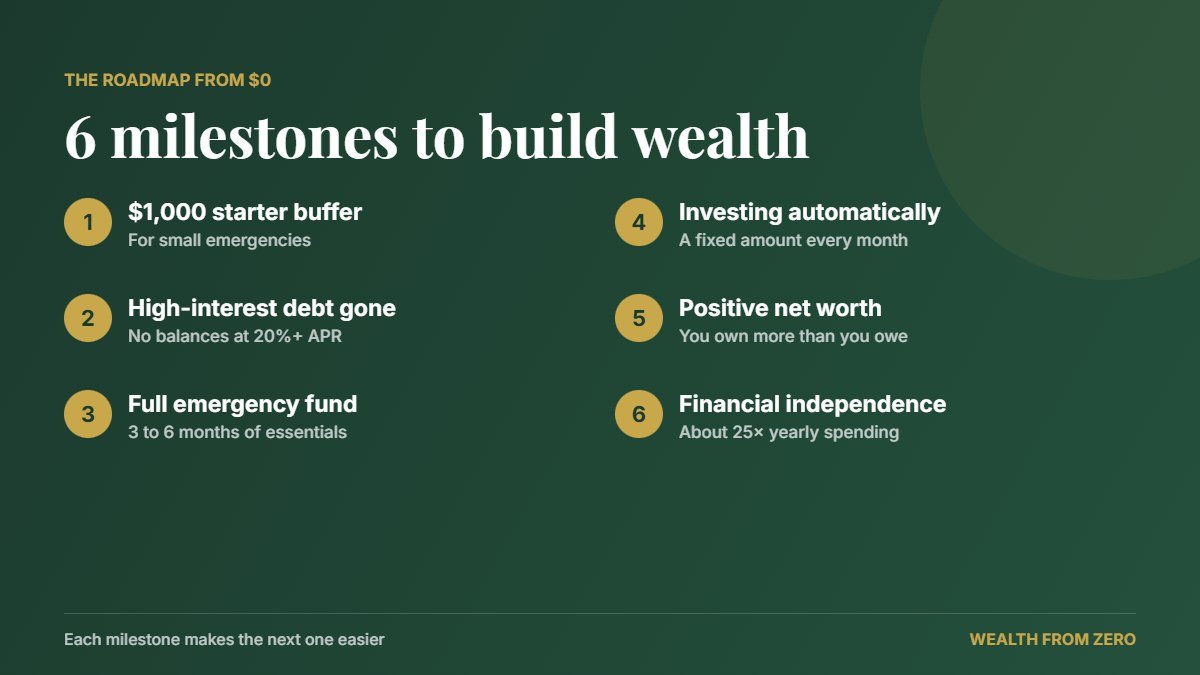
Your Wealth-Building Roadmap: 6 Milestones From $0
Building wealth from scratch happens in stages, and each one makes the next easier. Use this roadmap to see where you are and what comes next:
| Milestone | What it means | Typical timeline* | Guide |
|---|---|---|---|
| 1. Starter buffer | $1,000 set aside for small emergencies | ~3 months at $77 a week | Save $1,000 in 3 months |
| 2. High-interest debt gone | No credit card balances at 20%+ APR | Depends on balances; often 1–3 years | Get out of debt fast |
| 3. Full emergency fund | 3–6 months of essential expenses saved | 6–18 months after milestone 2 | Emergency fund calculator |
| 4. Investing automatically | A fixed amount goes into a retirement account every month | Start as soon as milestone 1 is done if your employer matches | How to invest in index funds |
| 5. Positive net worth | What you own is worth more than what you owe | Often within a few years of milestones 2–4 | Net worth calculator |
| 6. Financial independence | Investments of about 25× your yearly spending | ~17 years at a 50% savings rate; ~37 years at 20% | The math of retiring early |
*Rough guides only. Timelines depend on your income, expenses and investment returns. The financial independence figures assume you start from zero, earn a 5% real return and follow the 4% rule (our calculations).
Step 1: Know Your Starting Point
Deep dive: calculate your net worth and compare it with the average net worth by age.
Before you can improve your finances, you need to know exactly where you stand today.
Many people avoid checking their bank accounts, calculating their debts, or tracking their spending because they’re afraid of what they’ll discover.
Ironically, uncertainty is often more stressful than reality.
Once you know your numbers, you can start improving them.
Calculate Your Net Worth
Your net worth is one of the most important financial numbers you’ll ever track. Related: average net worth by age.
It’s calculated by subtracting your liabilities from your assets.
Your assets include things like:
- Cash in your bank accounts
- Investments
- Retirement accounts
- Property
- Vehicles
- Valuable possessions
Your liabilities include:
- Credit card balances
- Student loans
- Car loans
- Mortgage debt
- Personal loans
If the result is negative, don’t panic.
Many people begin adulthood with a negative net worth because of education loans or other debts.
The objective isn’t to impress anyone today.
The objective is to make that number increase every single year.
Set Clear Financial Goals
Once you’ve calculated your net worth, decide what success looks like for you.
Avoid vague goals like:
“I want more money.”
Instead, create measurable objectives.
For example:
- Save your first $5,000.
- Build a six-month emergency fund.
- Invest 20% of your income.
- Reach a $100,000 net worth before age 30.
- Become debt-free within three years.
Specific goals make it much easier to stay focused because you always know what you’re working toward.
Step 2: Increase Your Income First
Deep dive: how to negotiate a raise and ways to earn extra money from home.
Many people spend years trying to save an extra $20 each month while completely ignoring the biggest factor in wealth building: income.
Saving money is important.
But there’s a limit to how much you can cut.
There’s almost no limit to how much you can earn.
If you really want to accelerate your financial progress, focus on increasing your income before obsessing over tiny expense reductions.
That doesn’t mean you should ignore your budget.
It means you should dedicate as much energy to earning more as you do to spending less.
Invest in Skills That Increase Your Value
The highest return you’ll ever receive isn’t always from the stock market.
Often, it’s from investing in yourself.
Learning valuable skills can dramatically increase your earning potential for decades.
Some examples include:
- Sales
- Programming
- Digital marketing
- Data analysis
- Copywriting
- Graphic design
- Project management
Even one new skill could lead to a higher-paying job or a profitable side business.
Unlike material purchases, skills usually appreciate over time.
Don’t Be Afraid to Change Jobs
Many employees stay with the same company for years because it feels comfortable.
The problem is that annual raises often fail to keep pace with what you could earn elsewhere.
In many industries, changing employers every few years can lead to significantly larger salary increases than staying loyal to one company.
That doesn’t mean changing jobs every six months.
It means understanding your market value and being willing to explore better opportunities.
Build an Additional Income Stream
One income source is good.
Two are better.
Three provide real financial security.
A side hustle doesn’t need to replace your full-time job.
It simply needs to generate extra cash that can be invested.
Some popular options include:
- Freelancing
- Tutoring
- Selling digital products
- Affiliate marketing
- Content creation
- Online consulting
- Print-on-demand businesses
The goal isn’t to become busy.
The goal is to create additional cash flow that works toward your future instead of immediately increasing your lifestyle.
Avoid Lifestyle Inflation
One of the biggest mistakes people make after getting a raise is immediately increasing their spending.
A bigger apartment.
A newer car.
More expensive vacations.
Luxury subscriptions.
Before long, they’re earning more than ever—but saving exactly the same amount.
Instead, make a simple rule.
Every time your income increases, automatically increase your investments before increasing your spending.
If you receive a $500 monthly raise, consider investing $300 of it before adjusting your lifestyle.
Your future self will thank you.

Step 3: Build a Budget That Actually Works
Deep dive: budgeting for beginners and the 50/30/20 rule.
A budget isn’t designed to stop you from enjoying your money.
It’s designed to make sure you’re spending it on the things that matter most.
Many people avoid budgeting because they associate it with restrictions. They imagine tracking every coffee they buy or feeling guilty every time they spend money.
A good budget doesn’t work like that.
Instead, it gives every dollar a purpose before you spend it.
When you know exactly where your money is going, you’re far less likely to wonder why your bank account is empty a few days before payday.
The goal isn’t perfection.
The goal is awareness.
Find a Budgeting Method That Fits Your Lifestyle
There are dozens of budgeting methods available, but you don’t need to try them all.
Choose one that feels realistic for your situation.
The 50/30/20 Rule
This is one of the simplest budgeting systems for beginners.
Your after-tax income is divided into three categories.
| Category | Percentage | Examples |
|---|---|---|
| Needs | 50% | Rent, groceries, utilities, transportation, insurance |
| Wants | 30% | Eating out, hobbies, entertainment, shopping |
| Savings & Investing | 20% | Emergency fund, retirement, ETFs, extra debt payments |
This method works well because it’s flexible. You’re not tracking every single purchase—you simply make sure your spending stays roughly within each category. Related: how to become financially independent.
Pay Yourself First
This strategy completely changes the way most people think about saving.
Instead of saving whatever is left at the end of the month, you save first.
As soon as your salary arrives:
- Transfer money to your investments.
- Add to your emergency fund.
- Pay yourself before paying for non-essential spending.
Most wealthy people don’t save what’s left after spending.
They spend what’s left after saving.
That small mindset shift can make an enormous difference over time.
Zero-Based Budgeting
If you prefer having complete control over your finances, zero-based budgeting might be the best option.
Every euro or dollar you earn is assigned a specific purpose.
If your monthly income is €3,000, then all €3,000 should be allocated between bills, savings, investments, debt repayments and discretionary spending.
Nothing is left without a job.
It requires a little more effort, but many people find it gives them much greater confidence in their finances.
Track Your Spending for One Month
Before making big changes, spend one month simply observing your habits.
Track every expense.
Don’t judge yourself.
Don’t try to be perfect.
Just collect the data.
You might discover you’re spending far more than expected on food delivery, online shopping or subscriptions you rarely use.
These small discoveries often create the easiest opportunities to save money without feeling deprived.
Remember, the purpose isn’t to eliminate everything enjoyable.
It’s to stop paying for things that don’t genuinely improve your life.
If you’re paid every week instead of monthly, you may need a different approach. Our guide on How to Budget When You Get Paid Weekly explains exactly how to adapt your budget to a weekly income.
Automate Good Financial Habits
One of the easiest ways to build wealth is to remove willpower from the equation.
Automation turns good decisions into default decisions.
Whenever possible, automate:
- Investment contributions.
- Savings transfers.
- Bill payments.
- Retirement contributions.
- Debt repayments.
The fewer financial decisions you need to make each month, the more likely you are to stay consistent.
Building wealth shouldn’t depend on motivation.
It should depend on systems.
Step 4: Build an Emergency Fund Before You Chase Higher Returns
Deep dive: how to build an emergency fund, or use our emergency fund calculator.
Imagine you’ve been investing for two years.
Your portfolio is growing nicely.
Then your car breaks down.
A week later, your washing machine stops working.
Shortly afterwards, you unexpectedly lose your job.
Without emergency savings, you may be forced to sell your investments at exactly the wrong time—or worse, rely on expensive credit card debt.
That’s why an emergency fund should come before aggressive investing.
Think of it as the foundation of your financial house.
Without a strong foundation, everything built on top becomes far more vulnerable.
How Much Should You Save?
There’s no single number that’s right for everyone.
However, a good rule of thumb is:
| Situation | Recommended Emergency Fund |
|---|---|
| Stable full-time job | 3 months of living expenses |
| Variable income or self-employed | 6 months of living expenses |
| High-risk career or irregular income | 9–12 months of living expenses |
Notice that these recommendations are based on living expenses, not your salary.
If your essential monthly expenses are €2,000, a six-month emergency fund would be €12,000.
That may sound intimidating.
Don’t let the final number discourage you.
Start with your first €500.
Then €1,000.
Then one month’s expenses.
Building an emergency fund is a marathon, not a sprint.
Where Should You Keep Your Emergency Fund?
Your emergency fund has one job:
Be available when life goes wrong.
Because of that, it shouldn’t be invested in the stock market.
Even though stocks usually outperform cash over long periods, markets can fall sharply at exactly the wrong moment.
Instead, keep your emergency savings somewhere that’s:
- Safe.
- Easy to access.
- Separate from your daily spending account.
The goal isn’t maximum returns.
The goal is financial security.
Common Emergency Fund Mistakes
One of the biggest mistakes people make is using their emergency fund for expected expenses.
Christmas isn’t an emergency.
Neither is replacing your smartphone because a newer model has been released.
An emergency fund should only be used for genuine, unexpected situations such as:
- Losing your job.
- Medical emergencies.
- Essential home repairs.
- Major car repairs.
- Urgent travel for family emergencies.
If you’re regularly dipping into your emergency fund for predictable expenses, it’s a sign that you need a separate sinking fund for planned costs. Related: 5-year financial plan.
Step 5: Start Investing as Early as Possible
Deep dive: investing for beginners, index funds step by step and the Roth IRA.
If there’s one habit that separates people who build wealth from those who don’t, it’s investing consistently.
Saving money is important, but saving alone rarely creates long-term wealth.
Why?
Because cash gradually loses purchasing power due to inflation.
Over time, the cost of everyday goods and services increases. If your money is sitting in a bank account earning little or no interest, its real value slowly decreases.
Investing allows your money to grow faster than inflation over the long term.
The earlier you start, the more time your investments have to compound.
You don’t need thousands of dollars to begin.
You don’t need to predict the next big stock.
And you certainly don’t need to be an expert.
The most important step is simply getting started.
Why Time Is More Important Than Money
Many beginners delay investing because they think they don’t have enough money.
In reality, the amount you invest matters less than how long your money stays invested.
Imagine two investors.
Emma starts investing $250 every month at age 22.
James waits until he’s 32, but invests $500 every month.
James is investing twice as much every month.
Yet Emma could still end up with more money at retirement because her investments had an extra ten years to grow.
That’s the power of compound growth.
Every year, your investments generate returns.
The following year, those returns begin generating returns of their own.
Over time, your portfolio starts growing faster without you investing significantly more money.
The longer you stay invested, the stronger this effect becomes.
What Should Beginners Invest In?
One of the biggest misconceptions about investing is that you need to pick the perfect stock.
You don’t.
In fact, many experienced investors struggle to consistently beat the market.
Instead of trying to find tomorrow’s winning company, most beginners are better off investing in broad market index funds or ETFs.
These funds allow you to buy small pieces of hundreds—or even thousands—of companies through a single investment.
Rather than relying on one business to succeed, you’re investing in the overall economy.
This approach offers several advantages:
- Instant diversification.
- Lower risk than owning individual stocks.
- Lower management fees.
- Historically strong long-term performance.
- Very little maintenance.
For most people, simple beats complicated.
Index Funds vs ETFs
If you’ve started learning about investing, you’ve probably heard both terms.
They’re very similar, but not identical.
| Index Funds | ETFs |
|---|---|
| Usually bought once per day | Can be traded throughout the day |
| Often available through retirement accounts | Available through most brokerage accounts |
| Great for long-term investors | Great for long-term investors |
| Usually very low fees | Usually very low fees |
For someone building wealth over decades, either option can work extremely well. See our 401(k) for Beginners guide to learn how to maximize this.
The important decision isn’t choosing between an ETF and an index fund.
It’s building the habit of investing consistently.
If you’re unsure whether ETFs or index funds are right for you, compare both options in Index Funds vs ETFs for Beginners.
Don’t Try to Time the Market
One of the most expensive mistakes investors make is waiting for the “perfect” moment to invest.
They wait for the market to crash.
Then it crashes—and they’re too scared to invest.
Eventually the market recovers, reaches new highs, and they decide they’ve missed their chance.
The cycle repeats.
Nobody knows what the market will do next week or next month.
Professional investors don’t know.
Economists don’t know.
Financial news channels certainly don’t know.
Instead of trying to predict short-term movements, focus on investing regularly regardless of what the market is doing.
This strategy is known as Dollar-Cost Averaging.
By investing a fixed amount every month, you automatically buy more shares when prices are low and fewer when prices are high.
Over long periods, this removes much of the emotion from investing.
Diversification Is Your Best Friend
Imagine investing every penny you own into a single company.
If that company performs well, you could make a lot of money.
If it fails, your entire portfolio could disappear.
Diversification reduces that risk.
By spreading your investments across hundreds or thousands of companies, no single business has the power to destroy your financial future.
This doesn’t eliminate risk entirely.
But it dramatically reduces unnecessary risk.
Think of diversification as wearing a seatbelt.
You hope you’ll never need it.
But you’ll be glad it’s there if something goes wrong.
Invest Consistently, Not Occasionally
Many people invest only when they have extra money.
The problem is that “extra money” rarely appears.
A much better approach is to treat investing like paying a monthly bill.
Choose a fixed amount.
Automate it.
Forget about it.
Whether it’s $50, $200 or $1,000 each month doesn’t matter nearly as much as staying consistent for years.
Building wealth isn’t about making one perfect investment.
It’s about making hundreds of ordinary investments without giving up.
Common Investing Mistakes
Almost every investor makes mistakes.
The key is making small mistakes instead of expensive ones.
Some of the most common include:
- Waiting too long to start investing.
- Trying to get rich quickly.
- Buying investments without understanding them.
- Checking your portfolio every day.
- Panic selling during market downturns.
- Investing money you’ll need within the next few years.
- Following financial advice from social media influencers without doing your own research.
Remember, successful investing isn’t exciting.
In fact, it’s often quite boring.
And that’s exactly how it should be.
The investors who quietly stick to their plan year after year often outperform those who constantly chase the next big opportunity.

Step 6: Eliminate High-Interest Debt
Deep dive: how to get out of debt fast and our debt payoff calculator (with a snowball vs avalanche comparison).
Building wealth becomes much harder when a large portion of your income is going toward interest payments.
Every dollar you pay in unnecessary interest is a dollar that can’t be invested for your future.
Not all debt is bad, but high-interest debt—especially credit card debt—is one of the biggest obstacles to financial freedom.
Before focusing on growing your investments, make a plan to eliminate your most expensive debts.
Prioritize High-Interest Debt
If you have multiple debts, focus on the ones with the highest interest rates first.
This strategy is known as the Debt Avalanche Method.
For example:
| Debt | Balance | Interest Rate |
|---|---|---|
| Credit Card | $3,000 | 24% |
| Personal Loan | $6,000 | 10% |
| Car Loan | $12,000 | 5% |
In this situation, paying off the credit card first usually saves the most money over time.
Continue making the minimum payment on every debt while putting any extra money toward the highest-interest balance.
Once it’s paid off, move to the next one.
The Snowball Method
Some people prefer the Debt Snowball Method instead.
Rather than focusing on interest rates, you pay off your smallest balance first.
The financial savings may be slightly lower, but the quick wins can provide a huge psychological boost.
If eliminating a small debt keeps you motivated, that’s perfectly valid.
The best repayment strategy is the one you’ll actually stick to.
Avoid Taking on New Consumer Debt
Paying off debt while continuing to create new debt is like trying to fill a bucket with a hole in the bottom.
Before making any purchase, ask yourself one simple question:
“Will my future self be happy I’m borrowing money for this?”
If the answer is no, it’s probably worth waiting.
The less interest you pay throughout your life, the more money stays invested and working for you.
Step 7: Build Multiple Income Streams
Deep dive: passive income ideas that actually work.
One paycheck can build wealth.
Multiple income streams can accelerate it.
Relying on a single source of income isn’t necessarily dangerous, but it does create risk.
If that income disappears unexpectedly, your entire financial plan may be affected.
Creating additional income streams gives you more flexibility, more security and, most importantly, more money to invest.
Start With One Extra Source
You don’t need five businesses or ten side hustles.
One additional income source is enough to make a noticeable difference.
Some popular ideas include:
- Freelancing.
- Online tutoring.
- Selling digital products.
- Affiliate marketing.
- Content creation.
- Print-on-demand.
- Photography.
- Virtual assistance.
- Consulting.
The goal isn’t to replace your full-time income overnight.
The goal is to generate additional cash that can be invested instead of spent.
Turn Extra Income Into Investments
This is where many people go wrong.
They earn more money…
…and immediately spend more money.
Instead, treat your side income differently.
If your full-time salary covers your lifestyle, consider investing most—or even all—of your additional income.
Doing this can dramatically shorten the time it takes to reach financial independence.
Don’t Chase Every Opportunity
The internet is full of promises about making money online.
Some are legitimate.
Many are not.
Be cautious of anyone promising guaranteed wealth, passive income with no work or unrealistic returns.
Real wealth is usually built through patience, consistency and skills—not shortcuts.
Step 8: Protect the Wealth You Build
Growing your wealth is only half the battle.
Keeping it is just as important.
Many people spend years building financial security only to see it disappear because they overlooked basic protection.
Think of this step as putting locks on a house you’ve spent years building.
Have the Right Insurance
Insurance isn’t exciting.
But it can prevent a financial disaster.
Depending on your situation, consider whether you have adequate:
- Health insurance.
- Home or renters insurance.
- Car insurance.
- Life insurance (if others depend on your income).
- Disability insurance.
The goal isn’t to insure everything.
It’s to protect yourself against events that could seriously damage your finances.
Protect Yourself From Scams
Financial scams have become increasingly sophisticated.
Before sending money or investing in any opportunity:
- Verify who you’re dealing with.
- Be suspicious of guaranteed returns.
- Never invest under pressure.
- Research before making decisions.
If something sounds too good to be true, it almost always is.
Continue Learning
The financial world changes constantly.
You don’t need to become an expert.
But reading a few books each year, following reliable financial sources and continuing to improve your knowledge can help you make better decisions for decades.
One good financial decision can be worth thousands of dollars over your lifetime.
Learning is one of the highest-return investments you’ll ever make.
Step 9: Stay Consistent for Years
Deep dive: see how small amounts compound with our compound interest calculator.
This is the step that ties everything together.
Most people don’t fail because they choose the wrong ETF.
They fail because they stop.
They invest for six months.
They quit.
They start budgeting.
They give up after two weeks.
They build an emergency fund.
Then spend it on something that wasn’t actually an emergency.
Building wealth rarely involves dramatic breakthroughs.
Instead, it’s the result of ordinary habits repeated over a long period of time.
Small actions really do add up.
Investing a few hundred dollars every month may not feel life-changing today.
But over twenty or thirty years, those contributions—combined with compound growth—can become hundreds of thousands or even millions of dollars.
The people who become wealthy aren’t usually the smartest investors.
They’re the ones who remain consistent when everyone else gets distracted.
Every paycheck is another opportunity to move one step closer to financial freedom.
Don’t underestimate how powerful that can become over time.

Frequently Asked Questions:
Is it possible to build wealth from scratch with no money?
Yes. Building wealth from scratch starts with one habit: spending less than you earn and putting the difference to work. You don’t need a inheritance, a high salary, or a lucky break. You need consistency, a clear plan, and time.
What is the first step to building wealth from scratch?
Start with an emergency fund of $1,000. Before investing or aggressively paying off debt, you need a small cash buffer. Without it, any unexpected expense sends you back to square one. Once you have that buffer, follow a clear order: pay off high-interest debt, build a full emergency fund, then invest.
How long does it take to build wealth from scratch?
It depends on your income, savings rate, and investment returns. Someone saving and investing 20% of a modest income can build significant wealth over 10-20 years through compound growth. There are no shortcuts, but the process is straightforward and available to almost anyone.
What do wealthy people do differently?
They spend less than they earn consistently, invest early and regularly, avoid high-interest debt, and let compound interest do the heavy lifting over time. Most wealth is built quietly through decades of disciplined habits — not through windfalls or risky bets.
Do I need a financial advisor to build wealth from scratch?
Not necessarily. For most beginners, a low-cost index fund in a tax-advantaged account is all you need to get started. A financial advisor becomes more useful once your financial situation is more complex — multiple income streams, business ownership, estate planning, and so on.
What is the biggest obstacle to building wealth from scratch?
Lifestyle inflation — the tendency to spend more as you earn more. Every time your income increases, if your spending increases equally, you never get ahead. The wealth builders are the ones who keep their lifestyle stable while their income grows and invest the difference.
Related resources: net worth calculator, compound interest calculator, how to invest for beginners.
Frequently Asked Questions
How long does it take to build wealth from scratch?
There’s no single timeline — it depends on your income, savings rate, and investment returns. But most people who consistently save 20%+ of their income and invest it in low-cost index funds can build significant wealth within 10-20 years, regardless of starting point.
Can you build wealth on a low income?
Yes — income matters, but your savings rate matters more. Someone earning $40,000 who saves 25% will build more wealth than someone earning $80,000 who saves 5%. The key is keeping expenses low relative to income and investing the difference consistently.
What’s the first step to building wealth from zero?
An emergency fund. Before any investing, you need 3-6 months of expenses in a high-yield savings account. This prevents you from going into debt when unexpected expenses hit — which would derail any wealth-building plan.
Is it too late to start building wealth at 40 or 50?
Not at all. Someone starting at 40 with nothing still has 25+ years of compound growth ahead. The strategies shift — maxing tax-advantaged accounts (401k, IRA) becomes critical — but significant wealth is absolutely achievable.
Disclaimer: This article is for informational purposes only and does not constitute financial advice.