
Your 30s are a paradox. On one hand, they’re the decade when life gets genuinely expensive — mortgages, childcare, career pressure, ageing parents, the social expectations of adult life in full swing. On the other hand, your 30s are also the decade when most people reach their peak earning trajectory, when the financial habits of your 20s either start paying off or demand urgent correction, and when the choices you make about money still have enough time to compound into something genuinely life-changing.
According to S&P Dow Jones Indices’ SPIVA reports, most actively managed US stock funds have trailed their benchmark index over long periods — one reason low-cost index funds are the default choice for many long-term investors.
Financial independence — the point at which your investments and passive income cover your living expenses, making work optional — isn’t something most people in their 30s are seriously pursuing. Most are focused on keeping up, staying afloat, and hoping everything works out by the time traditional retirement age arrives.
But a growing number of people in their 30s are realizing that financial independence isn’t just for the ultra-wealthy or the extreme frugalists of the FIRE movement. It’s a legitimate, achievable goal for ordinary people with ordinary salaries — if they make the right decisions consistently over time.
This is the complete guide to achieving financial independence in your 30s. Not a watered-down version that ends with vague encouragement. A real, honest, step-by-step roadmap for what it actually takes.
What Financial Independence Actually Means
Why Your 30s Are a Critical Turning Point
Your 30s represent a crucial inflection point in your financial journey for several reasons.
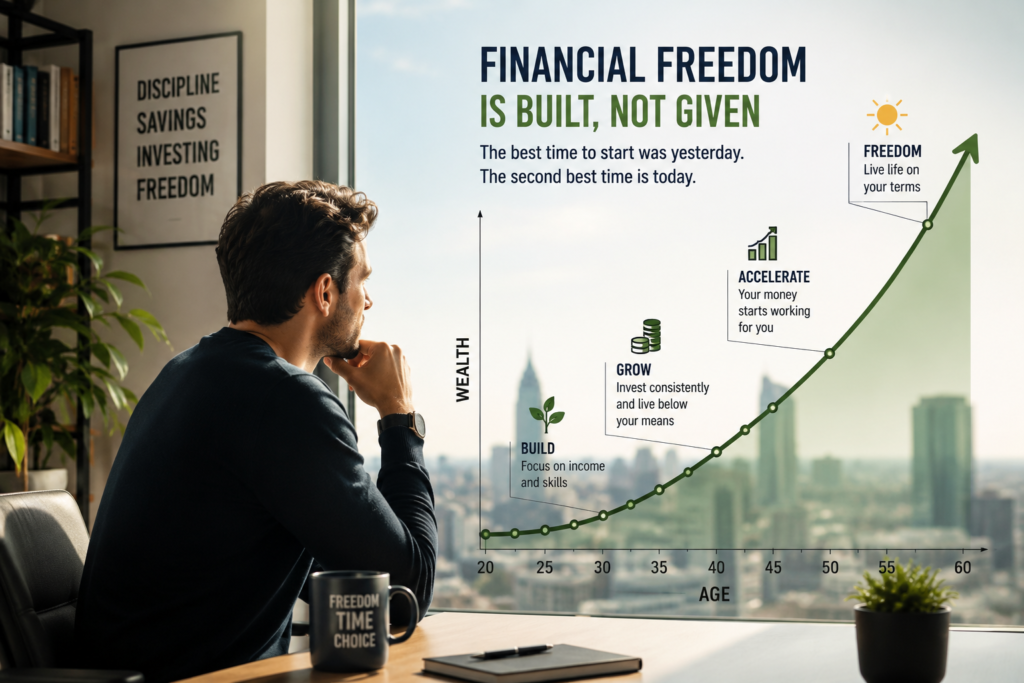
First, compound interest begins to show its power in a tangible way. If you started investing in your 20s, you may already have a meaningful portfolio balance that is growing significantly through returns rather than just contributions. If you haven’t started yet, the urgency is real — every year of delay at this stage costs significantly more than a year of delay in your 20s.
Second, your 30s are typically your highest-earning decade relative to your historical earnings. You have enough experience to command a meaningful salary while still having decades of earning potential ahead. This combination — higher income and enough time — creates an unusually powerful opportunity.
Third, the lifestyle choices you make in your 30s have long-lasting consequences. Lifestyle inflation — the tendency to spend more as you earn more — is at its most dangerous in this decade. A growing salary directed toward a bigger house, newer car, and more expensive lifestyle feels normal and even deserved. But the same salary directed primarily toward investments creates a very different outcome over the following decade.
Stage 1: Get Your Foundation Absolutely Right
If you’re entering your 30s without a solid financial foundation, the first priority is building one — quickly and without compromise.
Eliminate all high-interest debt. Credit card debt, personal loans, and any other debt above 7-8% interest should be paid off before investing aggressively. The guaranteed return of eliminating high-interest debt outpaces the expected return from most investments. Use the avalanche method — targeting the highest interest rate debt first — to minimize total interest paid.
Build a fully funded emergency fund. In your 30s, the recommended emergency fund is six months of expenses rather than three. Your financial responsibilities are likely greater — perhaps a mortgage, a family, or a business — and the consequences of a financial shock are more significant. Six months of expenses in a high yield savings account is non-negotiable before pursuing aggressive wealth-building.
Get your insurance sorted. Financial independence can be derailed instantly by an uninsured catastrophe. In your 30s, adequate health insurance, life insurance (particularly if you have dependants), disability insurance, and income protection become genuinely important. This isn’t a glamorous financial step — but the financial devastation of a serious illness or injury without adequate coverage is one of the most common ways people’s wealth-building plans are destroyed.
Stage 3: Invest Aggressively and Intelligently
Money saved is not the same as money invested. Cash sitting in a savings account, while safe, loses purchasing power to inflation over time. Building financial independence requires your savings to be invested in assets that generate meaningful long-term returns.

Maximize tax-advantaged accounts first
Before investing in a taxable brokerage account, maximize your contributions to tax-advantaged accounts. In the US, this means contributing to your 401(k) up to the employer match (free money — never leave this on the table), then maximizing your Roth IRA ($7,500 annual limit in 2026 for those under 50), then returning to the 401(k) up to the $24,500 annual limit (2026).
The tax savings from these accounts are significant over a long investment horizon. A Roth IRA, for example, shelters all investment growth from tax — meaning the entire return on your investments compounds tax-free for decades, then can be withdrawn tax-free in retirement.
Invest primarily in low-cost index funds
For most people pursuing financial independence, the optimal investment strategy is also the simplest: invest regularly in a small number of low-cost, broadly diversified index funds and leave them alone to compound over time.
A simple, highly effective portfolio for someone in their 30s might consist of:
- 80-90% in a global equity index fund (capturing the growth of thousands of companies worldwide)
- 10-20% in a bond fund (providing stability and reducing portfolio volatility)
As your portfolio grows and you approach your FI number, you can gradually shift toward a more conservative allocation. But in your 30s, with decades of growth ahead, a predominantly equity portfolio is appropriate for most investors.
The temptation to complicate your investment approach — picking individual stocks, timing the market, chasing the latest investment trend — is powerful and persistent. Resist it. The research consistently shows that simple, low-cost index fund investing outperforms most active investment strategies over long periods, particularly after fees.
Reinvest all dividends
Ensure your investment accounts are set to automatically reinvest dividends rather than paying them out as cash. Dividend reinvestment means that every distribution from your portfolio immediately buys more shares, which then generate their own dividends — a compounding effect that significantly accelerates portfolio growth over time.
Stage 4: Build Multiple Income Streams
Financial independence is easier to achieve with multiple income streams. A single salary, while often sufficient, leaves you vulnerable to job loss and limits the maximum savings rate you can achieve.
In your 30s, building additional income streams alongside your primary career is both more feasible and more important than it was in your 20s. You have more skills, more experience, more professional credibility, and more capital to deploy.
Career income optimization
Your primary income remains your most important income stream in your 30s. Optimize it aggressively:
Negotiate every raise and promotion opportunity. Negotiating matters more than it looks, because future raises, bonuses and retirement contributions are usually calculated as a percentage of your current salary. In your 30s, with established experience and marketable skills, you’re in a strong position to negotiate.
Don’t stay at a company out of loyalty if the market will pay you more elsewhere. Job changes remain one of the fastest ways to increase salary, and the loyalty premium offered by most employers rarely matches market-rate increases available externally.
Invest in skills and qualifications that command higher salaries in your field. In your 30s, professional development is a high-return investment in your future earning potential.
Side income and entrepreneurship
A side hustle in your 30s can serve multiple financial independence goals simultaneously: it generates extra income that accelerates savings, provides a backup income stream that reduces financial vulnerability, and potentially seeds a future business that could provide significant passive income.
The most effective side hustles in your 30s leverage skills you’ve developed in your professional career — consulting, freelancing, coaching, or training in your area of expertise. This approach maximizes your hourly rate and requires less time to generate meaningful income than starting from scratch in an unfamiliar field.
Passive income
Building genuine passive income streams is one of the most powerful ways to accelerate financial independence. True passive income — income that flows without your ongoing active involvement — reduces the amount of portfolio withdrawals needed in retirement and can reach your FI target with a smaller portfolio.
Real estate generates passive income through rental yields when properly managed. A portfolio of dividend-paying stocks or index funds generates passive income through dividends. A successful blog, YouTube channel, or online course generates passive income from content created once.
In your 30s, the combination of higher income, growing investment portfolio, and potentially multiple income streams creates a genuinely powerful financial independence acceleration effect.
Avoid lifestyle creep ruthlessly
This deserves repeating because it’s the most common way people in their 30s derail their financial independence progress. Lifestyle creep is insidious precisely because each individual upgrade seems reasonable — a nicer car because you can afford it, a bigger house because the family is growing, more expensive vacations because you’ve worked hard. Each decision seems justified in isolation. But collectively, lifestyle creep can absorb entire salary increases and keep you permanently one raise away from financial comfort rather than building genuine independence.
The antidote is a deliberate, written commitment to what you will and won’t spend money on — a personal spending philosophy that reflects your genuine values rather than social expectations or marketing messages.
Review and rebalance annually
Your investment portfolio will drift from its target allocation as different asset classes perform differently over time. An annual review and rebalance — selling assets that have grown above their target allocation and buying those that have fallen below — keeps your risk level consistent with your goals and forces you to buy low and sell high systematically.
Annual reviews are also an opportunity to assess your overall financial independence progress: Are you on track to hit your FI number by your target date? Has your spending changed in ways that affect your FI number? Do your income projections still support your savings rate targets?
The Bottom Line
Financial independence in your 30s is not a fantasy reserved for the exceptionally lucky or the extremely frugal. It is a mathematical outcome of saving a high percentage of income, investing consistently in low-cost index funds, building multiple income streams, and protecting your wealth from the risks most likely to derail it.
The decisions you make in your 30s — about what to spend money on, where to invest, how aggressively to build income, and how resolutely to resist lifestyle inflation — will determine whether you spend your 40s and 50s working because you have to, or living the life you actually want because you built the financial foundation to do so.
Start now. Calculate your FI number. Increase your savings rate. Invest consistently. The path is clear. The only question is whether you’ll walk it.
Frequently Asked Questions
Below are the most common questions people ask about how to become financially independent.
Below are the most common questions people ask about how to become financially independent.
What does financial independence mean?
Financial independence means having enough savings and investments to cover your living expenses without needing to work. You’re not necessarily retired — you just have the freedom to choose how you spend your time without being dependent on a paycheck.
Is it realistic to become financially independent in your 30s?
It’s ambitious but achievable for many people. It requires a high savings rate, consistent investing, and lifestyle choices that prioritize building wealth over consumption. It’s more realistic for those who start in their early 20s, but even starting in your 30s can lead to financial independence by your 40s.
How much money do I need to be financially independent?
The most widely used benchmark is 25 times your annual expenses — known as the 25x rule. If you spend $40,000 a year, you need $1,000,000 invested. This is based on the 4% safe withdrawal rate, which suggests you can withdraw 4% of your portfolio annually without running out of money over a 30-year period.
What is the fastest way to reach financial independence in your 30s?
Increase your savings rate as aggressively as possible, invest consistently in low-cost index funds, avoid lifestyle inflation as your income grows, and consider additional income streams. The savings rate is the single biggest lever — every percentage point increase shortens your timeline significantly.
What should I invest in to reach financial independence?
Low-cost index funds tracking broad market indices are the preferred vehicle for most people pursuing financial independence. Maximize tax-advantaged accounts first — 401(k) or Roth IRA — then invest in a taxable brokerage account. Keep fees low and stay consistent regardless of market conditions.
What are the biggest obstacles to financial independence in your 30s?
Lifestyle inflation is the biggest one — spending more as you earn more instead of investing the difference. Other obstacles include high-interest debt, lack of a clear investment strategy, and underestimating how much you need saved. Starting with a specific number and working backwards to monthly actions makes the goal far more achievable.
Once financially independent, your money should be working for you. See our guide to investing for beginners.
Related resources: net worth calculator, compound interest calculator.
Disclaimer: This article is for informational purposes only and does not constitute financial advice.