
Dividend stocks let you get paid just for owning shares in a company — no selling required. It’s one of the most straightforward ways to build passive income, and it compounds powerfully over time. Historically, dividends have made up a meaningful share of the stock market’s total return. Here’s how to get started as a beginner.
Dividend investing has been a cornerstone of wealth-building strategies for generations. Some of the world’s most successful investors — including Warren Buffett, whose portfolio generates billions in dividend income annually — have built enormous wealth through the compounding power of dividend reinvestment over long periods of time.
But dividend investing isn’t just for billionaires. Anyone with a brokerage account and even a modest amount to invest can start building a dividend portfolio today. This guide explains exactly how dividend stocks work, how to choose them wisely, and how to build a dividend portfolio as a complete beginner.
What Are Dividend Stocks?
Why Dividend Investing Is Particularly Powerful
Dividend investing offers several advantages that make it particularly compelling as a long-term wealth-building and income-generation strategy.
Passive income that grows over time
Unlike a salary that requires your ongoing labor, dividend income flows to you regardless of whether you’re working, sleeping, or on vacation. And unlike fixed-income investments like bonds, dividend income from quality companies tends to grow over time as companies increase their dividend payments.
Companies that have consistently increased their dividends for decades — known as Dividend Aristocrats in the US — provide investors with an income stream that not only keeps pace with inflation but often outstrips it. A company that increases its dividend by 7% annually doubles its payout in approximately 10 years. For patient investors, this dividend growth creates an ever-expanding income stream from the same initial investment.
Total return from both income and growth
Dividend stocks don’t just pay income — they also appreciate in value over time like any other stock. The total return from a dividend stock is the combination of the dividend income received and the capital appreciation of the share price.
Historically, dividends have accounted for a significant portion of the stock market’s total return. Over long periods, reinvested dividends have made up a large share of the S&P 500’s total return, which is why index providers publish a separate “total return” version of the index that includes them. Ignoring dividends means ignoring a substantial component of long-term stock market returns.
The power of dividend reinvestment
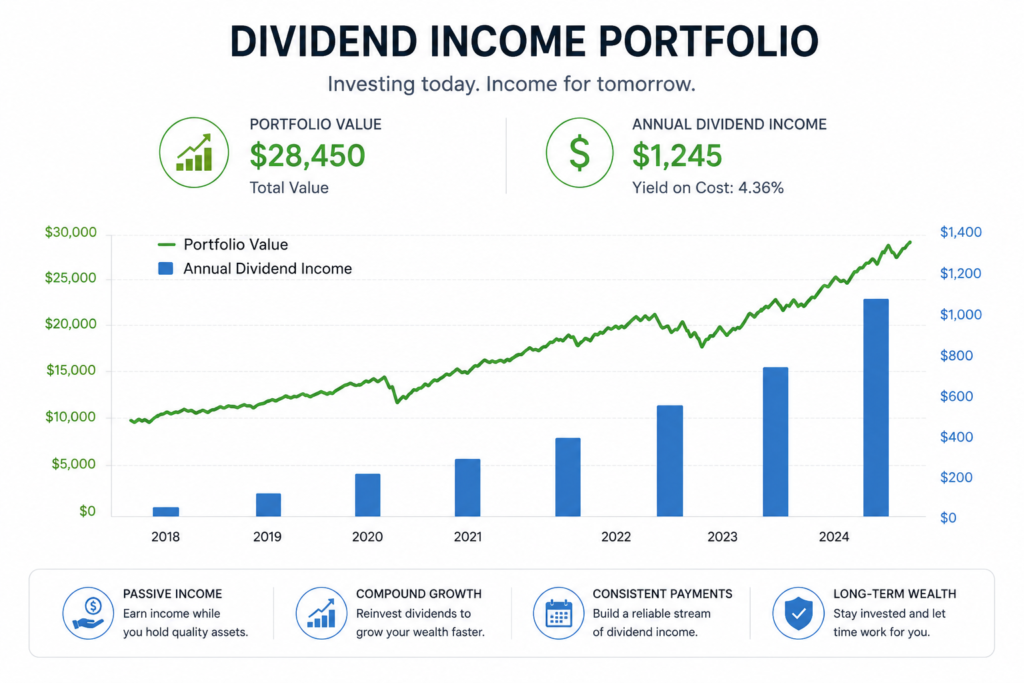
Perhaps the most powerful aspect of dividend investing is what happens when you reinvest dividends rather than taking them as cash. By using dividend payments to buy additional shares, you create a compounding effect — more shares generate more dividends, which buy even more shares, which generate even more dividends.
Over decades, dividend reinvestment can transform a modest initial investment into a substantial portfolio. A $10,000 investment in a dividend stock paying a 3% yield with 7% annual dividend growth, with all dividends reinvested and 8% annual price appreciation, grows to roughly $218,000 after 30 years, compared with about $100,600 from price growth alone. The difference, more than $115,000, comes from reinvested dividends buying more shares that then pay dividends of their own. (This is a hypothetical illustration with steady returns; real stocks are volatile, dividends can be cut, and returns are not guaranteed.)
Psychological benefits during market downturns
One of the challenges of long-term investing is maintaining discipline during market downturns, when portfolio values fall and the temptation to sell becomes overwhelming. Dividend investing provides a significant psychological advantage during these periods.
When you’re receiving regular dividend payments — even as your portfolio’s market value temporarily falls — you have concrete evidence that your investment is still working and generating income. This makes it significantly easier to stay the course during market volatility rather than panic-selling at the worst possible moment.
Key Dividend Metrics Every Beginner Must Understand
Before choosing dividend stocks, you need to understand the key metrics used to evaluate them. These numbers tell you how much a company pays in dividends, whether those dividends are sustainable, and whether the stock is priced attractively.
Dividend Yield
The dividend yield is the annual dividend payment expressed as a percentage of the current share price.
Formula: Annual dividend per share ÷ Current share price × 100
For example, a share priced at $50 that pays $2 in annual dividends has a yield of 4%.
The yield tells you how much income you’ll receive relative to what you pay for the stock. A higher yield means more income for every dollar invested — but it’s not always better. Unusually high yields can be a warning sign that the market expects the company to cut its dividend, which would cause the share price to fall.
A sustainable dividend yield for most quality companies falls in the range of 2-5%. Yields above 6-7% warrant careful scrutiny.
Dividend Payout Ratio
The payout ratio is the percentage of a company’s earnings paid out as dividends.
Formula: Annual dividends per share ÷ Earnings per share × 100
A company earning $4 per share and paying $2 in dividends has a payout ratio of 50%. This means the company retains 50% of its earnings for reinvestment in the business while distributing the other 50% to shareholders.
A payout ratio below 60% is generally considered sustainable for most industries — there’s sufficient earnings buffer to maintain dividends even if profits temporarily decline. Payout ratios above 80-90% suggest the dividend may be at risk if the business faces any headwinds.
Some sectors — REITs and utilities in particular — legitimately operate with higher payout ratios due to their business models and regulatory structures.
Dividend Growth Rate
The dividend growth rate is the annualized percentage increase in a company’s dividend payment over time. This metric is particularly important for long-term dividend investors because consistent dividend growth is what drives the compounding income effect that makes dividend investing so powerful.
A company with a 7-10% annual dividend growth rate will double its dividend payment in approximately 7-10 years. An investor who bought shares when the yield was 3% will effectively be receiving a 6% yield on their original investment a decade later — and 12% a decade after that — as long as the company continues growing its dividend.
Look for companies with consistent dividend growth histories — ideally 10 or more consecutive years of dividend increases.
Free Cash Flow
Free cash flow is the cash a company generates after accounting for capital expenditures — the money available to pay dividends, buy back shares, pay down debt, or reinvest in the business.
Dividends paid from genuine free cash flow are sustainable. Dividends paid by borrowing money or selling assets are not. Always check that the company generating dividends has free cash flow comfortably above its dividend payments.
Assess the business fundamentals
Behind every dividend is a business. A dividend is only sustainable if the underlying business continues to generate sufficient profits and cash flow to support it. Before buying any dividend stock, consider:
- Does the company have a durable competitive advantage — a moat — that protects its market position?
- Is the industry the company operates in stable and unlikely to be significantly disrupted?
- Does the company have a strong balance sheet with manageable debt?
- Has revenue and earnings grown consistently over the past decade?
- Is management’s track record of capital allocation good?
Check the valuation
Even excellent companies can be bad investments if purchased at too high a price. A useful metric for dividend investors is the price-to-earnings (P/E) ratio — the share price divided by annual earnings per share. Compare a company’s current P/E ratio to its historical average and to peers in the same sector.
Buying quality dividend stocks at fair or below-average valuations significantly improves long-term returns and reduces downside risk.

Diversify across sectors
Don’t concentrate all your dividend investments in a single sector. Different sectors face different risks — a recession might hurt financial stocks, while rising interest rates might pressure REITs, while regulatory changes might affect utilities. A well-diversified dividend portfolio spans multiple sectors, ensuring that no single sector’s difficulties can devastate your income stream.
A balanced dividend portfolio might include companies from utilities, consumer staples, healthcare, financial services, industrials, and REITs.
Add individual stocks as your knowledge grows
Once you’re comfortable with the basics of dividend investing and have done sufficient research, you can begin adding individual dividend stocks to complement your ETF holdings. Start with Dividend Aristocrats in sectors you understand well and build your individual stock exposure gradually over time.
Invest consistently
Regular monthly contributions — even small ones — combined with dividend reinvestment accelerate portfolio growth significantly. Set up an automatic monthly investment into your chosen dividend ETFs and let the compounding process work undisturbed.
Chasing the highest yield
The highest-yielding stocks are often the most dangerous. An abnormally high yield frequently signals that the market expects the company to cut its dividend — which would cause the share price to fall and income to decrease simultaneously. Focus on sustainable, growing dividends rather than maximum current yield.
Lacking diversification
Concentrating a dividend portfolio in a single sector — even a traditionally reliable one like utilities or consumer staples — exposes you to sector-specific risks that could simultaneously hit all your holdings. Always diversify across multiple sectors.
Not reinvesting in the early years
In the early stages of building a dividend portfolio, dividend income is relatively small in absolute terms. The temptation to take dividends as spending money is understandable — but reinvesting in the early years is when compound growth has the most time to work. Delay taking dividend income as cash until your portfolio is large enough that the income is genuinely meaningful.
How Dividends Are Taxed in the U.S.
Dividends paid in a regular brokerage account are taxable in the year you receive them, even if you reinvest them. Your broker reports them on Form 1099-DIV. The IRS splits them into two groups (IRS Topic 404):
- Qualified dividends are taxed at the lower long-term capital gains rates of 0%, 15% or 20%, depending on your taxable income. Most dividends from U.S. companies qualify if you’ve held the shares for more than 60 days during the 121-day period that starts 60 days before the ex-dividend date.
- Ordinary (non-qualified) dividends are taxed at your regular income tax rate. Distributions from REITs and money market funds are common examples.
Inside a Roth IRA, traditional IRA or 401(k), dividends aren’t taxed each year, which makes those accounts a natural home for dividend investing. To receive a dividend you must own the shares before the ex-dividend date; buying on or after that date means the seller gets the payment (Investor.gov).
Frequently Asked Questions
Below are the most common questions people ask about dividend stocks for beginners — answered simply and clearly.
What are dividend stocks?
Dividend stocks are shares in companies that regularly distribute a portion of their profits to shareholders as cash payments called dividends. Instead of just making money when the stock price rises, dividend investors also receive regular income — typically paid quarterly — simply for holding the shares.
How much money do I need to start investing in dividend stocks?
You can start with as little as $50-$100 through fractional shares on platforms like Fidelity or Schwab. However, to generate meaningful passive income from dividends alone, you typically need a substantial portfolio — $100,000 invested at a 4% dividend yield generates around $4,000 per year.
What is a good dividend yield for beginners?
A dividend yield of 3-5% is generally considered healthy for beginners. Be cautious of yields above 7-8% — they can signal that a company is in financial trouble and may cut its dividend. A sustainable, growing dividend from a financially stable company is worth more than a high but unreliable one.
Are dividend stocks safe for beginners?
Dividend stocks from established, financially stable companies — often called dividend aristocrats — are generally considered lower risk than growth stocks. However, no stock investment is risk-free. Diversifying across multiple dividend-paying companies or investing in a dividend ETF reduces risk significantly.
Should I reinvest my dividends or take the cash?
For beginners focused on building wealth, reinvesting dividends through a DRIP (Dividend Reinvestment Plan) is almost always the better choice. Reinvesting allows your dividends to buy more shares, which generate more dividends — compounding your returns significantly over time.
What is the difference between dividend stocks and index funds?
Index funds provide broader diversification across hundreds of companies, while dividend stocks focus on income-generating companies specifically. Many beginners are better served starting with a dividend-focused ETF rather than picking individual dividend stocks — it provides income with built-in diversification.
Sources
- Internal Revenue Service, Topic No. 404, Dividends.
- U.S. Securities and Exchange Commission, Investor.gov: Ex-Dividend Dates: When Are You Entitled to Stock and Cash Dividends.