
Most people never negotiate their salary. They accept whatever number is offered, stay quiet at performance review time, and silently hope that their employer will recognize their value and reward them accordingly. Sometimes that happens. More often, it doesn’t.
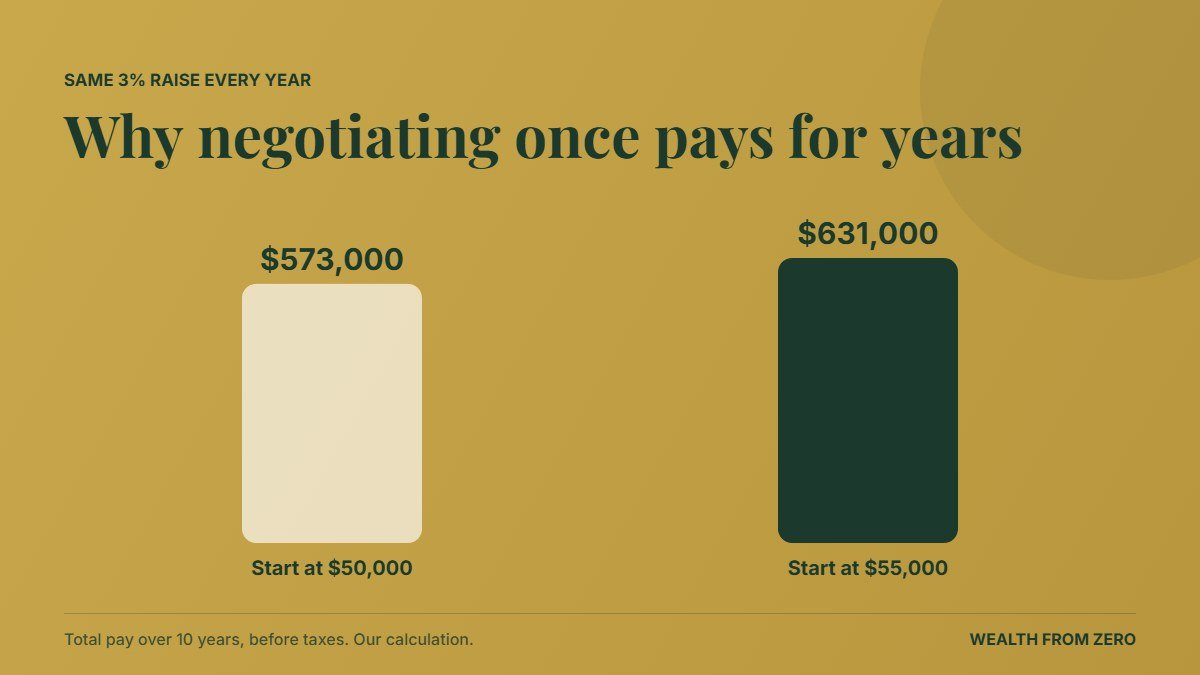
Because raises are usually calculated as a percentage of your current salary, negotiating your starting pay can compound over an entire career — yet many people never ask.
The reality is that employers rarely volunteer pay increases beyond the absolute minimum. Salary budgets are finite, and the people who advocate loudest for themselves — professionally and with solid evidence — tend to get more than those who wait and hope.
If you’ve never negotiated a salary increase before, the idea can feel terrifying. What if they say no? What if they think you’re being greedy? What if it damages your relationship with your manager? These fears are normal — and they’re also largely unfounded. Salary negotiation is a normal, expected part of professional life. Managers aren’t surprised when employees ask for more money. In many cases, they respect it.
This guide will walk you through exactly how to negotiate a salary increase for the first time — from preparation to the conversation itself to handling any outcome.

Why Most People Never Ask for a Raise
| Negotiation approach | When to use it | Why it works |
|---|---|---|
| Salary benchmarking data | Any negotiation | Shows what the market pays, not what you feel you deserve |
| Competing offer | Job offers | Gives a concrete number the employer has to match or beat |
| Performance data and achievements | Annual review | Ties the raise to results your manager can verify |
| Promotion tied to new responsibilities | Role expansion | Pay catches up with the work you already do |
| “I want to stay, but need X” | When another employer is interested | Only works if you are ready to leave; use it carefully |
Before we get into strategy, it’s worth understanding why salary negotiation feels so uncomfortable for so many people — particularly those doing it for the first time.
The first reason is fear of rejection. Nobody likes being told no, and the idea of asking for something and being refused feels personally humiliating to many people. But a salary negotiation isn’t a personal favor — it’s a professional discussion about the market value of your work. A no doesn’t mean your employer thinks less of you as a person.
The second reason is a lack of knowledge about what to say and how to say it. Most people were never taught how to negotiate. School doesn’t cover it, and most workplaces don’t either. Without a script or framework, the conversation feels improvised and risky.
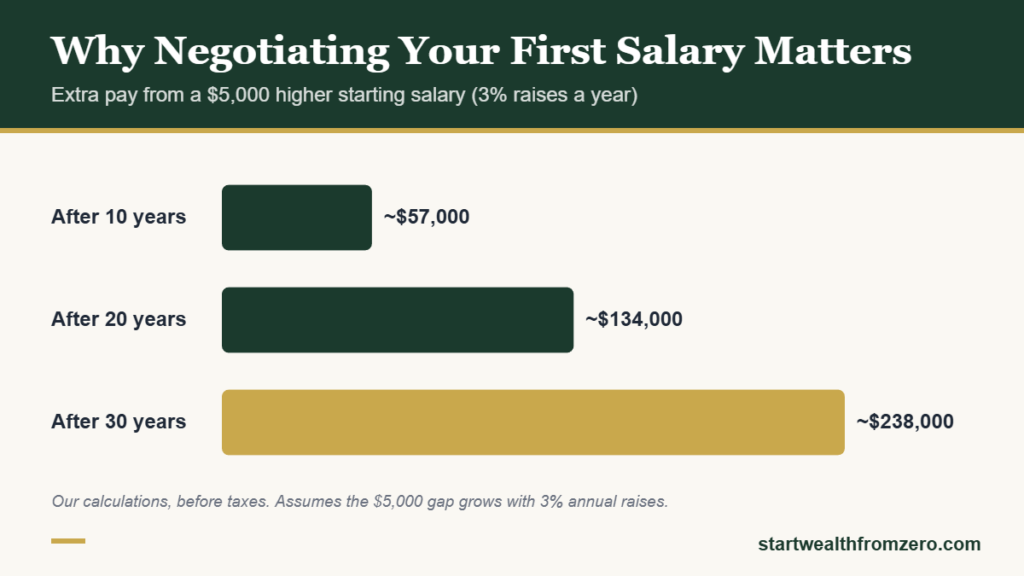
The third reason is a belief that asking is somehow inappropriate — that a good employer will recognize your value and reward you without being asked. This belief, while understandable, is expensive. Because future raises are usually calculated as a percentage of your current pay, a higher salary today can compound into significantly more income over your career.
When Is the Right Time to Ask for a Raise?
Timing matters enormously in salary negotiation. Asking at the wrong moment — when the company is struggling, immediately after a poor performance period, or during an exceptionally busy time for your manager — dramatically reduces your chances of success.
The best times to negotiate a salary increase are:
During your annual performance review. This is the most natural and expected time to discuss compensation. Many companies have salary review processes tied to annual reviews, which means your manager is already thinking about pay at this point.
After a significant achievement. If you’ve just completed a major project successfully, won a new client, saved the company money, or received external recognition for your work, you have fresh, concrete evidence of your value. Strike while the iron is hot.
When you’ve taken on additional responsibilities. If your role has expanded significantly since your last salary review — you’re managing more people, handling more complex work, or covering responsibilities that weren’t in your original job description — you have a strong case for a pay increase.
After receiving a competing offer. If another employer has offered you a job at a higher salary, you’re in a very strong negotiating position. However, only use this approach if you’re genuinely willing to leave — threatening to leave and then staying anyway damages your credibility significantly.
When the market rate for your role has increased. Salaries for specific roles shift over time. If your research shows that people in comparable roles are earning significantly more than you, you have a legitimate market-based argument for a raise.
How to Prepare for the Negotiation
Preparation is everything in salary negotiation. Walking into the conversation without solid preparation is one of the most common mistakes first-time negotiators make. Here’s how to prepare thoroughly:
Research the market rate for your role
Before you ask for anything, you need to know what people in comparable roles — same industry, same level of experience, same geographic area — are actually earning. This gives you an objective benchmark and prevents you from asking for too little or an unrealistically large amount.
Resources for salary research include:
- U.S. Bureau of Labor Statistics: the free Occupational Employment and Wage Statistics show pay ranges by job and metro area, and the Occupational Outlook Handbook gives median pay and job outlook for hundreds of occupations
- Glassdoor
- LinkedIn Salary
- Payscale
- Industry-specific salary surveys
- Conversations with peers in your industry (more common than people think)
Gather data from multiple sources and look for the range, not just the average. Knowing that people in your role earn between $45,000 and $65,000 is more useful than knowing the average is $55,000.
Document your achievements and contributions
This is where most first-time negotiators are underprepared. Don’t walk into the conversation with a vague sense that you’ve been doing a good job. Walk in with specific, quantified evidence of your contribution.
Think about:
- Projects you’ve completed and their outcomes
- Revenue you’ve generated or contributed to
- Costs you’ve saved the company
- Problems you’ve solved
- Responsibilities you’ve taken on beyond your original role
- Positive feedback from clients, colleagues, or senior leadership
- Any awards, recognition, or exceptional performance ratings
The more specific and quantified your evidence, the stronger your case. “I managed the rebranding project that launched on time and under budget, receiving praise from the CEO” is far more compelling than “I’ve been working really hard.”
Decide on your number
Before the conversation, decide exactly what you’re asking for. Research suggests that stating a specific number — rather than a range — tends to result in better outcomes. When you give a range, employers tend to anchor on the lower end.
Your target number should be:
- Based on your market research
- Reflecting your specific achievements and value
- Slightly above what you’d be genuinely happy to accept, to leave room for negotiation
- Realistic given your company’s size and circumstances
If you’re currently earning $40,000 and market research shows comparable roles pay $45,000-55,000, asking for $48,000-50,000 is reasonable. Asking for $65,000 is not.
Prepare for common objections
Think through the objections your manager might raise and prepare thoughtful responses:
- “The budget is tight this year” → “I understand, and I appreciate that. Could we agree on a timeline for when this could be reviewed?”
- “We give raises based on performance reviews” → “I’d love to discuss this now so we can factor it into the upcoming review.”
- “I’ll need to check with HR/finance” → “Of course — what timeline are we looking at for a decision?”
Having responses ready means you won’t be caught off guard and panic.
How to Have the Conversation
The actual negotiation conversation doesn’t need to be dramatic or confrontational. In fact, the best salary negotiations are calm, professional, and collaborative — two professionals discussing a business matter.
Request the meeting in advance
Don’t ambush your manager in the corridor or bring it up at the end of an unrelated meeting. Request a dedicated meeting and give a clear indication of what it’s about:
“Hi [Manager], I’d love to schedule some time to discuss my compensation. I’ve been doing some research and would like to share some thoughts. Could we find 20-30 minutes in the next couple of weeks?”
This gives your manager time to prepare, shows respect for their time, and signals that this is a serious professional conversation.
Open the conversation with confidence
When the meeting begins, get to the point relatively quickly. Don’t spend so long on small talk that you run out of time or lose your nerve.
A strong opening might sound like:
“I really appreciate you making time for this. I’ve been reflecting on my role and contributions over the past year, and I’d like to discuss my salary. Based on my research into market rates and looking at what I’ve contributed to the team, I’d like to propose a salary of [specific number].”
Then stop talking. Let your manager respond. Many first-time negotiators undermine themselves by immediately justifying, apologizing, or filling the silence with nervous chatter.
Present your evidence
After stating your number, walk your manager through your key achievements and the market research you’ve done. Keep it concise — three to five strong points are more persuasive than a long rambling list.
Frame everything in terms of value to the business, not personal need. “I need more money because my rent went up” is a weak argument. “Based on my contributions to X project and the market rate for this role, I believe $X reflects my value to the team” is strong.
Handle the response professionally
If your manager says yes immediately — fantastic. If they say they need to think about it or check with others, ask for a specific timeline:
“Of course, I completely understand. Could we agree to follow up by [specific date]?”
If they say no, don’t panic. Ask for clarity:
“I appreciate your honesty. Could you help me understand what would need to change for this to be possible in the future, and when we could revisit this conversation?”
This response keeps the door open, demonstrates professionalism, and gives you a roadmap for what to work toward.
What to Do After the Negotiation
Regardless of the outcome, follow up with an email summarizing what was discussed and agreed. This creates a paper trail and demonstrates professionalism.
If you received a raise, express genuine gratitude and continue performing at a high level. If you didn’t, use the feedback to guide your next steps — whether that’s working toward the milestones your manager outlined, or beginning a confidential job search if you feel your value isn’t being recognized.
One important note: if your employer consistently refuses reasonable salary requests without clear justification, that’s important information. Sometimes the most effective salary negotiation is finding a new employer who will pay you what you’re worth.
The Bottom Line
Negotiating a salary increase for the first time is uncomfortable. It requires preparation, confidence, and a willingness to have a conversation that most people avoid. But the financial returns — both immediately and compounded over a career — make it one of the highest-value activities available to any professional.
Research your market rate, document your achievements, decide on your number, request the meeting, and make your case calmly and professionally. The worst realistic outcome is a no — which is exactly where you are if you don’t ask.
Ask for what you’re worth. Most of the time, you’ll get closer to it than you expected.
Frequently Asked Questions
When is the right time to ask for a salary increase?
The best times are during your annual performance review, after completing a major project successfully, or when you’ve taken on significantly more responsibilities. Avoid asking during company-wide budget cuts or when your manager is under unusual stress.
How much of a salary increase should I ask for?
A reasonable request is typically 10-20% above your current salary, depending on your market research and performance. Come with a specific number rather than a range — asking for a range signals that you’ll accept the lower end.
What if my employer says no?
Ask for specific feedback on what you need to achieve to earn the increase and set a timeline to revisit the conversation. A no today doesn’t mean no forever. If the company consistently undervalues you despite strong performance, it may be time to explore opportunities elsewhere.
Should I mention a competing job offer when negotiating?
Only if you have a real offer and are genuinely willing to leave. Using a fake offer as leverage is risky — if called out, it destroys trust and could cost you your job. A real competing offer is one of the most powerful negotiating tools available.
How do I negotiate a salary increase without damaging my relationship with my manager?
Frame the conversation around your value and market data, not personal financial needs. “I’ve researched market rates and believe my contributions warrant a salary of X” lands better than “I need more money because my rent went up.” Keep it professional and collaborative, not confrontational.
Does negotiating salary really make a difference long term?
Enormously. A $5,000 raise negotiated at 25 compounds over an entire career — future raises, bonuses, and retirement contributions are often calculated as a percentage of your base salary. Negotiating early and consistently is one of the highest-return financial moves you can make.
A salary negotiation win is one of the fastest ways to accelerate your savings. Once you have more room in your budget, use our Savings Calculator to see how much faster you’ll hit your goals.
A salary raise is most powerful when you save the difference. See our wealth-building guide and use our Savings Calculator to model the impact of a $500/month raise.