
You’ve heard you should save for retirement. You probably know about both a Roth IRA and a 401(k). The real question most people face: when money is limited, which one gets it first?
This guide covers the core Roth IRA vs 401(k) differences for 2026, the optimal contribution order for most situations, the backdoor Roth strategy, and a side-by-side comparison with real numbers.
Roth IRA vs 401(k): Side-by-Side Comparison 2026
| Roth IRA | Traditional 401(k) | |
|---|---|---|
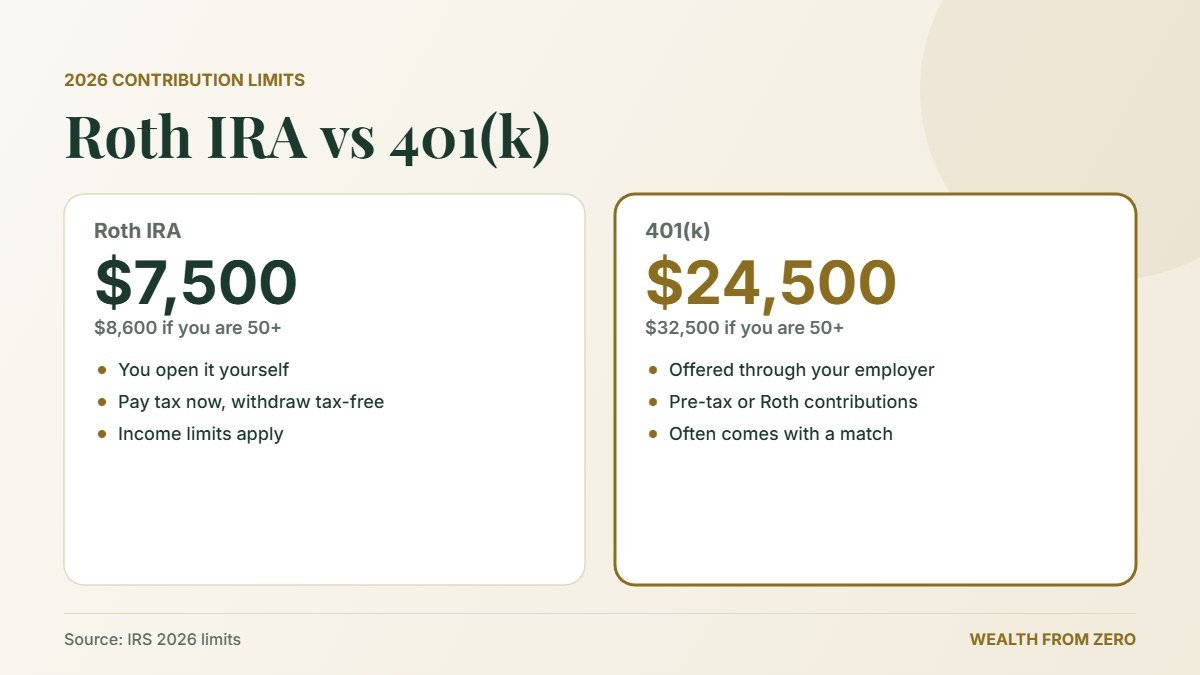
| 2026 contribution limit | $7,500 ($8,600 if 50+) | $24,500 ($32,500 if 50+) |
| Tax on contributions | After-tax (no deduction now) | Pre-tax (reduces taxable income now) |
| Tax on withdrawals | 100% tax-free | Taxed as ordinary income |
| Income limits | Phase out $153k–$168k single / $242k–$252k married | None |
| Employer match | No | Yes — typically 50–100% of first 3–6% |
| Early withdrawal | Contributions anytime penalty-free | 10% penalty + taxes on full amount |
| Required Minimum Distributions | None during your lifetime | Starting at age 73 |
| Investment options | Any stocks, ETFs, funds at your broker | Limited to employer plan menu |
The Core Decision: When Do You Pay Taxes?
The Roth vs 401(k) choice comes down to one question: will you be in a higher or lower tax bracket in retirement than you are today?
- Higher bracket expected in retirement (early career, or if tax rates rise): pay taxes now with a Roth IRA. Contributions taxed at today’s lower rate; all withdrawals tax-free.
- Lower bracket expected in retirement (peak earning years now): defer with a 401(k). Reduce taxable income at your higher rate today; pay lower rates on withdrawals later.
- Uncertain (the honest answer for most people): use both. Tax diversification — money in both pre-tax and after-tax accounts — gives you flexibility to optimize in retirement.
The Employer Match: The Most Important Factor of All
If your employer matches 50% of the first 6% of your salary, contributing enough to capture it is equivalent to a guaranteed 50% return on your money the moment you contribute. No investment reliably produces that. If you have a match and aren’t capturing it fully, you’re leaving guaranteed money on the table — more impactful than any Roth vs traditional debate.
New to workplace retirement plans? Our 401(k) guide for beginners explains how a 401(k) works and how to get the most from it.
Three Advantages of the Roth IRA Most People Overlook
- No Required Minimum Distributions. Traditional 401(k)s force you to take taxable withdrawals from age 73 whether you need them or not. A Roth IRA has no RMDs — you can let it compound indefinitely, which is powerful for estate planning.
- Contribution withdrawal flexibility. You can withdraw your Roth IRA contributions (not earnings) at any time without penalty or taxes. This makes it effectively a secondary emergency fund for disciplined savers.
- Better investment options. Most 401(k) menus offer 10–30 funds, sometimes with high fees. A Roth IRA at Fidelity gives access to FZROX at 0% expense ratio — the lowest cost total market fund available. See our ETF vs Index Fund guide for full comparisons.

The Optimal Strategy by Situation
| Your Situation | Best Move |
|---|---|
| Employer offers a 401(k) match | Contribute to 401(k) up to the full match — always first |
| Income under $150k (single), any age | Max Roth IRA ($7,000) after capturing the match |
| Money remaining after Roth IRA | Return to 401(k) and max to $24,500 |
| No employer match, under 40 | Roth IRA first — decades of tax-free compounding |
| No employer match, over 50 | Traditional 401(k) — current deduction more valuable |
| Income over $165k (single) | 401(k) first; consider backdoor Roth IRA |
The Backdoor Roth IRA: What High Earners Need to Know
If your income exceeds the Roth IRA limit ($168,000 single, $252,000 married in 2026), you can’t contribute directly. But there’s a legal workaround: the backdoor Roth IRA.
- Step 1: Contribute to a traditional IRA (non-deductible, no income limit)
- Step 2: Convert that traditional IRA to a Roth IRA immediately
- Step 3: Pay taxes on any gains (usually minimal if converted quickly)
This strategy is fully legal and explicitly permitted by the IRS. The main complication: the “pro-rata rule” means if you have other pre-tax IRA money, the conversion becomes partly taxable. Consult a tax advisor if you have existing traditional IRA balances.
Roth IRA vs 401k: A Real-Life 30-Year Comparison
Let’s run the actual numbers for someone investing $500/month for 30 years at 7% average annual return, comparing a Roth IRA (after-tax contributions) vs a traditional 401(k) (pre-tax contributions).
Scenario A — Roth IRA: You invest $500/month of after-tax money. At 7%, your portfolio grows to $567,000. In retirement, every dollar you withdraw is tax-free. You keep $567,000.
Scenario B — Traditional 401(k): You invest $500/month pre-tax (reducing your taxable income now). Your portfolio also grows to $567,000. In retirement, withdrawals are taxed as ordinary income. At a 22% effective rate, you pay $125,000 in taxes. You keep $442,000.
The real comparison isn’t that simple though. In Scenario B, the tax savings from deducting contributions should be invested — if they are, the 401(k) can match or beat the Roth IRA depending on your retirement tax rate. Use our Investment Return Calculator to model your specific situation.
How to Use Both a Roth IRA and 401k Together
The most tax-efficient strategy for most people under 50 combines both accounts strategically:
- In your working years: 401(k) for the employer match + tax deduction now. Roth IRA for tax-free growth on everything else.
- In early retirement (before 65): Draw from taxable accounts and Roth IRA contributions (penalty-free) to keep taxable income low.
- At 65+: Combine 401(k) withdrawals with Social Security strategically to stay in the lowest possible tax bracket.
- Estate planning: Roth IRAs pass to heirs tax-free and have no Required Minimum Distributions — a significant advantage over 401(k)s.
For the official IRS guidance on contribution limits and income thresholds, see the IRS retirement topics page.
When to Choose Roth IRA Over 401k (And Vice Versa)
| Choose Roth IRA when… | Choose 401(k) first when… |
|---|---|
| You’re early in your career (lower tax bracket now than later) | Your employer offers a match — always capture it first |
| You want flexibility to withdraw contributions penalty-free | You’re in the 32%+ tax bracket and need the deduction now |
| You expect tax rates to rise in the future | Your 401(k) plan has excellent low-fee fund options |
| You want no Required Minimum Distributions | You earn over $168,000 single / $252,000 married |
| You’re self-employed with no employer plan | You want to maximize total tax-deferred savings ($24,500 vs $7,500 limit) |
Roth IRA vs 401k: Common Mistakes to Avoid
- Not contributing enough to get the full employer match. If your employer matches 50% of the first 6% of your salary, not contributing at least 6% is leaving guaranteed money on the table. This single mistake costs the average American $1,000–$3,000 per year.
- Opening a Roth IRA but leaving it in cash. The account itself does nothing. You have to actually invest the money — buy FZROX, VTI, or another index fund inside the account.
- Cashing out a 401k when changing jobs. The 10% early withdrawal penalty plus income tax typically costs 30–40% of the balance. Always roll over to an IRA or your new employer’s plan.
- Ignoring the Roth 401(k) option. Many employers now offer a Roth 401(k) — after-tax contributions with the $24,500 limit. If your employer matches contributions to a Roth 401(k), this is often the best of both worlds.
How Much Should Be in Your Roth IRA vs 401k?
There’s no universal right answer, but a simple framework for most people under 50 earning under $150,000:
- Contribute to 401(k) up to the full employer match (non-negotiable)
- Max Roth IRA ($7,500 in 2026)
- If money remains: return to 401(k) and contribute up to the $24,500 limit
- After tax-advantaged accounts are maxed: taxable brokerage account
Following this order consistently for 20 years, even at moderate income, produces retirement security that most people never achieve. See the IRS retirement contribution limits page for the most current figures each year.
Roth IRA vs 401k After Age 50: The Calculus Changes
Everything we’ve discussed assumes you’re building toward retirement. Once you’re within 10-15 years of retiring, some priorities shift:
- Traditional 401(k) becomes more attractive if you’ll be in a lower tax bracket in retirement than you are now. High earners in their 50s at peak salary often find this is true.
- The Roth IRA is still valuable for estate planning. A Roth IRA has no Required Minimum Distributions during your lifetime and passes to heirs completely tax-free. For people who don’t need the money in retirement, the Roth IRA is often the best asset to leave to children.
- Catch-up contributions matter a lot here. The additional $8,000 catch-up to the 401(k) and $1,100 extra to the IRA (for those 50+) in 2026 can make a significant difference over 10-15 years if used consistently.
401k vs Roth IRA: The Bottom Line
The right answer for most people under 50 earning under $150,000: capture the employer match in your 401(k) first — always, without exception. Then max a Roth IRA ($7,500 in 2026). Then return to the 401(k) with anything remaining. The order matters because the employer match is a guaranteed 50–100% return, and the Roth IRA offers tax-free growth that compounds for decades. Having both accounts gives you tax flexibility in retirement that neither account provides alone. Start today, contribute consistently, and let compound interest handle the rest. Use our Investment Return Calculator to see exactly what consistent contributions grow to over your timeline.
One final point that often gets overlooked: the best account is the one you actually use consistently. A Roth IRA with $100/month in contributions will outperform a 401(k) that you contribute to sporadically and cash out when you change jobs. Tax optimization matters — but consistency matters more. Pick the account that makes sense for your situation, set up automatic contributions, and leave it alone for 30 years.
Frequently Asked Questions
Can I have both a Roth IRA and a 401(k)?
Yes — and most advisors recommend it. The 401(k) limit ($24,500) and Roth IRA limit ($7,000) are completely separate. Contributing to both in the same year is not only allowed but ideal for tax diversification.
Should I convert my 401(k) to a Roth IRA?
A Roth conversion triggers income taxes on the converted amount in the year of conversion. It makes sense in low-income years (career transitions, early retirement) or if you expect tax rates to rise significantly. It generally does not make sense if the conversion pushes you into a much higher bracket.
What if my employer doesn’t offer a 401(k)?
A Roth IRA becomes your primary retirement account. Open one at Fidelity (FZROX, 0% expense ratio) or Vanguard (VTI, 0.03%). Self-employed individuals should also consider a Solo 401(k) or SEP-IRA, which allow much higher contributions than an IRA. Read our full Roth IRA beginners guide to open one in 10 minutes.
For the latest official limits and rules, see the IRS 2026 retirement contribution limits.
Disclaimer: This article is for informational purposes only and does not constitute financial or tax advice. Consult a qualified advisor for guidance specific to your situation. Contribution limits and income thresholds are for 2026 and subject to IRS annual adjustments.