
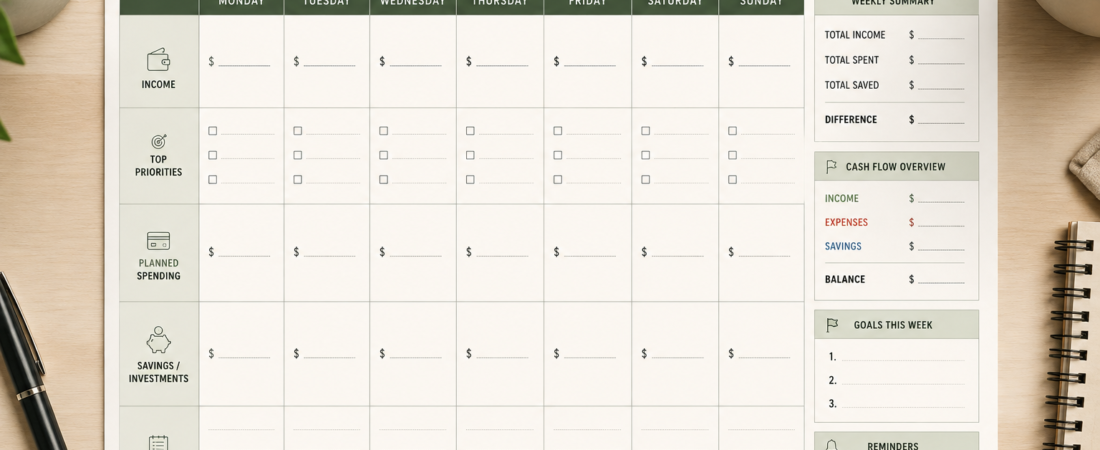
Most budgeting advice is written for people who get paid monthly or twice a month. But millions of people receive their pay weekly — and the standard budgeting frameworks don’t always translate well to a weekly pay cycle.
If you get paid weekly, you know the challenge: some weeks feel fine financially, and others feel incredibly tight. Monthly bills arrive unpredictably relative to your pay dates. It can be hard to plan ahead when your financial horizon is only seven days at a time.
The good news is that budgeting on a weekly pay cycle is absolutely manageable — and in some ways, it’s actually easier than monthly budgeting because you get more frequent feedback on how you’re doing. You just need the right framework.

Why Weekly Pay Budgeting Is Different
The core challenge of budgeting on a weekly income is the mismatch between how often you get paid and how often your bills arrive.
Most significant expenses — rent, mortgage payments, utility bills, insurance, subscriptions — are billed monthly. If you get paid weekly, you’ll have four or five pay packets arrive in a month, but your big bills typically hit once. This means some weeks feel flush and others feel dangerously tight, depending on where in the month you are and which bills have just landed.
There’s also the psychological challenge of weekly pay. Because money arrives more frequently, it can feel like you always have money available — right up until a big monthly bill hits and suddenly you’re scrambling.
The solution is to stop thinking in weeks and start thinking in months, while still working with your weekly pay structure.
Step 1: Calculate Your Monthly Income
The first step is to convert your weekly pay into a monthly figure so you can budget against your actual monthly expenses.
This is slightly more complicated than it sounds, because months don’t divide evenly into weeks. There are 52 weeks in a year, which means there are 4.33 weeks per month on average — not exactly 4.
To calculate your monthly income from weekly pay:
Weekly pay x 52 ÷ 12 = Monthly income
For example, if you earn $500 per week:
$500 x 52 = $26,000 per year
$26,000 ÷ 12 = $2,167 per month
This monthly figure is what you’ll use to build your budget. It also means that two months per year you’ll receive five pay packets instead of four — and knowing this in advance helps you plan for those bonus weeks rather than spending the extra money without thinking.
Step 2: List All Your Monthly Expenses
Now list every expense you have on a monthly basis. Include:
- Rent or mortgage
- Utility bills (electricity, gas, water, internet)
- Phone bill
- Insurance (car, health, renters)
- Subscriptions (streaming services, gym, etc.)
- Minimum debt payments
- Groceries (estimate based on weekly spending x 4.33)
- Transport costs
- Any other regular expenses
Add everything up. This is your total monthly outgoing.
Subtract your total monthly outgoing from your monthly income. Whatever remains is your discretionary income — the money available for wants, savings, and extra debt payments.
Step 3: Create a Weekly Spending Allowance
Once you know your monthly budget, convert it into a weekly allowance for variable expenses. This is the amount you can spend each week on groceries, dining out, entertainment, clothing, and other day-to-day expenses.
To calculate your weekly spending allowance:
Monthly discretionary income ÷ 4.33 = Weekly spending allowance
Having a specific weekly number to work with makes it much easier to manage your day-to-day spending. At the start of each week, you know exactly how much you have available — and when it’s gone, it’s gone until next week.
Step 4: Set Up a Bills Account
This is the most important practical step for anyone budgeting on a weekly income. Open a separate bank account specifically for bills and fixed expenses.
Each week when you get paid, transfer a fixed amount into this bills account. The amount should be calculated to cover all your monthly fixed expenses:

Total monthly fixed expenses ÷ 4.33 = Weekly bills transfer
For example, if your total monthly fixed expenses are $1,300:
$1,300 ÷ 4.33 = approximately $300 per week
Every week, $300 goes straight into your bills account. Over the course of a month, this accumulates to cover all your bills when they arrive — regardless of which week of the month they hit.
This simple system eliminates the feast-and-famine cycle that many weekly earners experience. Instead of having a great week followed by a terrible week when rent is due, every week feels the same because you’ve already set aside the money for bills.
Step 5: Handle the Five-Paycheck Months
Because of the 4.33 weeks per month reality, approximately two months per year you’ll receive five weekly pay packets instead of four. This can feel like a windfall — and it’s tempting to spend it.
Instead, plan in advance what you’ll do with the extra pay packet. Good options include:
- Adding it to your emergency fund
- Making an extra debt payment
- Putting it toward a savings goal
- Investing it
Having a plan for these extra pay packets before they arrive means you’ll use them intentionally rather than watching them disappear into lifestyle spending.
Step 6: Track Your Weekly Spending
With a weekly budget, tracking is simpler than with a monthly budget — you only need to review one week at a time. At the end of each week, look at what you spent against your weekly allowance.
Did you come in under budget? Great — roll the surplus into next week or put it toward savings. Did you overspend? Identify what caused it and adjust next week accordingly.
Weekly reviews also give you 52 chances per year to course-correct, compared to just 12 with a monthly budget. This more frequent feedback loop makes it easier to stay on track and catch problems early.
Step 7: Build Your Emergency Fund Weekly
One of the advantages of weekly pay is that you can build your emergency fund in smaller, more frequent increments. Rather than finding $200 at the end of the month, you set aside $50 per week — which achieves the same result but feels more manageable.
Include a weekly savings transfer in your budget alongside your bills transfer. Even $25-50 per week adds up to $1,300-2,600 per year, which is a meaningful emergency fund contribution.
Common Mistakes Weekly Earners Make
Treating every week as independent. The biggest mistake is thinking of each week’s pay as standalone spending money without accounting for monthly bills. Always think in monthly terms, even when you’re paid weekly.
Spending the five-paycheck month windfalls. As discussed above, these extra pay packets feel like bonus money but should be treated as planned income, not surprises.
Not separating bills money from spending money. Without a dedicated bills account, it’s very easy to spend money that was earmarked for rent or utilities. Separation is the key to making this system work.
Forgetting irregular expenses. Annual car insurance, quarterly utility bills, and similar irregular expenses need to be factored into your monthly budget and set aside weekly. Divide the annual cost by 52 to get a weekly contribution amount.
A Simple Weekly Budget Example
Let’s put this all together with a practical example. Suppose you earn $600 per week ($2,600/month).
Monthly expenses breakdown:
- Rent: $800
- Utilities: $150
- Phone: $50
- Insurance: $100
- Subscriptions: $30
- Groceries: $300
- Transport: $150
- Debt payment: $100
- Total fixed/essential: $1,680
Remaining after essentials: $2,600 – $1,680 = $920
Allocate the $920 as follows:
- Savings: $200/month ($46/week)
- Discretionary spending: $720/month ($166/week)
Weekly breakdown:
- Bills transfer: $388/week ($1,680 ÷ 4.33)
- Savings transfer: $46/week
- Spending money: $166/week
- Total: $600/week ✅
This simple structure means every week is predictable and manageable, regardless of which bills happen to fall that week.
The Bottom Line
Budgeting on a weekly pay cycle works best when you stop thinking week-to-week and start thinking month-to-month. Convert your weekly income to a monthly figure, list all your monthly expenses, set up a dedicated bills account, and transfer a fixed amount there every payday.
Once the system is set up, managing money on weekly pay becomes straightforward and even satisfying — because you get to see your progress every single week rather than waiting a whole month to review how you’re doing.
Frequently Asked Questions:
Is it harder to budget when you get paid weekly?
Not necessarily — it can actually be easier. Weekly pay gives you more frequent checkpoints to track your spending and adjust. The key is to divide your monthly expenses by four and assign each paycheck a specific job rather than treating each one as free money.
How do I handle monthly bills on a weekly paycheck?
Set aside a portion of each weekly paycheck for monthly bills. If your rent is $800 a month, put $200 aside from each weekly paycheck into a separate account. When the bill is due, the money is already there. This prevents the feast-and-famine cycle many weekly earners experience.
What budgeting method works best for weekly pay?
The envelope method or zero-based budgeting work particularly well for weekly earners. Assign every dollar a job the moment your paycheck arrives — bills, groceries, savings, and spending money. What’s left after essentials is what you actually have to spend.
How do I save consistently on a weekly paycheck?
Automate a small transfer to savings the moment each paycheck lands — even $10 or $20 per week adds up to $500–$1,000 a year. Saving what’s left over rarely works. Pay yourself first, every single week, before anything else.
What do I do with the extra paycheck in a five-paycheck month?
Treat it as a financial opportunity, not a bonus to spend. Use it to boost your emergency fund, make an extra debt payment, or invest. Five-paycheck months happen roughly four times a year and can significantly accelerate your financial progress if used wisely.
How do I stop running out of money before my next paycheck?
Track your spending for two weeks to identify where money is leaking. Most people are surprised by small daily expenses that add up — coffee, takeaway, subscriptions. Once you can see the leaks, plug them with a weekly spending limit on non-essentials.
Disclaimer: This article is for informational purposes only and does not constitute financial advice.