
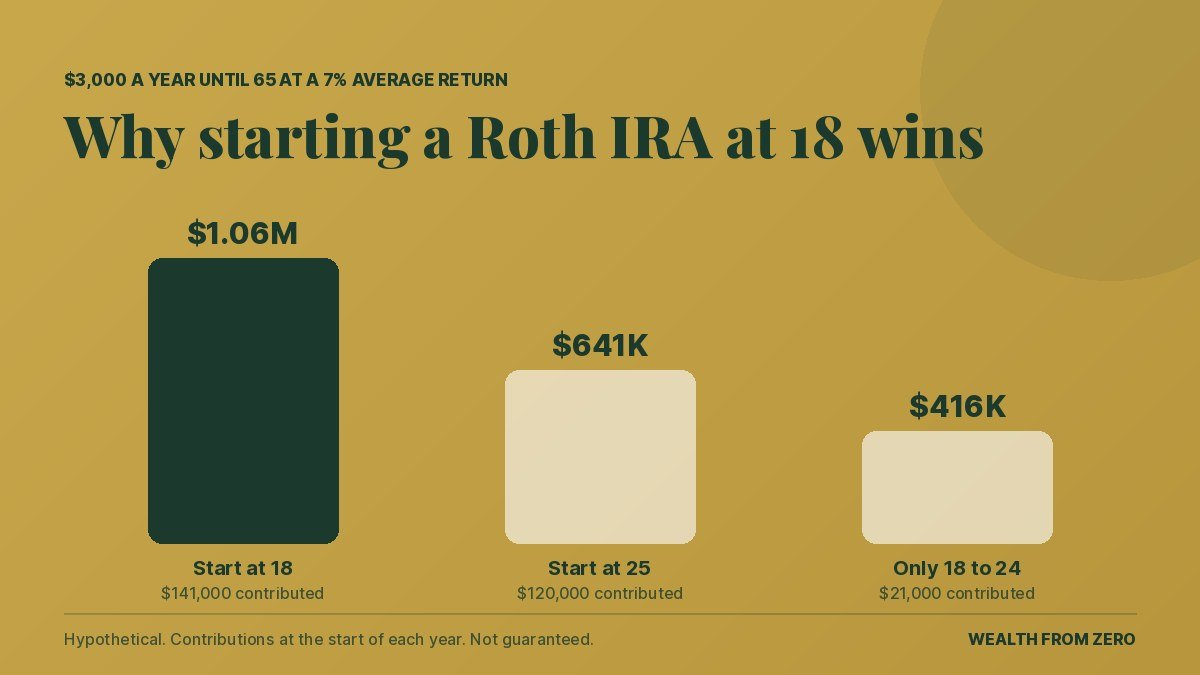
Can you open a Roth IRA at 18? Short answer: yes, you can open a Roth IRA at 18 as long as you have earned income from a job or self-employment. For 2026 you can contribute up to $7,500 or the amount you earned, whichever is less. Starting at 18 instead of 25 is one of the most powerful money moves there is: $3,000 a year from 18 to 65 could grow to about $1.06 million at a 7% average return, versus about $641,000 if you start at 25 — a $416,000 difference for $21,000 more in contributions.
Here’s how a Roth IRA works at 18, the rules that matter, how to open one in about 15 minutes, and what to invest in once the money is there.
Can You Open a Roth IRA at 18?
There’s no minimum age for a Roth IRA. What you need is taxable compensation — wages from a job, tips, or net self-employment income. Allowance, gifts and investment income don’t count. Under IRS contribution rules, your total contributions for the year can’t be more than either the annual limit ($7,500 for 2026) or your earned income for the year.
- Earned $4,000 from a summer job? You can contribute up to $4,000.
- Earned $20,000 working part time? You can contribute up to $7,500.
At 18 you can usually open an account in your own name at most brokerages. In a few states the age of majority is 19 or 21, and under that age the account is opened as a custodial Roth IRA with a parent, who manages it until you take over. The money is still yours.
Someone else can also put money in for you — a parent can “match” your contributions, for example — as long as the total stays within your earned income.
Why a Roth Is Usually the Best Fit at 18
With a Roth IRA you contribute money you’ve already paid tax on, and qualified withdrawals in retirement — including all the growth — are tax-free (IRS: Roth IRAs). At 18, you’re probably in the lowest tax bracket you’ll ever be in, or paying no federal income tax at all. Paying tax now at a low rate to avoid tax on decades of growth later is a very good trade.
What Starting at 18 Can Grow To
Here is $3,000 a year (about $250 a month), invested once a year at the start of the year, until age 65:
| Scenario | You contribute | At a 6% average return | At a 7% average return |
|---|---|---|---|
| Start at 18, keep going to 65 | $141,000 | about $767,000 | about $1,057,000 |
| Start at 25, keep going to 65 | $120,000 | about $492,000 | about $641,000 |
| Contribute only from 18 to 24, then stop | $21,000 | about $275,000 | about $416,000 |
| $1,000 a year from 18 to 65 | $47,000 | about $256,000 | about $352,000 |
The third row is the striking one: seven years of contributions in your late teens and early twenties, then nothing, still grows to hundreds of thousands of dollars, because that money gets more than 40 years to compound. Returns are hypothetical and never guaranteed — markets fall sometimes, and real results will differ. You can test your own numbers with the SEC’s compound interest calculator or our retirement calculator.
How it grows, decade by decade
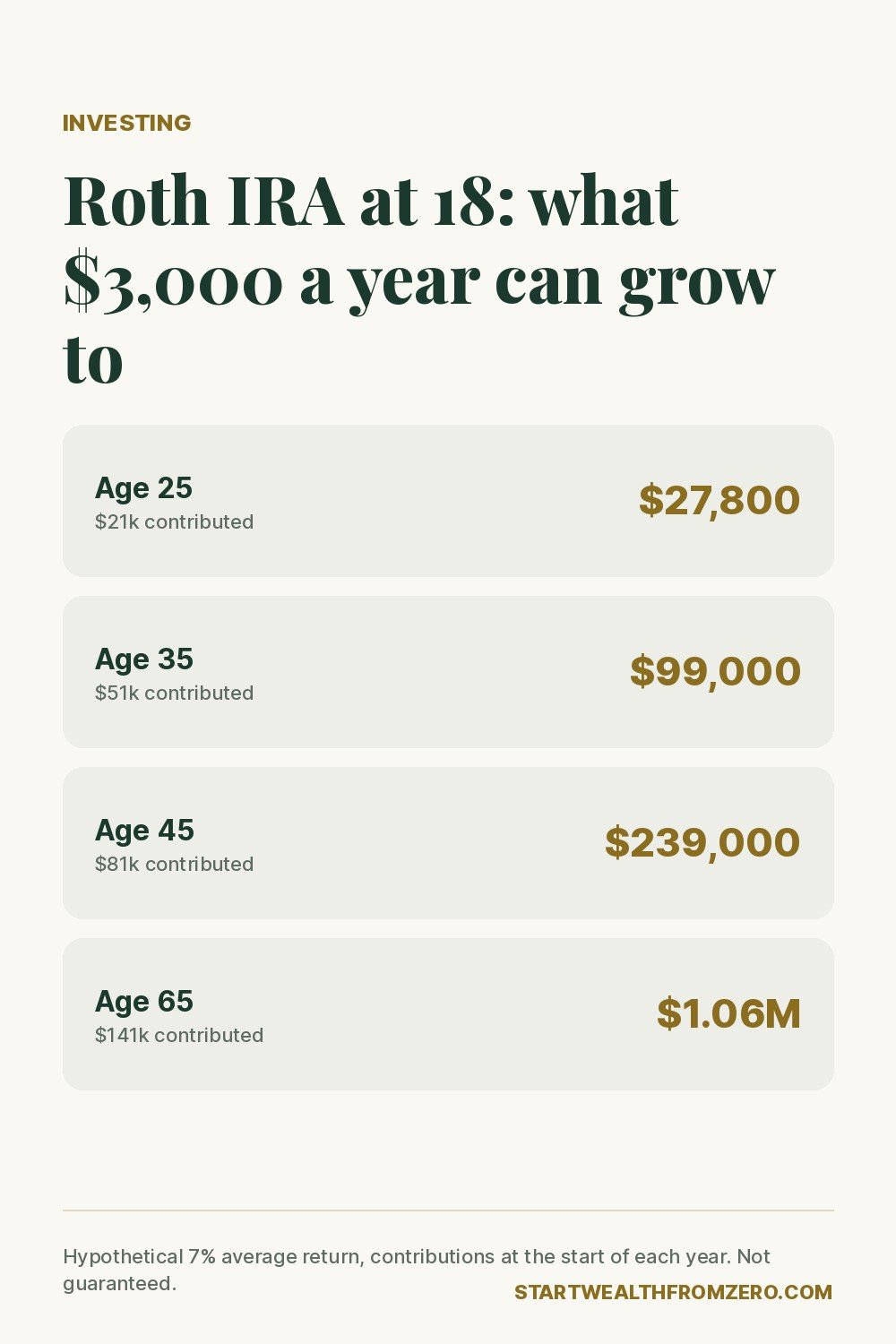
Same $3,000 a year from age 18, at a 7% average return:
| Age | Total contributed | Account value |
|---|---|---|
| 25 | $21,000 | about $27,800 |
| 35 | $51,000 | about $99,000 |
| 45 | $81,000 | about $239,000 |
| 55 | $111,000 | about $515,000 |
| 65 | $141,000 | about $1,057,000 |
For the first several years it looks like a savings account. The growth only takes over later: between 55 and 65 alone, the account adds more than it did in its first 37 years. That’s why the years at 18–25 matter so much — they give your money the longest runway.
Roth IRA vs. leaving it in savings
Same $3,000 a year from 18 to 65:
| Where it sits | Value at 65 | Taxes on the growth |
|---|---|---|
| Roth IRA, invested, 7% average | about $1,057,000 | None on qualified withdrawals |
| High-yield savings, if rates stayed at 4% | about $415,000 | Interest taxed every year |
| Regular savings at 0.5% | about $159,000 | Interest taxed every year |
Savings is still the right place for your emergency fund. The Roth IRA is for money you won’t need for a long time.
The Rules You Need to Know
You can take out your contributions anytime
The dollars you put in (not the growth) can be withdrawn at any time without tax or penalty. That makes a Roth IRA less scary at 18: the money isn’t locked away forever. The growth is different — it’s generally tax-free and penalty-free only after age 59½ and once the account is at least five years old, with some exceptions, such as up to $10,000 for a first home. IRS Publication 590-B has the details.
Contributions for a year can be made until the tax deadline
You can contribute for 2026 until the tax filing deadline in April 2027. That’s useful if you only know your total earnings after the year ends.
Income limits probably won’t affect you
Direct Roth contributions phase out at higher incomes (for 2026, between $153,000 and $168,000 of modified AGI for single filers). At 18, that’s rarely an issue.
How to Open a Roth IRA at 18 (Step by Step)
- Pick a low-cost brokerage with no account minimum and no monthly fee. Large online brokerages all offer Roth IRAs.
- Open a “Roth IRA” — not a regular brokerage account. You’ll need your Social Security number, ID and bank details.
- Link your bank and transfer money. Even $50 is a start.
- Invest the money. This is the step people miss: cash that just sits in the account doesn’t grow much. A simple choice is a single target-date fund for the year you’ll turn about 65, or a broad, low-cost index fund. Our guide to index funds for beginners explains the options.
- Automate it. Set a monthly transfer, even $25–$50, and raise it when your pay goes up.
Example: A $4,000 Summer Job
Jordan is 18 and earns $4,000 from a summer job. Jordan’s income is below the 2026 standard deduction of $16,100, so there’s no federal income tax to pay on it (Social Security and Medicare still apply). Jordan can contribute up to $4,000 to a Roth IRA for the year.
- Jordan keeps $2,000 for spending and an emergency cushion, and puts $2,000 in a Roth IRA invested in a target-date fund.
- Doing that every year until 65 could grow to about $705,000 at a 7% average return.
- Even if Jordan only did it once, that single $2,000 could grow to about $48,000 by 65.
If Jordan needs money for college or an emergency, the $2,000 contributed each year can come back out without tax or penalty — only the growth stays in.
Roth IRA at 18: How Much to Contribute From a Part-Time Job
You can contribute up to 100% of what you earn (capped at $7,500 in 2026), but you don’t have to. Here’s what different savings rates look like on typical first-job earnings:
| Earned this year | Most you can contribute | Save 20% | Save 50% |
|---|---|---|---|
| $3,000 | $3,000 | $600 | $1,500 |
| $6,000 | $6,000 | $1,200 | $3,000 |
| $10,000 | $7,500 | $2,000 | $5,000 |
| $20,000 | $7,500 | $4,000 | $7,500 |
If you live at home and have few bills, putting a large share of a summer job into a Roth IRA is one of the best uses of the money. If you need it for school or a car, even $50 a month builds the habit, and you can always take your contributions back out if you truly need them.
Do You Need to File Taxes for a Roth IRA at 18?
A Roth IRA doesn’t require you to owe tax, only to have earned income. In 2026 a single filer doesn’t pay federal income tax on the first $16,100 of income (the standard deduction), so many 18-year-olds owe little or nothing. You may still want to file a return: it gets back any tax that was withheld and creates a record of your earned income. Keep your W-2s or, if you’re self-employed, records of what you earned, in case you ever need to show the contribution was allowed.
What to Invest In Once Your Roth IRA Is Open
The most common mistake at 18 is opening the account, transferring money and never investing it, so it sits in cash earning very little. After your contribution arrives, buy something:
- A target-date fund for the year you’ll turn about 65 (for example, a 2070 fund). It’s one fund that handles the mix for you.
- A total U.S. stock market or S&P 500 index fund with a low expense ratio, if you’re comfortable with more ups and downs.
- Automatic investing, if your brokerage offers it, so each new contribution is invested without you having to remember.
Our guide to how to start investing explains these options in more detail.
Common Mistakes at 18
- Leaving the money uninvested in the account’s cash setting for years.
- Contributing more than you earned that year. Excess contributions are taxed each year until corrected.
- Skipping the emergency fund. Keep a small cushion in savings first so you’re not tempted to pull money out of the Roth.
- Waiting for “enough” money. Small, early contributions are worth more than larger ones later — that’s the whole point of the table above.
Roth IRA or 401(k) at 18?
If your job offers a 401(k) with an employer match, contribute enough to get the full match first — it’s an instant return. Then the Roth IRA is usually the next best place for your savings. Our Roth IRA vs 401(k) guide covers the full order, and the Roth IRA beginner’s guide goes deeper on how the account works.
Frequently Asked Questions
Can I open a Roth IRA at 18 with no job?
Not with no earned income at all. You need wages or self-employment income for the year, and you can contribute up to that amount (or $7,500 for 2026, whichever is less). Babysitting, lawn care or freelancing can count as self-employment income if it’s reported.
How much should I put in a Roth IRA at 18?
Whatever you can do consistently. $50–$250 a month is a great start. As the table shows, even $1,000 a year from 18 could grow to about $350,000 by 65 at a 7% average return.
Is it better to start a Roth IRA at 18 or 25?
Earlier is better because the money has more time to compound. In our example, starting at 18 instead of 25 adds about $416,000 at 65 for $21,000 more in contributions.
Should I open a Roth IRA or a traditional IRA at 18?
Usually a Roth. A traditional IRA gives you a tax deduction now, but at 18 your income is often taxed at 0% or 10%, so the deduction is worth little. A Roth lets decades of growth come out tax-free later.
Can my parents open a Roth IRA for me?
If you’re under your state’s age of majority, a parent can open a custodial Roth IRA for you. Either way, contributions are limited to what you earned that year.
The Bottom Line
Opening a Roth IRA at 18 is one of the simplest high-impact money moves you can make: if you have earned income, you can contribute up to $7,500 in 2026, invest it in a low-cost fund and let decades of tax-free growth do the work. Start with whatever you can, even a few hundred dollars from a summer job, make sure the money is actually invested, and add to it every year you work.
How We Calculated These Numbers
Growth figures assume equal yearly contributions at the end of each year and a constant hypothetical 7% average annual return, with no withdrawals, fees or inflation adjustment. Real returns vary and are not guaranteed. Contribution limits and the standard deduction are the 2026 figures published by the IRS.
Sources
- IRS: IRA contribution limits
- IRS: Roth IRAs
- IRS Publication 590-B: Distributions from IRAs
- SEC Investor.gov: Compound interest calculator
Projections assume contributions at the start of each year and a constant average return; real returns vary and are not guaranteed. This article is for education, not personal financial or tax advice.