
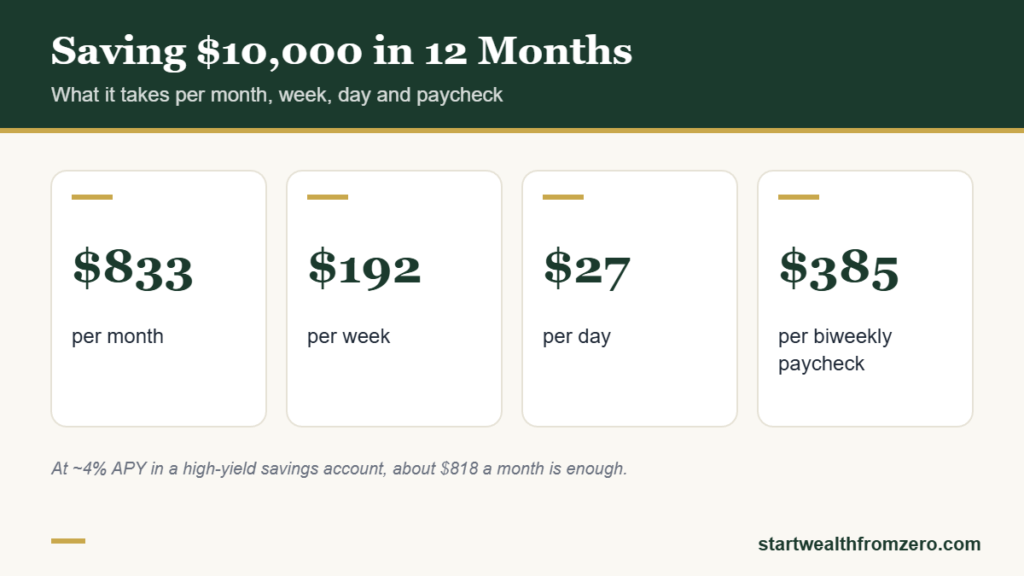
Saving $10,000 in a year sounds like a big number, but broken down it’s a specific, repeatable amount: about $833 a month. Whether that’s comfortable or a stretch depends on your income — so below you’ll find the exact math, how the target compares with different paychecks, and a month-by-month plan to get there.
The same pace also gets you $5,000 in six months, so this plan works for either goal. If you’re starting smaller, our guide to saving $1,000 in 3 months is a good first step.
The Math: How Much to Save for $10,000 in 12 Months
| Per day | Per week | Per biweekly paycheck | Per month |
|---|---|---|---|
| ~$27.40 | ~$192 | ~$385 | ~$833 |
If your savings earn about 4% APY in a high-yield account, interest does a little of the work: you would need roughly $818 a month, and a full year of $833 deposits would grow to about $10,185. Our calculations. Try your own numbers in our Savings Calculator.
What Percentage of Your Pay Is That?
| Monthly take-home pay | $833 as a share of pay | How it usually feels |
|---|---|---|
| $3,000 | ~28% | Very ambitious — needs cuts plus extra income |
| $4,000 | ~21% | Achievable with a tight budget and some cuts |
| $5,000 | ~17% | Realistic for most people with a clear plan |
| $6,000 | ~14% | Comfortable if spending is under control |
A common guideline is to save about 20% of take-home pay (the “20” in the 50/30/20 rule). If $833 is well above 20% of your income, stretch the timeline to 18 or 24 months rather than giving up — see the options further down.
Your 12-Month Plan to Save $10,000
| By the end of… | Total saved | What to focus on |
|---|---|---|
| Month 1 | ~$833 | Open a high-yield account and set up automatic transfers |
| Month 3 | ~$2,500 | Cut your biggest costs; cancel unused subscriptions |
| Month 6 | ~$5,000 | Add a source of extra income if you’re behind |
| Month 9 | ~$7,500 | Put any windfalls (bonus, tax refund) toward the goal |
| Month 12 | ~$10,000 | Decide where the money goes next |
Step 1: Automate $385 Every Payday
Set up an automatic transfer to a separate high-yield savings account for the day your paycheck lands — $385 if you’re paid every two weeks, $417 if you’re paid twice a month, or $833 if you’re paid monthly. Money you never see in your checking account is much harder to spend.
Step 2: Cut Your Three Biggest Costs
Small cuts help, but the fastest progress comes from housing, transportation and food, which make up the bulk of most budgets. For example (your numbers will differ):
| Change | Example monthly saving |
|---|---|
| Add a roommate or move to a cheaper place at renewal | $200–$600 |
| Refinance or sell a car with a high payment; shop your insurance | $100–$300 |
| Meal planning and fewer takeout orders | $100–$250 |
| Cancel unused subscriptions and memberships | $20–$80 |
Our guides on saving money on rent and cutting grocery costs go into each of these in detail.
Step 3: Add $200–$400 a Month in Extra Income
If cuts alone don’t get you to $833, extra income closes the gap faster than further cuts. Overtime, a part-time weekend job, freelancing a skill you already have, or selling items you no longer use can all work. Send every extra dollar straight to the savings account so it doesn’t get absorbed into spending. See our list of ways to make extra money from home.
Step 4: Send Every Windfall to Savings
Tax refunds, work bonuses, cash gifts and rebates can cover weeks or months of saving in one go. Decide in advance that 100% — or at least most — of any windfall goes to the goal.
Step 5: Track Progress Monthly
Check your balance once a month against the plan above. If you’re ahead, great. If you’re behind, look for one more cost to cut or one more source of income — don’t quietly lower the goal. Small course corrections early are much easier than a big catch-up at the end.
Other Timelines: $5,000 in 6 Months, $10,000 in 18 or 24 Months
| Goal | Per month | Per week | Per biweekly paycheck |
|---|---|---|---|
| $5,000 in 6 months | ~$833 | ~$192 | ~$385 |
| $5,000 in 12 months | ~$417 | ~$96 | ~$192 |
| $10,000 in 18 months | ~$556 | ~$128 | ~$256 |
| $10,000 in 24 months | ~$417 | ~$96 | ~$192 |
Figures ignore interest, which would lower them slightly. A longer timeline you actually stick to beats an aggressive one you abandon in month three.
What to Do With Your $10,000
- No emergency fund yet? Keep 3–6 months of essential expenses in savings first. Our Emergency Fund Calculator gives you a target.
- High-interest debt? Paying off credit card balances at 20%+ APR is a guaranteed return.
- Investing for retirement? A Roth IRA allows up to $7,500 in contributions for 2026. See our Roth IRA guide.
- Saving for a specific goal in the next few years (a car, a down payment)? Keep it in a high-yield savings account or short-term CDs rather than the stock market.
Frequently Asked Questions
How much do I need to save each month to have $10,000 in a year?
About $833 a month, or roughly $818 if your savings earn around 4% APY in a high-yield account. That works out to about $192 a week, $27 a day or $385 per biweekly paycheck.
Is saving $10,000 in a year realistic?
It depends mostly on your income and fixed costs. On $5,000 a month take-home it’s about 17% of your pay, which many people can reach with a few cuts. On $3,000 a month it’s nearly 28%, which usually requires both cutting costs and adding income.
What’s the fastest way to save $10,000?
Combine three things: automate a transfer on every payday, cut your biggest fixed costs (housing, transportation and food), and put every windfall — tax refunds, bonuses, side income — straight into savings.
Where should I keep the money while I save?
In a separate FDIC-insured high-yield savings account. Top accounts were paying around 4.0–4.2% APY in September 2026, versus a 0.38% national average (FDIC). At about 4%, saving $833 a month for a year earns roughly $185 in interest.
Should I save $10,000 or pay off debt first?
Keep a small emergency buffer of around $1,000, then prioritize high-interest debt such as credit cards — paying off a 22% APR card is a guaranteed return no savings account can match. After that, build your savings goal.
Sources: FDIC National Rates (national average savings rate, July 2026); Bankrate savings rate surveys (September 2026); IRS 2026 IRA contribution limits. Savings figures are our own calculations.
Disclaimer: This article is for informational purposes only and is not financial advice.