
Your 30s are when retirement saving shifts from “something to start eventually” to the decade that does the heavy lifting. Income is usually higher than in your 20s, and you still have 25 to 35 years for compound growth. Here is exactly what to do, in order, and what the numbers look like.
This guide is US-focused and uses the 2026 IRS contribution limits. For a side-by-side comparison of the two main accounts, see our Roth IRA vs 401(k) guide.
Where You Should Be: Retirement Savings Benchmarks for Your 30s
Fidelity’s widely cited guideline is to have saved about 1× your salary by 30, 2× by 35 and 3× by 40.
| Age | Fidelity Guideline | On a $50,000 Salary | On a $75,000 Salary | On a $100,000 Salary |
|---|---|---|---|---|
| 30 | 1× salary | $50,000 | $75,000 | $100,000 |
| 35 | 2× salary | $100,000 | $150,000 | $200,000 |
| 40 | 3× salary | $150,000 | $225,000 | $300,000 |
These are rules of thumb that assume retirement around 67 and saving about 15% a year. Many people are behind them — what matters most is closing the gap from here. Our Retirement Calculator shows where your current savings and contributions put you.
2026 Retirement Account Contribution Limits
| Account | 2026 Limit (Under 50) | 2026 Limit (50+) | Tax Treatment |
|---|---|---|---|
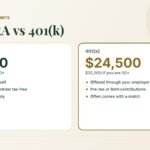
| 401(k), 403(b), most 457 plans | $24,500 | $32,500 ($35,750 at ages 60–63) | Traditional: pre-tax now, taxed later. Roth: taxed now, tax-free later |
| Roth IRA | $7,500 | $8,600 | After-tax contributions; qualified withdrawals tax-free |
| Traditional IRA | $7,500 | $8,600 | May be tax-deductible; taxed on withdrawal |
Roth IRA contributions phase out for single filers with modified adjusted gross income between $153,000 and $168,000 in 2026. Source: IRS retirement contribution limits.
The Order to Save In
- Get the full employer match. If your employer matches part of your 401(k) contributions, that match is an immediate return you won’t get anywhere else.
- Pay off high-interest debt. Credit card balances at 20%+ APR cost more than investments are likely to earn.
- Fund a Roth IRA. Up to $7,500 in 2026 if you’re under the income limit. Tax-free growth is especially valuable with decades ahead.
- Increase your 401(k) contributions. Work toward the $24,500 limit, or at least toward 15% of income in total.
- Invest in a taxable brokerage account once the tax-advantaged options are covered.
What $300, $500 or $800 a Month Grows To by 65
The table below assumes a steady 7% average annual return with monthly contributions — a rough stand-in for a stock-heavy portfolio over long periods. Returns are never guaranteed and will vary year to year.
| Start Age | $300/month | $500/month | $800/month |
|---|---|---|---|
| 30 | ~$540,000 | ~$901,000 | ~$1,441,000 |
| 35 | ~$366,000 | ~$610,000 | ~$976,000 |
| 40 | ~$243,000 | ~$405,000 | ~$648,000 |
Our calculation; figures rounded. Because 7% is closer to a historical after-inflation return for US stocks, you can think of these amounts roughly in today’s dollars. The pattern is the point: starting at 30 instead of 40 with the same $500 a month adds roughly $500,000 — more than double — mostly from extra years of compounding rather than extra contributions.

What to Invest In
With 25+ years to go, most retirement savers in their 30s hold mostly stocks. Two simple options:
- A target-date fund (for example, one labeled 2055 or 2060): a single fund that holds a mix of stocks and bonds and automatically becomes more conservative as the year approaches. Check the expense ratio — low-cost index-based versions are widely available.
- Low-cost index funds: a total US stock market or S&P 500 fund, optionally with an international fund. See our guide to investing in index funds.
Whatever you choose, keep fees low. Over 30 years, the difference between a 0.05% and a 1% annual fee adds up to a meaningful share of your final balance.
If You’re Behind in Your 30s
- Start with the match, then increase by 1% a year. Many 401(k) plans offer automatic annual increases; small steps are easier to stick with.
- Direct part of every raise to retirement before your spending adjusts to it.
- Don’t cash out old 401(k)s when you change jobs. Roll them into your new plan or an IRA to avoid taxes and a 10% early withdrawal penalty.
- Keep a separate emergency fund so a surprise expense doesn’t force you to raid retirement accounts.
Frequently Asked Questions
Is it too late to start saving for retirement at 35?
No. At a 7% average annual return, $500 a month invested from age 35 grows to about $610,000 by 65. Starting at 30 would give about $900,000, so earlier is better — but 35 still leaves three decades of compounding.
How much should I have saved for retirement by 35?
Fidelity’s widely used guideline is about 2× your salary by 35 and 3× by 40. They’re rules of thumb, not requirements — many people are behind them, and the trend of your savings rate matters more than hitting an exact number.
What percentage of my income should I save for retirement in my 30s?
A common target is about 15% of gross income toward retirement, including any employer match. If you started late or want to retire early, aim higher. At minimum, contribute enough to get the full employer match.
Should I choose a Roth or traditional 401(k) in my 30s?
If you expect your income — and tax bracket — to rise over your career, Roth contributions are often attractive because you pay tax now at a lower rate. If you’re already in a high bracket, traditional contributions give you a bigger deduction today. Many people split contributions between both.
What should my retirement money be invested in during my 30s?
With 25–35 years to go, most of it is typically in stocks, through low-cost index funds or a target-date fund. Target-date funds automatically shift toward bonds as the target year approaches, which makes them a simple default.
Sources: IRS 2026 contribution limits (Notice 2025-67); Fidelity retirement savings guidelines; projections are our own calculations.
Sources
- IRS: IRA contribution limits
- IRS: 401(k) contribution limits
- Fidelity: How much do I need to retire? (savings-by-age guideline)
- SEC Investor.gov: Compound interest calculator
Disclaimer: This article is for informational purposes only and is not financial or tax advice. Investment returns are not guaranteed; consult a qualified professional for advice specific to your situation.