
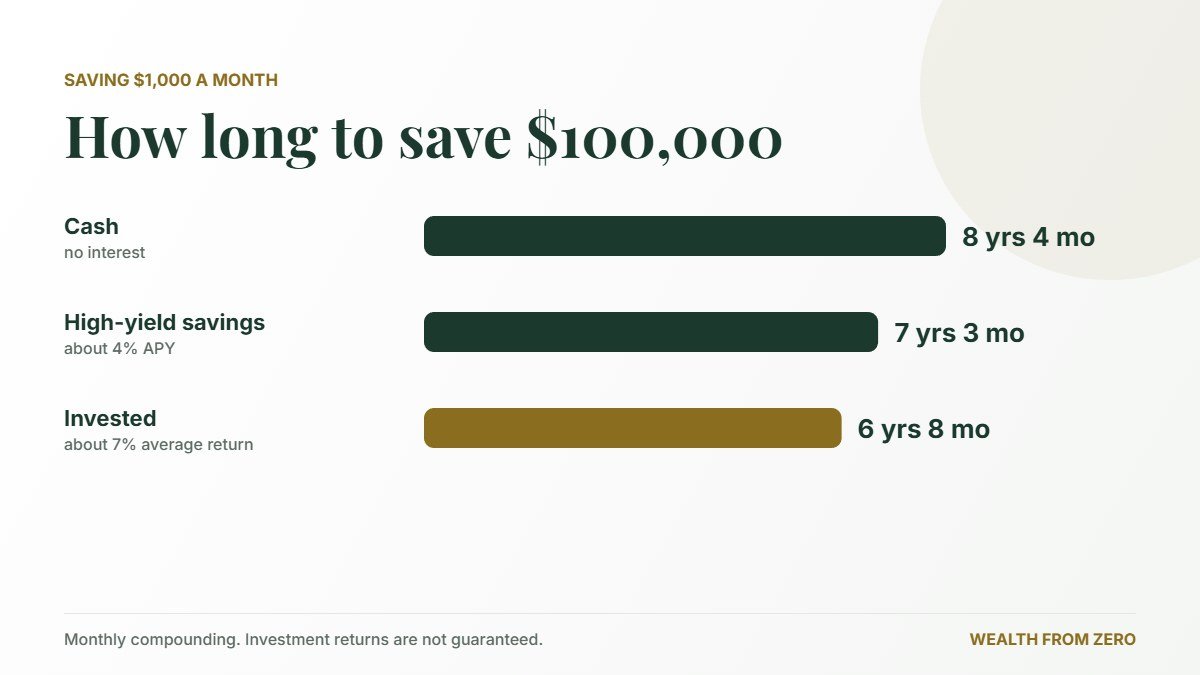
$100,000 is a milestone many people use to mark the point where money starts working for them. How long it takes comes down to two numbers: how much you put away each month, and what that money earns while it waits.
Below you’ll find the full timeline table, what it takes to hit $100,000 in five or ten years, and how to decide between saving and investing. For smaller goals, see our plans for saving $1,000 in 3 months.
How Long It Takes to Save $100,000
| Saved per month | No interest (cash) | ~4% (high-yield savings) | ~7% (long-term investing) |
|---|---|---|---|
| $500 | 16 yrs 8 mo | 12 yrs 10 mo | 11 yrs 1 mo |
| $1,000 | 8 yrs 4 mo | 7 yrs 3 mo | 6 yrs 8 mo |
| $1,500 | 5 yrs 7 mo | 5 yrs 1 mo | 4 yrs 9 mo |
| $2,000 | 4 yrs 2 mo | 3 yrs 11 mo | 3 yrs 9 mo |
| $2,500 | 3 yrs 4 mo | 3 yrs 2 mo | 3 yrs 1 mo |
| $3,000 | 2 yrs 10 mo | 2 yrs 8 mo | 2 yrs 7 mo |
Our calculations: monthly contributions and monthly compounding, before taxes and fees. The 7% rate is roughly the S&P 500’s long-run average after inflation (NYU Stern data, 1928–2025); actual returns vary widely from year to year and are not guaranteed.
The Big Insight: Returns Matter Most When You Save Less
Look at the first and last rows. At $3,000 a month, investing instead of holding cash saves only about three months, because you reach $100,000 before compounding has much time to work. At $500 a month, it saves more than five and a half years — and you contribute about $66,500 of your own money instead of $100,000, with growth covering the rest.
That’s why putting long-term money to work early matters more than waiting until you can save large amounts. You can model your own numbers with our Compound Interest Calculator or the S&P 500 Investment Calculator.
How Much to Save for $100,000 in 5 or 10 Years
| Timeline | No interest | ~4% | ~7% |
|---|---|---|---|
| 5 years | ~$1,667/month | ~$1,510/month | ~$1,400/month |
| 10 years | ~$833/month | ~$680/month | ~$580/month |
Our calculations. Over five years, investment returns are especially unpredictable — a market downturn near the end could leave you short. For a goal with a fixed date, many people shift toward safer options as the date approaches.
Saving vs Investing: Which Should Your $100,000 Plan Use?

- Need the money within about 3–5 years? (a home down payment, a car, a business) Use a high-yield savings account, CDs or Treasury bills. You earn less, but the balance won’t drop. See our comparison of high-yield savings accounts.
- Money for 10+ years from now? (retirement, long-term wealth) Diversified, low-cost index funds have historically grown much faster. Use tax-advantaged accounts first — see our Roth IRA guide.
- Somewhere in between? Many people split: a safe portion for flexibility and an invested portion for growth.
How to Get to Your First $100,000 Faster
- Automate a fixed amount on payday and increase it whenever your income rises.
- Capture every employer 401(k) match — it’s money added to your balance that you didn’t have to save.
- Clear high-interest debt first. Credit card interest works against you faster than savings work for you.
- Keep fees low. A 1% annual fee can cost you years on a long timeline compared with a 0.03% index fund.
- Track your net worth every few months with our Net Worth Calculator to see progress beyond a single account.
Run your own numbers: the SEC’s compound interest calculator on Investor.gov lets you plug in your monthly amount, time frame and an assumed return. Use a conservative rate — returns are never guaranteed — and remember that cash in an FDIC-insured savings account is protected, while invested money can lose value.
Frequently Asked Questions
How long does it take to save $100,000?
It depends on how much you save and where the money sits. At $1,000 a month it takes about 8 years 4 months with no interest, about 7 years 3 months in a savings account earning around 4%, and about 6 years 8 months if invested at a 7% average annual return. At $500 a month, the timelines are roughly 16 years 8 months, 12 years 10 months and 11 years 1 month.
How much should I save a month to reach $100,000 in 5 years?
About $1,667 a month with no interest, roughly $1,510 a month at 4%, or about $1,400 a month at a 7% average return (our calculations). Investment returns are not guaranteed, especially over a period as short as five years.
Should I invest or keep the money in savings?
If you’ll need the money within a few years — for a home down payment, for example — a high-yield savings account or short-term CDs are safer. For long-term goals such as retirement, diversified investments have historically grown faster, but their value can fall sharply in some years.
Why is the first $100,000 considered the hardest?
Because at the start almost all of the growth comes from your own contributions. Once your balance is large, investment returns begin to add meaningful amounts on their own — 7% of $100,000 is $7,000 a year — so later milestones tend to arrive faster.
Sources: NYU Stern historical returns data; FDIC and Bankrate savings rate data (2026). Timelines are our own calculations.
Disclaimer: This article is for informational purposes only and is not financial advice. Investing involves risk, including loss of principal.