Learning how to create a monthly budget that works is one of the most transformative financial skills you can develop. Not because budgeting is complicated — it isn’t. But because most people never do it properly, and the difference between having a budget and not having one is the difference between intentional financial progress and wondering where your money went at the end of every month.
Already know what budgeting is? This guide skips the theory and focuses specifically on the mechanics of building a monthly budget — the exact steps, numbers, and categories you need to set one up this week. If you’re brand new to budgeting, start with our beginner’s guide to budgeting first.
The word “budget” carries negative connotations for many people. It sounds restrictive, joyless, and complicated. But a well-designed monthly budget isn’t a spending prison — it’s a spending plan. It gives you permission to spend on the things that matter to you, a clear framework for saving consistently, and the financial clarity that most people spend their entire lives without.
According to the Bureau of Labor Statistics, the average US household spent about $78,535 in 2024 — roughly $6,545 a month.
This guide walks you through exactly how to create a monthly budget that works — one you’ll actually stick to — in simple, practical steps.

Why Most Budgets Fail
Monthly Budget Methods Compared:
| Method | How It Works | Best For | Effort |
|---|---|---|---|
| 50/30/20 Rule | 50% needs, 30% wants, 20% savings | Beginners wanting simplicity | ⭐ Very Low |
| Zero-Based | Every dollar assigned a job; income − expenses = 0 | People who want full control | ⭐⭐⭐ High |
| Pay Yourself First | Save first, spend the rest | People who struggle to save | ⭐⭐ Low |
| Envelope System | Cash in envelopes per category | Overspenders on variable costs | ⭐⭐ Medium |
Before building a budget that works, it’s worth understanding why most budgets don’t. The most common reasons people abandon their budgets are:
They’re too restrictive. A budget that allows no money for enjoyment, socializing, or personal treats is one that feels punishing rather than empowering. People rebel against financial deprivation the same way they rebel against extreme diets — briefly and dramatically.
They’re based on estimates rather than real numbers. A budget built on what you think you spend, rather than what you actually spend, is built on sand. The numbers won’t add up and the budget won’t reflect reality.
They don’t account for irregular expenses. Annual insurance renewals, car services, birthday gifts, and seasonal costs blow carefully constructed monthly budgets because they weren’t planned for. When the budget “fails,” people abandon it entirely rather than adjusting. Related: save on car insurance.
They require too much ongoing effort. A budget that demands daily tracking and constant attention is unsustainable for most people. The best budgets are simple enough to maintain with minimal effort once set up.
A budget that avoids these pitfalls — based on real numbers, realistic, built around automation, and simple enough to maintain — is one you’ll actually stick to.
Step 1: Calculate Your Real Monthly Income
Start with what actually lands in your bank account each month — your take-home pay after tax and all other deductions. This is your real income, and it’s the only figure that matters for budgeting purposes.
If your income varies month to month — because you’re self-employed, work variable hours, or have multiple income sources — use the average of your last three months as your baseline. If income is genuinely unpredictable, budget based on your lowest recent month to be conservative.
Include all income sources: your main salary, any side hustle income, rental income, freelance earnings, and any other regular money coming in.
Write this number down. Everything else in your budget flows from it.
Step 2: Track Your Actual Spending for One Month
This step is where most budget guides skip straight to giving you categories and percentages. Don’t skip it. Tracking your actual spending for one full month before building your budget is the single most important step in creating a budget that reflects your real life.
Go through your bank statements and credit card bills for the past month and categorize every transaction. Don’t estimate — use the actual numbers.
Organize spending into categories:
Fixed essential expenses (the same amount every month):
- Rent or mortgage
- Car payment
- Insurance premiums
- Loan minimum payments
- Phone bill
- Internet
- Subscriptions
Variable essential expenses (change month to month but necessary):
- Groceries
- Fuel or transport
- Utility bills
- Medical expenses
Discretionary expenses (wants rather than needs):
- Dining out and takeaways
- Entertainment
- Clothing and personal care
- Hobbies and leisure
- Gifts
Irregular expenses (don’t occur every month):
- Annual subscriptions
- Car maintenance
- Vacation costs
- Seasonal expenses
Add up each category. This is your baseline spending — the starting point from which you’ll build your budget.
Step 3: Set Your Savings Target First
Here’s the most important principle of effective budgeting: save first, spend what’s left — not the other way around.
Decide how much you want to save each month before you allocate money to anything else. Treat your savings contribution as a fixed expense — the first and most important bill you pay each month.
Use our Savings Calculator to see exactly how your monthly savings contributions will grow over time and what you’ll have saved in one, five, or ten years. Seeing the long-term impact of consistent saving is one of the most powerful motivators to prioritize it.
A good starting savings target is 20% of take-home income — aligned with the 50/30/20 budget rule. If 20% isn’t currently achievable, start with whatever you can manage and increase it incrementally over time.

Step 4: Allocate Your Remaining Income
With your savings target set, allocate the remaining income across your expense categories. The goal is to assign every dollar of income a specific purpose — so that your income minus all expenses and savings equals zero.
A simple starting framework:
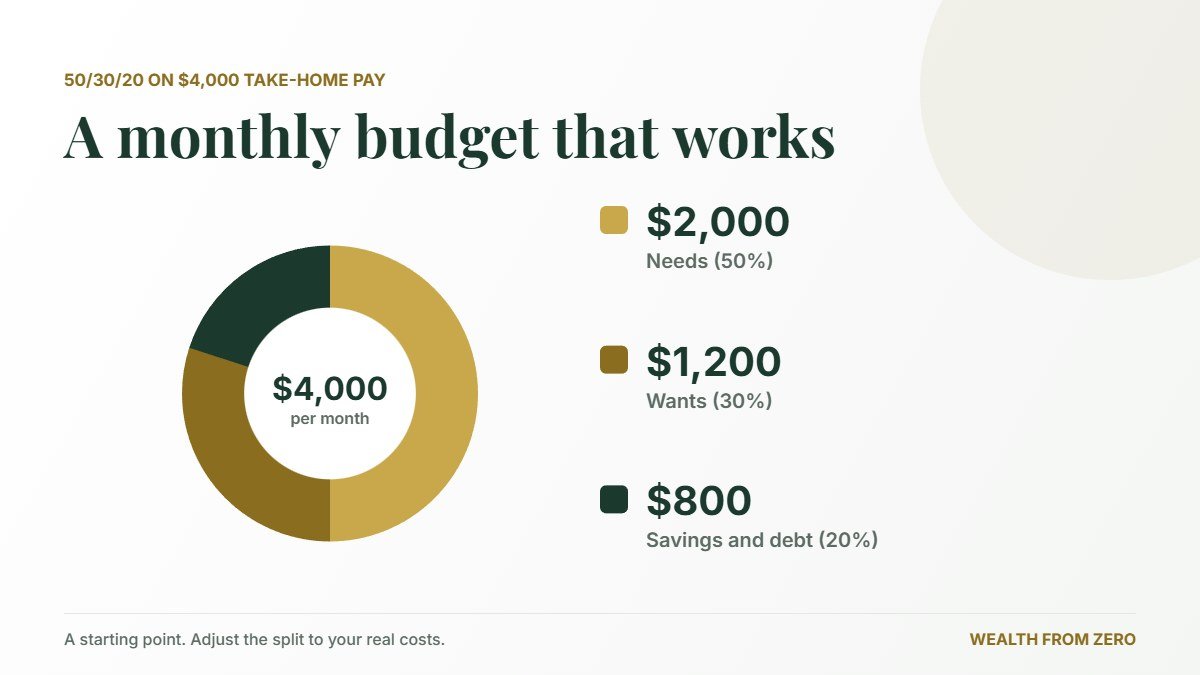
- 50% of take-home income → needs (rent, groceries, transport, utilities, minimum debt payments)
- 30% of take-home income → wants (dining out, entertainment, hobbies, clothing)
- 20% of take-home income → savings and extra debt repayment
Adjust these percentages based on your actual situation. If your essential expenses naturally consume more than 50% of your income — common in expensive cities — reduce the wants allocation rather than the savings allocation. Related: how to lower your utility bills.
Step 5: Plan for Irregular Expenses
This is the step most people miss, and it’s the one that causes more budget failures than any other.
Go through your list of irregular expenses from Step 2 and estimate the annual cost of each. Divide each annual figure by 12 to get a monthly allocation.
For example:
- Annual car insurance: $1,200 → $100/month
- Car maintenance: $600/year → $50/month
- Vacation: $1,500/year → $125/month
- Christmas gifts: $400/year → $33/month
Add these monthly allocations to a dedicated “irregular expenses” or “sinking funds” category in your budget. Transfer this amount to a separate savings account each month. When the irregular expense arrives, the money is already there.
This single step eliminates the most common budget-busting experience: the unexpected but entirely predictable expense that “ruins” the budget.
Step 6: Address Any Budget Gaps
Compare your total planned spending (including savings and irregular expenses) to your monthly income. Three outcomes are possible:
You have a surplus: More income than spending. Direct this surplus toward your highest-priority financial goal — building your emergency fund, paying off debt, or investing.
You break even: Income exactly covers planned spending. This is fine as a starting point, but look for opportunities to reduce expenses or increase income to create a savings surplus.
You have a deficit: Planned spending exceeds income. This is unsustainable and requires action. Look for the largest opportunities to reduce spending — starting with discretionary categories — or strategies to increase income.
If debt repayment is a priority, use our Debt Payoff Calculator to see exactly how extra monthly payments accelerate your debt-free date and reduce the total interest you pay.
Step 7: Automate Everything Possible
The best monthly budget is one that largely runs itself. Automation removes willpower from the equation — the money moves where it’s supposed to go before you have a chance to spend it differently.
Set up automatic transfers on payday for:
- Your monthly savings contribution (to a separate savings account)
- Your irregular expenses allocation (to a dedicated sinking funds account)
- Any extra debt payments above the minimum
With automation in place, the only active management your budget requires is tracking your discretionary spending — the wants category — to ensure you stay within your allocated amount.
Step 8: Track Your Spending Weekly
Even with automation handling savings and fixed expenses, tracking your variable and discretionary spending throughout the month is essential for staying on budget.
You don’t need to track every transaction in real time. A weekly review — spending 10-15 minutes each week checking your bank statement and comparing actual spending to your budget — is sufficient for most people.
Weekly reviews allow you to catch overspending early — when you’ve spent $150 of a $200 dining budget with two weeks still to go — rather than discovering at month-end that you’ve blown every discretionary category.
Step 9: Review and Adjust Monthly
Your first monthly budget won’t be perfect. Some categories will be over-allocated, others under. Some expenses you forgot to include will appear. Your income might be slightly different from your estimate.
Spend 20-30 minutes at the end of each month reviewing your budget against your actual spending. Ask yourself:
- Which categories were accurate?
- Where did you overspend and why?
- Where did you underspend?
- Were there any expenses you forgot to include?
- Did your income match expectations?
Use these insights to adjust next month’s budget. After two or three months of this process, your budget will be closely aligned with your real spending patterns and will require minimal adjustment going forward.
Step 10: Build Your Budget Around Your Values
The most sustainable monthly budgets aren’t built around what you think you should spend money on — they’re built around what you actually value.
If socializing with friends is genuinely important to you, your dining out budget should reflect that rather than being squeezed to the point where you can never go out. If travel is a core priority, your vacation sinking fund should be funded before less meaningful categories.
A budget that aligns with your real values feels empowering rather than restrictive. You’re not saying no to everything — you’re saying yes to the things that matter most and being intentional about everything else.
Common Budgeting Mistakes to Avoid
Setting unrealistic targets. If your current dining out spending is $400 per month, budgeting $50 is setting yourself up to fail. Reduce gradually — aim for $300 this month, $250 next month — rather than making dramatic cuts you won’t maintain.
Ignoring irregular expenses. As discussed above, this is the most common budget-killer. Plan for irregular expenses every month, without exception.
Giving up after one bad month. Everyone has months where the budget doesn’t work out as planned. One bad month doesn’t mean budgeting doesn’t work — it means you’re human. Analyze what happened, adjust, and continue.
Not having a buffer. Include a small miscellaneous category — $50-100 per month — for genuinely unexpected small expenses. This prevents minor surprises from blowing your entire budget.
Monthly Budget Template: Real Example at $4,000 Take-Home Pay
| Category | Budget | % | Notes |
|---|---|---|---|
| Rent/mortgage | $1,200 | 30% | Aim for under 30% of take-home |
| Groceries | $300 | 7.5% | Meal planning cuts this significantly |
| Utilities | $150 | 3.75% | Electric, gas, water, internet |
| Transport | $250 | 6.25% | Car payment or transit pass |
| Insurance | $100 | 2.5% | Health, auto, renter’s |
| Dining out | $150 | 3.75% | Wants category |
| Entertainment | $100 | 2.5% | Streaming, events, hobbies |
| Personal care | $80 | 2% | Haircuts, toiletries |
| Subscriptions | $50 | 1.25% | Review monthly — cancel unused |
| Emergency fund | $200 | 5% | Until 3-6 months expenses saved |
| Investing | $400 | 10% | 401(k) + Roth IRA contributions |
| Debt payoff | $200 | 5% | Above minimums on highest-rate debt |
| Buffer | $120 | 3% | Irregular expenses, car maintenance |
| TOTAL | $4,000 | 100% |
This template is a starting point. Use the Budget Calculator to build your own version with your actual income and expenses.
Frequently Asked Questions
Below are the most common questions people ask about how to create a monthly budget — answered simply and clearly.
How long does it take to create a monthly budget?
The initial setup — tracking one month of spending, categorizing expenses, and setting targets — takes two to three hours. Once set up, maintaining your budget requires approximately 30 minutes per month for review and 10-15 minutes per week for spending tracking.
What’s the best app for budgeting?
Popular options include YNAB (You Need A Budget), Monarch Money and EveryDollar. YNAB is the most hands-on and has a learning curve; others are simpler to set up. Mint, once the best-known free app, shut down in 2024, and most apps now charge a subscription after a free trial. Try a free option first, such as a simple spreadsheet or your bank’s built-in spending tools, before committing to a paid subscription.
Should my partner and I have a joint budget?
If you share expenses with a partner, a joint budget for shared expenses — rent, groceries, utilities — is generally more effective than separate budgets. Many couples maintain both a joint budget for shared costs and individual budgets for personal spending, which provides transparency on shared finances while preserving some individual financial autonomy.
What if my income changes month to month?
Budget based on your lowest expected monthly income. In months where you earn more, direct the additional income toward your highest-priority financial goal — emergency fund, debt repayment, or investments — rather than increasing spending.
How do I stick to my budget when unexpected expenses come up?
This is exactly what your irregular expenses category and emergency fund are for. If you’ve planned for irregular expenses and maintained your emergency fund, most unexpected costs are covered without derailing your budget. For genuinely unexpected large expenses, adjust your budget for that month rather than abandoning it entirely.
If you’re brand new to budgeting, start with our complete beginner’s budgeting guide before setting up your monthly system.