
Learning how to pay off credit card debt fast is one of the most financially urgent skills you can develop. Credit card debt is among the most expensive debt most people carry — with the average APR on accounts charged interest at about 22% in 2026, according to the Federal Reserve — and every month you carry a balance, a significant portion of your payment goes toward interest rather than reducing what you actually owe.
Credit card debt is also psychologically crushing. The combination of high balances, high interest rates, and the feeling of making minimum payments that barely dent the principal creates a sense of hopelessness that can persist for years. Many people feel trapped in credit card debt not because they lack the discipline to pay it off, but because they lack a clear, effective strategy for doing so.
According to the New York Fed’s Household Debt and Credit Report, US household debt reached $18.8 trillion in the second quarter of 2026, including $1.26 trillion in credit card balances.
This guide provides exactly that: a practical, step-by-step plan to pay off credit card debt as fast as possible — even if you’re starting with multiple cards, high balances, and a limited budget.

Why Credit Card Debt Is So Dangerous
Credit Card Debt Payoff Strategies: Compared:
| Strategy | How It Works | Saves Most Interest? | Best For |
|---|---|---|---|
| Avalanche | Extra payments to highest-APR card first | ✅ Yes | Mathematically optimal |
| Snowball | Extra payments to smallest balance first | ❌ Not optimal | Needs motivational wins |
| Balance Transfer | Move debt to 0% APR card (12–21 months) | ✅ Yes — if paid off in time | Good credit, discipline to pay off |
| Debt Consolidation Loan | Single lower-interest loan replaces multiple cards | ✅ Often yes | Multiple high-APR balances |
| Minimum Only | Pay minimums and hope | ❌ Pays maximum interest | Nobody — avoid this |
Before diving into the strategies, it’s worth understanding exactly why credit card debt is so financially destructive.
Credit card interest compounds daily in most cases. This means that interest is calculated on your outstanding balance every single day and added to what you owe. The next day, interest is calculated on the slightly higher balance — including yesterday’s interest charge. This daily compounding makes credit card debt grow significantly faster than most people realize.
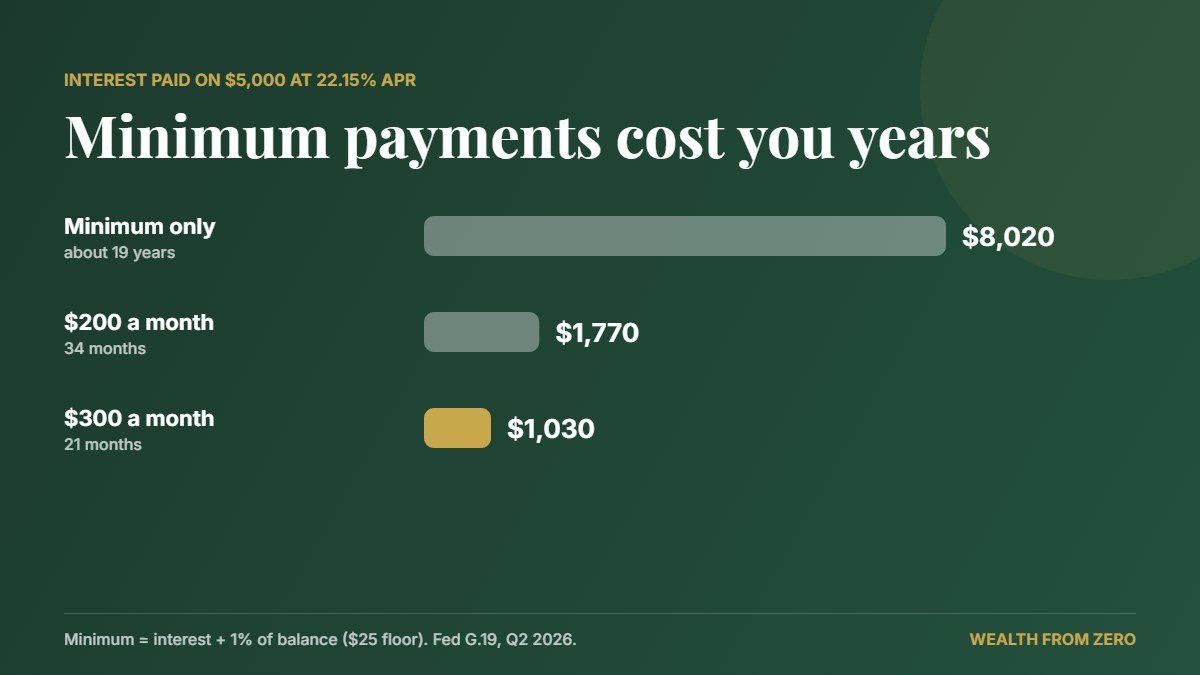
Here is what that looks like with real numbers. The Federal Reserve reports that the average APR on credit card accounts that were charged interest was 22.15% in the second quarter of 2026 (Federal Reserve G.19). Take a $5,000 balance at that rate and compare three ways of paying it:
| Monthly payment | Time to pay off | Total interest paid |
|---|---|---|
| Minimum only (interest + 1% of balance, $25 floor) | About 19 years (228 months) | About $8,020 |
| Fixed $200 per month | 34 months | About $1,770 |
| Fixed $300 per month | 21 months | About $1,030 |
Paying $300 a month instead of the minimum saves roughly $7,000 in interest and gets you out of debt about 17 years sooner. You don’t have to guess your own numbers: under the Credit CARD Act, your monthly statement must show how long it will take to pay off your balance with minimum payments only, and how much you’d pay in total (CFPB). You can also run your own cards through our debt payoff calculator.
The minimum payment trap is real, and escaping it requires a deliberate strategy.
Working with a specific balance? Our breakdown of how to pay off $5,000 in credit card debt shows the exact monthly payment for 6, 12 or 24 months.
Step 1: Stop Adding to Your Debt
This is the most fundamental step and the one most often skipped. You cannot pay off credit card debt effectively while continuing to add to it. Before implementing any payoff strategy, you need to stop using the credit cards that carry balances.
This doesn’t necessarily mean cutting them up or closing the accounts — both of which can affect your credit score. It means removing them from your wallet, deleting them from online shopping accounts, and committing to cash or debit for all purchases until the debt is cleared.
If you’re currently spending more than you earn — which is how most people accumulate credit card debt — you also need to address this gap. Review your spending and identify where cuts can be made to bring your monthly expenses below your monthly income. Without this step, any extra payments toward debt will simply be offset by new charges.
Step 2: Know Exactly What You Owe
Sit down and create a complete picture of your credit card debt. For each card, note:
- The card name and issuer
- The current balance
- The interest rate (APR)
- The minimum monthly payment
- The credit limit
This information is available on your most recent statement or by logging into your account online. Many people avoid doing this because seeing the total is uncomfortable — but you cannot effectively pay off debt you’re not willing to look at clearly.
Once you have this information for all your cards, calculate your total credit card debt. This is your starting point, and knowing it precisely is the foundation of everything that follows.
Step 3: Choose Your Payoff Strategy
There are two primary strategies for paying off multiple credit cards, each with different strengths. Choose the one that best fits your personality and situation.
The Avalanche Method
The avalanche method focuses your extra payments on the card with the highest interest rate first, while making minimum payments on all other cards. Once the highest-rate card is paid off, you redirect all payments to the next highest-rate card, and so on.
The avalanche method is mathematically optimal — it minimizes the total interest you pay and gets you debt-free faster than any other approach. If you’re motivated by numbers and long-term efficiency, this is the right strategy.
Use our Debt Payoff Calculator to see exactly how the avalanche method will work for your specific balances and interest rates, and how quickly you’ll be debt-free with different monthly payment amounts.
The Snowball Method
The snowball method focuses your extra payments on the card with the smallest balance first, regardless of interest rate. Once the smallest balance is cleared, you add those payments to the next smallest balance.
The snowball method is less efficient mathematically but psychologically powerful. Paying off a card completely — even a small one — delivers a tangible win that builds momentum and motivation. Behavioral research on debt repayment suggests many people stick with the snowball method because early victories keep them engaged.
If you’ve struggled with debt payoff in the past and need psychological momentum to stay on track, the snowball method may serve you better despite its higher total interest cost.
Which should you choose? If you’re highly motivated and disciplined, choose the avalanche. If you need early wins to stay engaged, choose the snowball. The best strategy is the one you’ll actually execute consistently.

Step 4: Find Extra Money to Throw at Your Debt
Making only minimum payments will keep you in credit card debt for years. The faster you can direct extra money toward your highest-priority card, the sooner you’ll be debt-free.
Finding extra money to accelerate debt payoff requires looking at both sides of your financial equation: reducing expenses and increasing income.
On the expense side:
Review your budget and identify the largest opportunities for temporary cuts. The goal isn’t permanent deprivation — it’s a focused, time-limited effort to free up as much money as possible for debt repayment. Common targets include dining out, entertainment, subscriptions (as we explored in our guide on how to save money on subscriptions), and any other discretionary spending that can be reduced without significantly affecting your quality of life.
On the income side:
Even a modest increase in income — $200-300 per month from a side hustle, overtime, or selling unused items — can dramatically accelerate your debt payoff timeline. Direct every additional dollar of income straight to your priority debt rather than allowing it to disappear into general spending.
Step 5: Consider a Balance Transfer
If you have good credit, a balance transfer credit card — one that offers 0% interest on transferred balances for a promotional period, typically 12-21 months — can significantly reduce the interest you pay while clearing your debt.
By transferring a high-interest balance to a 0% card, every payment you make goes entirely toward reducing the principal rather than being partially consumed by interest. This can save hundreds or thousands of dollars in interest and accelerate your payoff timeline considerably.
Key considerations for balance transfers:
Transfer fees: Most 0% balance transfer cards charge a transfer fee of 3-5% of the transferred amount. Calculate whether the interest saved outweighs this upfront cost — it usually does for balances above $1,000 transferred to a lengthy 0% period.
The promotional period: You need a realistic plan to pay off the transferred balance before the promotional period ends. When the 0% period expires, the remaining balance typically reverts to a high standard interest rate. Divide the balance by the number of months in the promotional period to determine the monthly payment required.
Don’t use the new card for purchases: Using a balance transfer card for new purchases defeats the purpose. Keep the card solely for the transferred balance.
Step 6: Call Your Card Issuers and Negotiate
This is a step most people never think to take — but it works more often than you’d expect. Call your credit card companies and ask for a lower interest rate.
When you call, explain that you’re committed to paying off your balance and ask if they can reduce your APR. Many issuers will agree, particularly if you have a history of on-time payments. Even a reduction from 24% to 18% APR can save significant amounts in interest over your payoff period.
If you’re genuinely struggling to make payments, ask about hardship programs. Many credit card companies offer temporary interest rate reductions, fee waivers, or modified payment plans for customers experiencing genuine financial difficulty. These programs are not widely advertised but are often available to those who ask.
Step 7: Build a Small Emergency Fund Alongside Debt Payoff
This might seem counterintuitive — why save while paying off high-interest debt? The answer is that without any cash buffer, every unexpected expense goes back onto the credit card, potentially undoing weeks or months of payoff progress.
Before aggressively attacking your credit card debt, build a small emergency fund of $500-1,000 in a separate savings account. Use our Emergency Fund Calculator to work out exactly how long it will take to build this buffer alongside your debt payments.
Once your emergency fund is in place, unexpected expenses — a car repair, a medical bill, an appliance breakdown — can be covered in cash rather than adding to your credit card balance.
Step 8: Track Your Progress and Stay Motivated
Paying off credit card debt is a marathon, not a sprint. Staying motivated over months or years requires actively tracking your progress and acknowledging how far you’ve come.
Create a simple debt tracker — a spreadsheet or even a handwritten chart — showing each card’s balance at the start of each month. Watching balances decrease is genuinely motivating, particularly once the compounding effect of regular extra payments starts to accelerate your progress.
Celebrate milestones: when you pay off your first card, when you reduce your total debt by 25%, when you hit the halfway point. Acknowledging progress reinforces the positive financial behaviors that got you there.
What to Do After Your Credit Card Debt Is Gone
The moment you make your final credit card payment, immediately redirect every payment you were making toward debt into savings and investments. You’ve already proven you can live without that money — now put it to work building wealth.
If you haven’t yet built a full emergency fund of three to six months of expenses, that’s your first priority. Use our Emergency Fund Calculator to set a target and timeline.
After your emergency fund is complete, direct your former debt payments toward investing — index funds, retirement accounts, or any other investment vehicle aligned with your long-term financial goals. The transition from debt repayment to wealth building is one of the most powerful financial moments of a person’s life.
When to Get Outside Help
If your minimum payments already take up more than you can afford, a payoff method alone may not be enough. Two options are worth knowing about, and one to be careful with:
- Nonprofit credit counseling. A counselor reviews your budget and may offer a debt management plan, where you make one monthly payment and the agency pays your cards, often at reduced interest rates negotiated with the issuers. The CFPB explains how debt management plans work.
- Calling your issuer directly. Many issuers have hardship programs that temporarily lower your rate or payment. Ask what is available and get the terms in writing.
- Debt settlement (use caution). Settlement companies typically tell you to stop paying your cards while they negotiate, which can add late fees and damage your credit, and they can’t guarantee results. Read the CFPB’s overview of debt settlement and its risks and the FTC’s guide on how to get out of debt before signing anything.
Frequently Asked Questions
Below are the most common questions people ask about how to pay off credit card debt fast — answered simply and clearly.
How long will it take to pay off my credit card debt?
It depends on your balance, interest rate, and how much extra you can pay each month. Use our Debt Payoff Calculator to get a precise timeline based on your specific situation.
Should I close my credit cards once they’re paid off?
Not necessarily. Closing credit cards reduces your available credit and can lower your credit score by increasing your credit utilization ratio. A better approach is to keep paid-off cards open but unused, or to use them occasionally for small purchases and pay them off in full each month.
Is it better to pay off credit card debt or invest?
If your credit card interest rate is above 7-8%, paying off the debt first almost always makes more financial sense than investing. The guaranteed return of eliminating high-interest debt outpaces the expected return from most investments. Once your high-interest debt is cleared, redirect those payments toward investing. The main exception is an employer 401(k) match: contributing enough to get the full match is usually worth it even while you pay down cards, because the match is an immediate return on your money.
What if I can’t afford the minimum payments?
Contact your credit card issuers immediately and explain your situation. Ask about hardship programs, temporary interest rate reductions, or modified payment plans. If you’re overwhelmed by debt, consider speaking with a non-profit credit counseling organization, which can help you negotiate with creditors and create a manageable repayment plan.
Does paying off credit card debt improve my credit score?
Yes, significantly. Credit card debt affects your credit utilization ratio — the percentage of your available credit that you’re using — which is one of the most important factors in your credit score. Paying down balances reduces your utilization ratio and typically leads to a meaningful improvement in your credit score.
Sources
- Federal Reserve, Consumer Credit (G.19): interest rates on credit card plans, Q2 2026.
- Federal Reserve Bank of New York, Household Debt and Credit Report, Q2 2026.
- Consumer Financial Protection Bureau, repayment disclosures on credit card statements.
- Federal Trade Commission, How To Get Out of Debt.