$500 might not sound like much in the context of investing. You’ve probably seen headlines about people making millions in the stock market, or heard about real estate investors building empires worth tens of millions. Against that backdrop, $500 can feel almost embarrassingly small — hardly worth the effort of doing anything with.
According to S&P Dow Jones Indices’ SPIVA reports, most actively managed US stock funds have trailed their benchmark index over long periods — one reason low-cost index funds are the default choice for many long-term investors.
But here’s the truth that most financial media doesn’t emphasize: every serious investor started somewhere. Warren Buffett bought his first stock at 11 years old with a few hundred dollars. The journey of a thousand miles begins with a single step — and in investing, that first step is more important than almost any subsequent one, because of the irreplaceable value of time. Related: how to invest $1,000 as your portfolio grows.
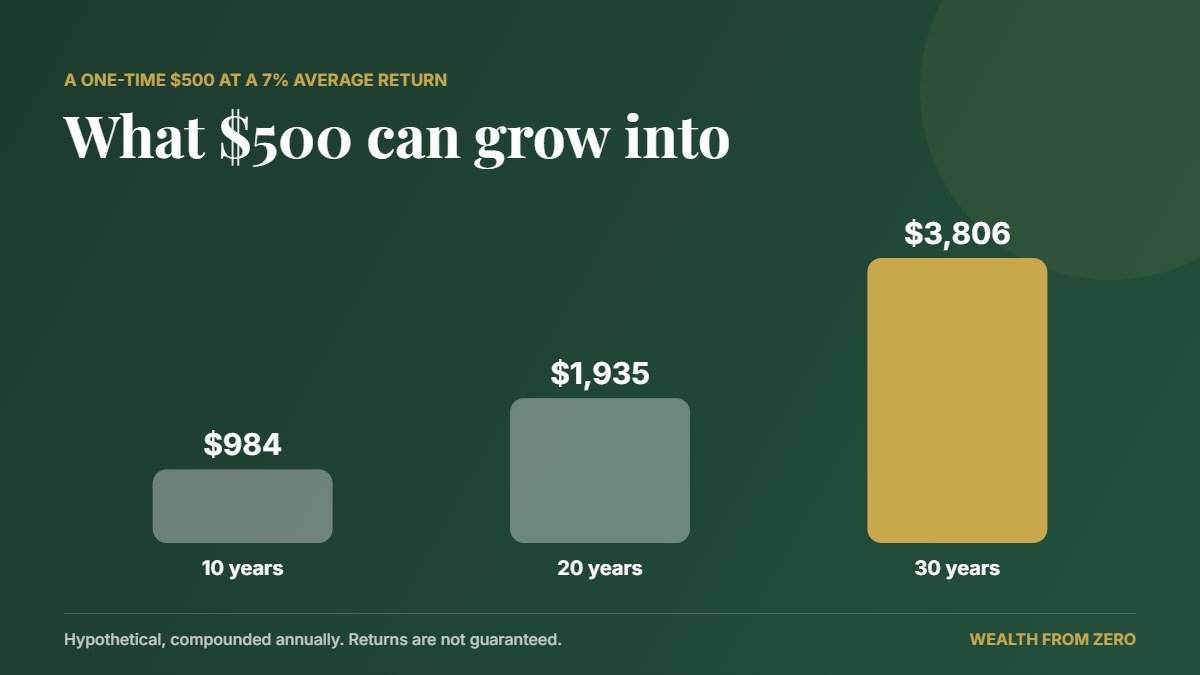
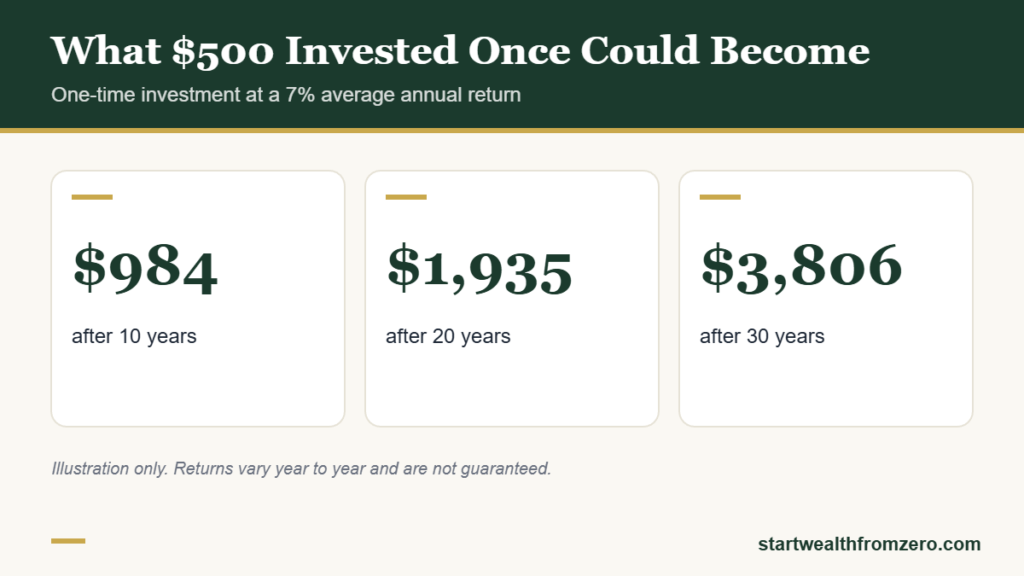
$500 invested today, left alone for 30 years at an average 8% annual return, grows to over $5,000. That same $500 invested 10 years from now grows to just under $2,500. The difference isn’t the amount — it’s when you start. This guide will show you exactly how to invest your first $500 wisely, so that step is taken in the right direction.
Before You Invest: Three Questions to Answer
How to Invest $500: Best Options Compared
| Option | Risk | Expected Return | Liquidity | Best For |
|---|---|---|---|---|
| S&P 500 Index ETF (e.g. VOO) | Medium | ~7–10%/year | High | Long-term wealth building |
| High-Yield Savings Account | None | around 4% APY | Very High | Emergency fund / short-term savings |
| Robo-Advisor (Betterment/Wealthfront) | Low-Medium | 6–8%/year | Medium | Hands-off investing beginners |
| Individual Stocks | High | Varies widely | High | Experienced investors with research time |
| Bonds / Bond ETFs | Low | 3–5%/year | Medium | Conservative investors |
| REITs | Medium | 4–8%/year + dividends | High | Real estate exposure without buying property |
Want to see what $500 invested monthly could grow into? Use our Compound Interest Calculator — enter $500 as starting amount, add your monthly contribution, and see the power of compounding over 10–30 years.
Before putting $500 into any investment, answer these three questions honestly:
Do you have an emergency fund?
If you don’t have at least $500-1,000 in a readily accessible savings account for unexpected expenses, that should come first. Investing money you might urgently need means you could be forced to sell at the worst possible time — potentially at a loss — to cover an emergency. Your emergency fund and your investment portfolio serve different purposes and shouldn’t be confused.
Do you have high-interest debt?
If you have credit card debt or other high-interest loans, paying these off before investing is almost always the better financial decision. A credit card charging 20% interest is a guaranteed 20% return when you pay it off — which no investment can reliably match over the short term.
Is this money you won’t need for at least three to five years?
Investing is a long-term activity. Markets go up and down in the short term, and if you need this money within the next few years, you might be forced to sell at a loss during a downturn. Only invest money you genuinely won’t need for three to five years minimum.
If you’ve answered yes to the emergency fund question, no to the high-interest debt question, and yes to the long-term horizon question — you’re ready to invest. Here’s where to put your first $500.
Option 1: A Roth IRA
Before deciding where to invest, decide which account to invest through. This distinction matters enormously for your long-term returns.
In the United States, a Roth IRA is one of the best investment accounts available to most people. You contribute after-tax money, and all future growth and withdrawals in retirement are completely tax-free. On a $500 investment that grows to $5,000 over 30 years, that’s $4,500 of growth you’ll never pay tax on.
Both accounts can hold a wide range of investments including index funds, ETFs, and individual stocks. Opening one of these tax-advantaged accounts as your first investment account is almost always the right move — the tax savings over a long investment horizon are significant.
Popular platforms for opening a Roth IRA in the US include Fidelity, Vanguard, and Charles Schwab.
Option 2: A Low-Cost S&P 500 Index Fund
Once you’ve chosen your account type, the next question is what to invest in. For most first-time investors with $500, the answer is straightforward: a low-cost index fund tracking the S&P 500 or a total stock market index.
An S&P 500 index fund gives you exposure to the 500 largest companies in the United States — Apple, Microsoft, Amazon, Google, Berkshire Hathaway, and hundreds more — in a single, diversified investment. When these companies collectively grow in value, so does your investment.
The historical average annual return of the S&P 500 is approximately 10% before inflation and 7% after inflation. No other asset class has consistently delivered similar returns over long periods. And because index funds simply track the market rather than trying to beat it, their fees are extremely low — often 0.03-0.10% per year.
Some excellent S&P 500 index funds and ETFs for beginners include:
- Vanguard S&P 500 ETF (VOO) — expense ratio 0.03%
- iShares Core S&P 500 ETF (IVV) — expense ratio 0.03%
- Fidelity 500 Index Fund (FXAIX) — expense ratio 0.015%
- Schwab S&P 500 Index Fund (SWTSX) — expense ratio 0.02%
With $500, you can buy fractional shares of any of these funds through most modern investment platforms, meaning you don’t need to have enough for a full share to get started.
Option 3: A Total World Stock Market Fund
If you want even broader diversification than the S&P 500 — which is US-only — a total world stock market fund gives you exposure to thousands of companies across developed and emerging markets worldwide.
This means your investment isn’t entirely dependent on the performance of the US economy. If US markets underperform for a period while international markets outperform, a world fund captures both.
Popular total world market funds include:
- Vanguard Total World Stock ETF (VT)
- iShares MSCI World ETF
The trade-off is slightly higher fees than pure US index funds and historically slightly lower returns, since the US stock market has outperformed international markets over most long periods. But for diversification-minded investors, a world fund is an excellent choice.
Option 4: A High-Yield Savings Account
If you’re not comfortable with investment risk or if your time horizon is shorter than three to five years, a high-yield savings account is a legitimate use of $500. In a higher interest rate environment, savings accounts can offer 4-5% annual returns with zero risk to your capital.
While savings account returns won’t match long-term stock market returns, they’re significantly better than leaving money in a standard checking account earning near-zero interest. And for money you might need within the next few years, the guaranteed return and capital protection of a savings account is more appropriate than the volatility of stock market investment.
High-yield savings accounts in the US include those offered by Marcus by Goldman Sachs, Ally Bank, and American Express.
Option 5: Fractional Shares of Individual Stocks
With $500, you can also buy fractional shares — partial shares — in individual companies you believe in. Platforms like Robinhood, Freetrade, and Trading 212 allow you to buy $1 or more of any stock, regardless of the full share price.
This means $500 could be spread across fractional shares of Apple, Microsoft, Tesla, and Amazon — giving you exposure to some of the world’s largest companies without needing thousands of dollars to buy full shares.
The caveat is that individual stock investing is riskier than index funds. A single company can dramatically underperform or even fail, whereas an index fund spreading across 500 or thousands of companies is protected by diversification. For most first-time investors, index funds are a better starting point than individual stocks.
If you do want to invest in individual stocks, limit this to a small portion of your portfolio — perhaps $100 of your $500 — and put the rest in diversified index funds.
Option 6: A Robo-Advisor
If the idea of choosing your own investments feels overwhelming, robo-advisors offer a hands-off alternative. A robo-advisor is an automated investment platform that creates and manages a diversified portfolio on your behalf based on your risk tolerance and investment goals.
You answer a series of questions about your financial situation and goals, and the platform automatically builds and manages a portfolio of index funds and ETFs tailored to your profile. Rebalancing — the process of maintaining your target asset allocation as markets move — is handled automatically.
Popular robo-advisors include Betterment and Wealthfront. Fees are typically 0.25-0.75% per year — higher than managing your own index fund portfolio but lower than traditional financial advisors, and with the significant advantage of removing the need for active decision-making.
For true beginners who find the investment landscape confusing and want a simple, automated solution, a robo-advisor is an excellent starting point.
How to Actually Get Started: A Step-by-Step Summary
Knowing your options is one thing. Actually taking action is another. Here’s a concrete step-by-step plan to invest your first $500 today:
Step 1: Choose your account type. If you’re not yet contributing to a Roth IRA, start there.
Step 2: Choose your platform. For DIY investing, Vanguard, Fidelity or Charles Schwab are all reputable starting points.
Step 3: Complete the account opening process. This typically takes 10-15 minutes online and requires your personal details, tax information, and bank account details.
Step 4: Transfer your $500. Most platforms allow bank transfers, which typically take 1-3 business days.
Step 5: Choose your investment. For most first-time investors, a low-cost S&P 500 index fund or total world market fund is the right starting choice. Search for your chosen fund by name or ticker symbol within your platform.
Step 6: Place your first investment. Enter the amount you want to invest ($500) and confirm the transaction. You’re now an investor.
Step 7: Set up a regular contribution. Even $50-100 per month added to your investment account will compound significantly over time. Set up an automatic monthly transfer so investing becomes a habit rather than a decision.
What to Do After Your First Investment
Once your $500 is invested, the most important thing to do is very little. Don’t check your portfolio every day. Don’t panic when the market drops — and it will drop, sometimes significantly. Don’t sell because you’re worried about short-term volatility.
Long-term investing success comes from staying invested through market ups and downs, not from trying to time the market. The investors who earn the best long-term returns are often those who invest consistently and then largely ignore their portfolios between annual reviews.
Set a reminder to review your portfolio once per year. Check that your investment still aligns with your goals and risk tolerance. If you have additional savings, add them to your portfolio. Otherwise, let compound interest work undisturbed.

The Bottom Line
$500 is enough to start investing seriously. It’s enough to open a Roth IRA, buy a diversified index fund, and set the compounding process in motion. It’s enough to build a habit that, sustained over years and decades, leads to genuine financial security.
The most important investment decision you’ll ever make is the first one — because it’s the decision to start. Don’t wait until you have more money, more knowledge, or more confidence. Start with $500. Add to it consistently. Leave it alone to grow.
Your future self — decades from now, with a portfolio worth far more than you can currently imagine — will thank you for starting today.
Frequently Asked Questions
Below are the most common questions people ask about how to invest 500 dollars.
Below are the most common questions people ask about how to invest 500 dollars.
Is $500 enough to start investing?
Absolutely. $500 is a perfectly solid amount to begin investing. Many platforms allow you to start with even less through fractional shares. The amount matters far less than starting — $500 invested consistently and left to grow will build meaningful wealth over time.
What is the best way to invest $500 for a beginner?
For most beginners, a low-cost S&P 500 index fund or ETF is the best starting point. It gives you instant diversification across 500 of the largest US companies, historically strong long-term returns, and extremely low fees. Platforms like Fidelity, Schwab, or Vanguard make it straightforward to get started.
Should I put $500 in a savings account or invest it?
It depends on your situation. If you don’t have an emergency fund yet, put it in a high-yield savings account first. If you already have 3-6 months of expenses saved, investing the $500 in a low-cost index fund will likely generate better long-term returns than any savings account.
Can I lose my $500 by investing it?
Yes, in the short term. Markets go up and down, and your investment can decrease in value temporarily. However, broad market index funds have historically recovered from every downturn and delivered positive returns over long periods. The key is not to panic sell during downturns.
How long should I leave $500 invested?
The longer the better. Investing works best as a long-term strategy — ideally 5 years minimum, with 10-20+ years being optimal. If you might need the money within 1-2 years, keep it in a high-yield savings account instead.
What should I do after investing my first $500?
Set up a recurring monthly contribution — even $50 or $100 per month. Consistent investing over time, known as dollar-cost averaging, builds far more wealth than a one-time lump sum. Your first $500 is the foundation — keep adding to it regularly.
Once you’ve invested your first $500, the key is consistency. Learn how to scale up with our complete beginner’s investing guide, or explore dividend stocks for passive income.