How rising interest rates affect your savings in 2026 is one of the most important financial questions you can be asking right now. Interest rates have a profound and direct impact on virtually every aspect of your personal finances — from how much your savings earn to how much your debt costs — and understanding this relationship puts you in a significantly stronger position to make smart financial decisions.
The good news for savers is that rising interest rates are generally positive. After years of near-zero interest rates that made saving feel almost pointless, higher rates mean your money can finally work meaningfully harder for you. The bad news is that the same rising rates that benefit savers hurt borrowers — making mortgages, car loans, and credit card debt more expensive.
This guide explains exactly how rising interest rates affect each area of your personal finances in 2026 and what specific actions you should take right now to make the most of the current rate environment.
What Are Interest Rates and Who Sets Them?
Interest rates are the cost of borrowing money — or conversely, the reward for saving it. When you deposit money in a savings account, the bank pays you interest for the use of your money. When you borrow money through a mortgage or credit card, you pay the lender interest for the use of theirs.
Central banks — the Federal Reserve in the United States, the Bank of England in the UK, and the European Central Bank in the Eurozone — set a benchmark interest rate that influences the rates offered by commercial banks throughout the economy.
When a central bank raises its benchmark rate, commercial banks typically raise both their lending rates (making borrowing more expensive) and their savings rates (making saving more rewarding). When the benchmark rate falls, the opposite happens.
According to the Federal Reserve, interest rate decisions are made based on economic conditions — primarily inflation and employment data. When inflation is high, central banks raise rates to cool economic activity and bring prices back under control.
High Yield Savings Accounts
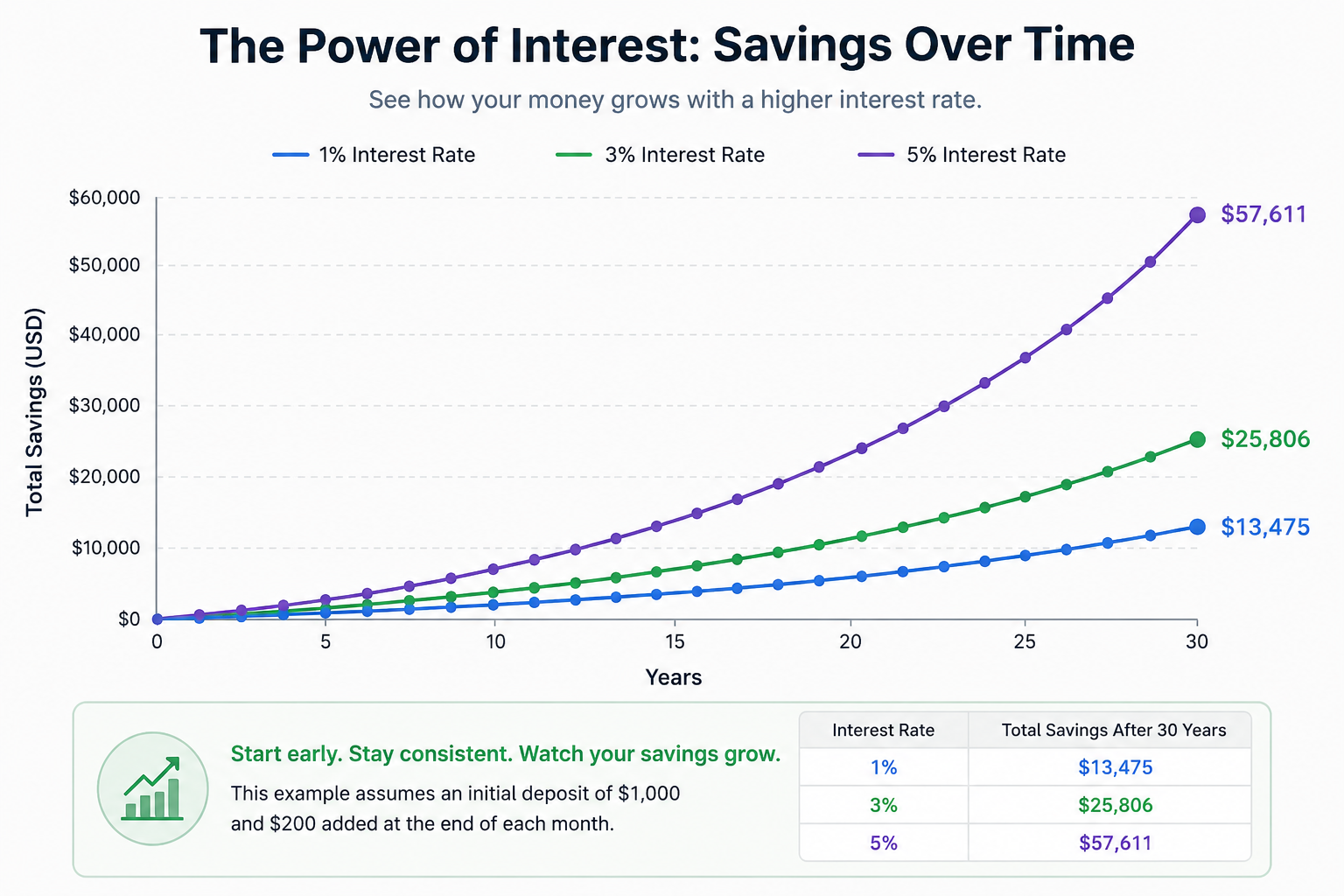
The most immediate and direct benefit of rising interest rates for savers is higher returns on savings accounts. As central bank rates rise, commercial banks compete for deposits by offering more attractive savings rates.
In a low interest rate environment, a typical high yield savings account might offer 0.5-1% APY. In a higher rate environment, the same type of account might offer 4-5% APY — a dramatically better return on your cash savings.
The difference is significant in practice. Consider $10,000 in savings:
| Interest Rate | Annual Interest Earned | 5-Year Total Interest |
|---|---|---|
| 0.5% APY | $50 | $253 |
| 2.0% APY | $200 | $1,041 |
| 4.0% APY | $400 | $2,166 |
| 5.0% APY | $500 | $2,763 |
At 5% APY versus 0.5% APY, you earn $450 more per year — purely from choosing the right savings account. Over five years, that difference compounds to over $2,500 in additional interest on a $10,000 balance.
What to do: If your savings are still sitting in a low-interest current account or a standard savings account, move them to a high yield savings account immediately. Use our Savings Calculator to see exactly how much more your savings could earn at current rates.
Fixed Rate Bonds and Certificates of Deposit
Rising interest rates also improve returns on fixed-rate savings products — bonds and certificates of deposit (CDs) in the US, fixed-rate bonds in the UK. These products lock your money away for a set period (typically 1-5 years) in exchange for a guaranteed interest rate.
In a rising rate environment, fixed-rate products can offer excellent returns — sometimes exceeding those of easy access accounts. The trade-off is that your money is locked away for the fixed term, so timing matters. If you lock in a rate today and rates continue to rise, you’ll miss out on higher rates later.
| Fixed Term | Typical Rate (Rising Rate Environment) |
|---|---|
| 6 months | 4.5-5.0% |
| 1 year | 4.8-5.3% |
| 2 years | 4.5-5.0% |
| 3 years | 4.2-4.8% |
| 5 years | 4.0-4.5% |
What to do: Consider a laddering strategy — spreading your savings across fixed-rate products with different maturity dates. For example, putting equal amounts in 1-year, 2-year, and 3-year bonds means you always have a portion maturing soon, giving you flexibility while still earning competitive fixed rates.
Emergency Fund Returns
One underappreciated benefit of rising interest rates is that your emergency fund — which should always be kept in a safe, accessible account — now earns meaningful interest while sitting idle.
Previously, a $10,000 emergency fund in a savings account earning 0.5% generated just $50 per year — barely noticeable. At 4.5%, the same fund generates $450 per year in completely passive interest income. Your financial safety net is now also a modest income generator.
Use our Emergency Fund Calculator to ensure your emergency fund is the right size, then move it to a high yield savings account to take full advantage of current rates.
Credit Card Debt
Credit card interest rates are typically variable and closely linked to the central bank benchmark rate. When rates rise, credit card APRs rise too — often within one or two billing cycles.
If you’re carrying a credit card balance, rising rates mean you’re paying more interest on that balance every month. A $5,000 credit card balance at 20% APR costs $1,000 per year in interest. At 25% APR — possible in a high rate environment — the same balance costs $1,250 per year.
What to do: Paying off credit card debt becomes even more urgent in a rising rate environment. Use our Debt Payoff Calculator to create an aggressive payoff plan. Every month you carry a high-interest balance in a rising rate environment costs you more than it did the month before.
As we covered in our guide on how to pay off credit card debt fast, the avalanche method — targeting the highest interest rate debt first — is particularly effective in a rising rate environment.

Mortgages
The impact of rising interest rates on mortgages depends on whether your mortgage is fixed or variable rate.
Fixed-rate mortgages are unaffected by rate rises for the duration of the fixed term. If you locked in a low fixed rate before rates rose, you’re protected — your payments remain the same regardless of what happens to market rates.
Variable or tracker mortgages rise and fall directly with the central bank rate. A 1% increase in the base rate translates directly to higher monthly mortgage payments. On a $200,000 variable rate mortgage, a 1% rate increase adds approximately $100-120 per month to your payment — $1,200-1,440 per year.
| Mortgage Balance | Rate Increase | Additional Monthly Payment | Additional Annual Cost |
|---|---|---|---|
| $150,000 | +1% | +$75 | +$900 |
| $200,000 | +1% | +$100 | +$1,200 |
| $300,000 | +1% | +$150 | +$1,800 |
| $400,000 | +1% | +$200 | +$2,400 |
What to do: If you’re on a variable rate mortgage and rates are rising, investigate whether fixing your rate makes sense. Speak with a mortgage broker to compare available fixed-rate deals against your current variable rate, factoring in any early repayment charges on your existing deal.
Student Loans
The impact of rising rates on student loans depends on whether your loans are fixed or variable rate, and whether they’re federal or private (in the US).
Federal student loans in the US have fixed interest rates set at the time of borrowing, so existing federal loans are unaffected by rate changes. New federal loans issued each academic year are priced based on current market rates, so students taking out new loans in a rising rate environment will pay higher rates than those who borrowed when rates were lower.
Private student loans are often variable rate and therefore rise with market rates.
Stock Market
The relationship between interest rates and stock markets is complex, but the general pattern is that rising rates create headwinds for stocks — particularly for growth-oriented companies whose future earnings are worth less in present value terms when discount rates are higher.
However, the relationship is not consistent or predictable in the short term. Markets are driven by many factors beyond interest rates, and periods of rising rates have historically been accompanied by both rising and falling stock markets depending on broader economic conditions.
For long-term index fund investors, the appropriate response to rising rates is the same as always: stay invested, keep contributing regularly, and ignore short-term volatility. As we explored in our guide on how to invest in index funds for beginners, time in the market consistently beats timing the market.
Frequently Asked Questions
Below are the most common questions people ask about how rising interest rates affect your savings — answered simply and clearly.
Are rising interest rates good or bad for my finances overall?
It depends on your financial situation. If you’re primarily a saver with little debt, rising rates are generally positive — your savings earn more. If you carry significant variable-rate debt, rising rates increase your costs. Most people are both savers and borrowers, so the net impact depends on the balance between your savings and debt.
Should I fix my savings rate now or wait for rates to rise further?
Predicting future interest rate movements is impossible even for professional economists. Rather than trying to time rates perfectly, a laddering strategy — spreading savings across different fixed terms — provides a reasonable middle ground between locking in current rates and maintaining flexibility.
Will rising interest rates cause a recession?
Central banks raise rates specifically to slow economic growth and reduce inflation — so there is always a risk that rates rise too far and tip the economy into recession. However, predicting recessions is notoriously difficult, and the appropriate personal finance response to recession risk is the same regardless: maintain your emergency fund, reduce high-interest debt, and stay invested for the long term.
How do I find the best savings rates available right now?
Comparison sites like NerdWallet in the US and MoneySavingExpert in the UK provide regularly updated lists of the best available savings rates. Check these sites before opening any new savings account to ensure you’re getting the most competitive rate currently available.
Should I change my investment strategy because of rising rates?
For long-term investors with a horizon of 10+ years, no significant strategy change is warranted. Continue regular index fund contributions, maintain your target asset allocation, and resist the temptation to make dramatic portfolio changes based on short-term rate movements.
Disclaimer: This article is for informational purposes only and does not constitute financial advice.