

Retiring early isn’t just for tech millionaires. With the right savings rate and investment strategy, it’s achievable on a normal salary — it just requires starting sooner than most people do. The Social Security Administration’s retirement planner shows that delaying retirement by even 5 years dramatically changes your financial security. Here’s how to flip that equation and retire on your terms.
Below we break down the math behind early retirement, the savings rates it takes and the accounts to use.
But here’s what those people don’t know: early retirement on a normal salary is not only possible, it’s being achieved right now by thousands of ordinary people around the world through a movement known as FIRE — Financial Independence, Retire Early.
This guide will explain exactly what FIRE is, how it works mathematically, what you need to do to pursue it, and how to make it realistic even if you’re starting from scratch on an average income.
What Is the FIRE Movement?
| FIRE Number (25× expenses) | Annual Expenses | Monthly Expenses | Savings Rate Needed |
|---|---|---|---|
| $500,000 | $20,000 | $1,667 | 50%+ on avg income |
| $750,000 | $30,000 | $2,500 | 40–50% on avg income |
| $1,000,000 | $40,000 | $3,333 | 30–40% on avg income |
| $1,250,000 | $50,000 | $4,167 | 25–35% on avg income |
FIRE stands for Financial Independence, Retire Early. The core idea is simple: if you save and invest aggressively enough, you can accumulate a portfolio large enough that investment returns cover your living expenses indefinitely — meaning you no longer need to work for money.
The movement gained mainstream attention after the 2010 publication of a blog called Mr. Money Mustache, written by a Canadian engineer who retired at 30. Since then, thousands of people have documented their own journeys to financial independence online, demonstrating that early retirement isn’t limited to a lucky few.
FIRE isn’t about deprivation or living in poverty. It’s about being intentional with money, prioritizing financial independence over lifestyle consumption, and buying back your time while you’re still young enough to enjoy it.
The Mathematics of Early Retirement
To understand how FIRE works, you need to understand two key concepts: the savings rate and the 4% rule.
The Savings Rate
Your savings rate is the percentage of your income that you save and invest. It’s the single most powerful variable in determining how quickly you can reach financial independence.
Here’s the key insight that most people miss: your savings rate determines both how quickly you accumulate wealth and how little you need to accumulate. If you spend 90% of your income and save 10%, you need to replace 90% of your income in retirement — and you’re saving very slowly. If you save 50% of your income, you only need to replace 50% of your income in retirement — and you’re saving much faster.
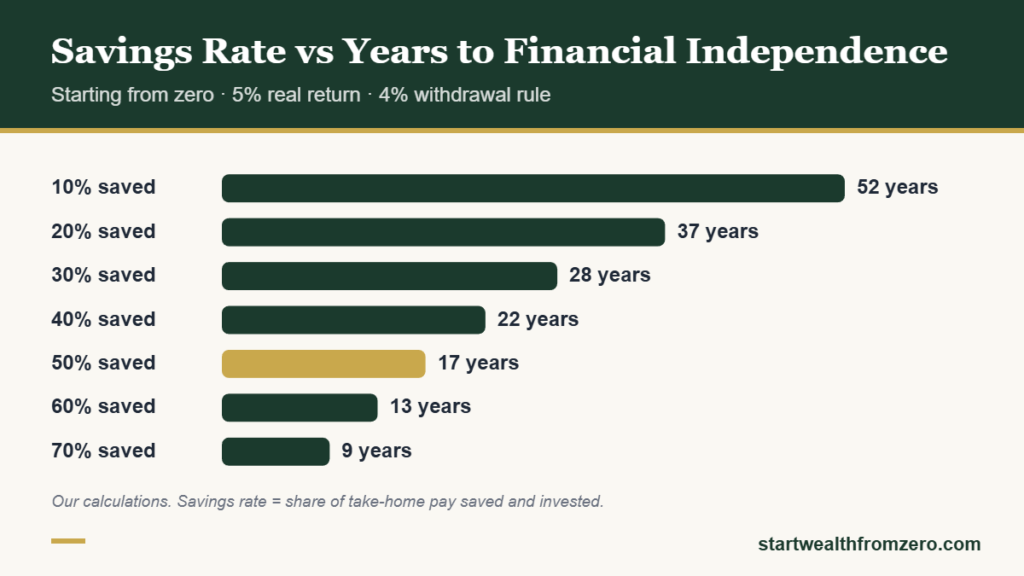
The relationship between savings rate and years to retirement is dramatic:
- Save 10% → approximately 51 years to retirement
- Save 20% → approximately 37 years to retirement
- Save 30% → approximately 28 years to retirement
- Save 40% → approximately 22 years to retirement
- Save 50% → approximately 17 years to retirement
- Save 60% → approximately 12 years to retirement
- Save 70% → approximately 9 years to retirement
These numbers assume you start from zero and earn an average return of about 5% a year after inflation (a conservative assumption), with years rounded. Our calculation. They’re also based on the 4% rule, which we’ll cover next.
The key takeaway is that doubling your savings rate from 10% to 20% cuts about 15 years off your working life. Going from 20% to 50% cuts another 20 years. The leverage is extraordinary.
The 4% Rule
The 4% rule comes from research by financial planner William Bengen, published in 1994, and the later “Trinity Study” (1998) by three professors at Trinity University. Both used historical U.S. stock and bond returns to test how much retirees could withdraw each year, adjusted for inflation, without running out of money over a 30-year retirement.
The conclusion: starting withdrawals at about 4% of the portfolio held up in the large majority of the historical 30-year periods they tested, including ones that began just before major bear markets. It is a historical rule of thumb, not a guarantee.
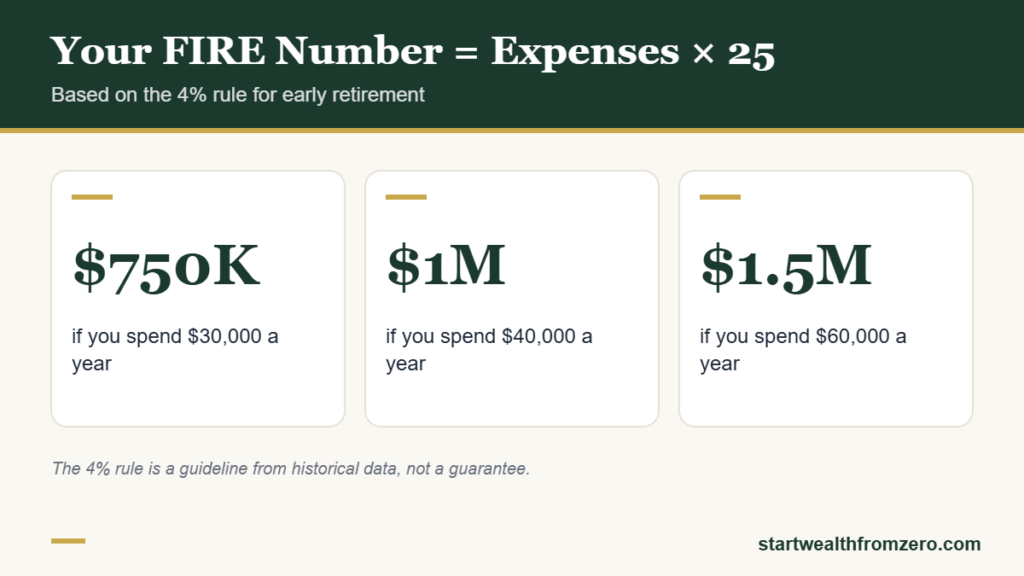
In practice, this means you need a portfolio worth 25 times your annual expenses to be financially independent. Here’s the formula:
Annual expenses x 25 = Financial independence number
For example:
- If you spend $30,000 per year, you need $750,000
- If you spend $40,000 per year, you need $1,000,000
- If you spend $50,000 per year, you need $1,250,000
Important if you plan to retire early: those studies tested 30-year retirements. If you stop working at 40, your money may need to last 50 years or more, so many early retirees plan with a more cautious withdrawal rate of around 3.25% to 3.5%. At 3.5%, you need about 28.6 times your annual expenses instead of 25 (about $857,000 instead of $750,000 if you spend $30,000 a year).
This is why reducing your expenses is so powerful in the FIRE framework — it simultaneously increases your savings rate and reduces the amount you need to accumulate. Every $1,000 you cut from your annual expenses reduces your financial independence number by $25,000.
Is the 4% Rule Still Valid?
Some financial experts have questioned whether the 4% rule remains reliable given current market conditions, lower expected future returns, and the fact that early retirees may have 50+ year retirements rather than the 30 years the Trinity Study examined.
Many FIRE practitioners use a more conservative 3.5% or 3% withdrawal rate to account for longer retirement periods and uncertainty. This means accumulating 28-33 times your annual expenses rather than 25 times.
For the purposes of this guide, we’ll use 25x as the target, but being aware of this nuance is important if you’re seriously pursuing FIRE.
Different Flavors of FIRE
The FIRE movement isn’t one-size-fits-all. Several variations have emerged to suit different income levels, risk tolerances, and lifestyle preferences:
Lean FIRE
Living very frugally and retiring on a minimal budget — typically under $30,000 per year. This requires the smallest portfolio but also the most lifestyle sacrifice.
Fat FIRE
Retiring with a larger portfolio that supports a more comfortable lifestyle — typically $80,000+ per year in spending. This requires a much larger portfolio but allows for a more conventional standard of living in retirement.
Barista FIRE
Reaching partial financial independence and then working part-time in a low-stress job to cover some expenses while the portfolio continues to grow. This approach significantly reduces the portfolio needed and is a popular middle ground.
Coast FIRE
Accumulating enough invested assets early that, if left to compound without further contributions, they’ll grow to a full retirement fund by traditional retirement age. Once you reach your Coast FIRE number, you only need to earn enough to cover current expenses — not save anything additional.
For people on normal salaries, Barista FIRE and Coast FIRE are often the most achievable and realistic entry points into financial independence.
How to Pursue FIRE on a Normal Salary: Step by Step
Step 1: Calculate Your Current Annual Expenses
Track every penny you spend for three months and multiply by four to get an annual figure. This is your baseline. It tells you how large a portfolio you need and gives you a starting point for identifying areas to reduce spending.
Step 2: Calculate Your Financial Independence Number
Multiply your annual expenses by 25 (or 28-33 for a more conservative estimate). This is your target portfolio value — the number you’re working toward.
For example, if you spend $35,000 per year:
$35,000 x 25 = $875,000 financial independence number
Step 3: Reduce Your Expenses Intentionally
FIRE on a normal salary almost always requires reducing expenses below what most people consider normal. This doesn’t mean misery — it means being deliberate about what you spend money on and ruthlessly cutting spending that doesn’t genuinely improve your life.
The big three expenses — housing, transport, and food — offer the most significant opportunities for reduction:
Housing: Consider house hacking (buying a property and renting out rooms to offset your mortgage), living in a less expensive area, or sharing accommodation longer than your peers might. Housing is typically the single biggest expense and the biggest opportunity.
Transport: Avoiding car ownership entirely, driving an old paid-off car, or cycling for local journeys can save thousands per year. Transport is often the second biggest household expense after housing.
Food: Meal planning, cooking at home, and shopping at discount supermarkets can cut food costs significantly without sacrificing nutrition or enjoyment.
Beyond the big three, the question to ask about every expense is: does this spending genuinely improve my life enough to justify the time I had to work to earn it? Viewed through this lens, many expenses start to look very different.
Step 4: Increase Your Income
On a normal salary, reducing expenses alone may not be enough to achieve the high savings rates needed for early retirement. Increasing your income is often equally important.
Strategies include asking for raises, changing jobs strategically, developing higher-value skills, starting a side hustle, or eventually moving into self-employment or consulting in your field.
Every additional dollar of income that goes directly into savings and investments — rather than into lifestyle inflation — dramatically accelerates your path to financial independence.
Step 5: Invest Aggressively in Low-Cost Index Funds
The investment strategy for FIRE doesn’t need to be complicated. The overwhelming majority of successful FIRE practitioners invest primarily in low-cost, broadly diversified index funds — specifically funds tracking the total US stock market, the S&P 500, or a global stock market index.
Maximize contributions to tax-advantaged accounts first: 401(k) up to the employer match, then Roth IRA to the annual limit, then back to the 401(k) up to the annual limit. Any remaining savings capacity goes into a taxable brokerage account.
The investment approach is the same as for any long-term investor: invest consistently, diversify broadly, keep costs low, and don’t panic during market downturns.
Step 6: Track Your Progress
One of the most motivating aspects of the FIRE journey is tracking your net worth and your progress toward your financial independence number. Many FIRE practitioners track their portfolio monthly and calculate their percentage of the way to financial independence.
Seeing the number grow — slowly at first, then faster as compound interest kicks in — is one of the most powerful motivators to continue. Many people report that once they start seriously pursuing FIRE, their relationship with money changes fundamentally. Spending less stops feeling like deprivation and starts feeling like buying freedom.
The power of early investing: The IRS allows contributions of up to $24,500 per year into a 401(k) in 2026 (plus an $8,000 catch-up contribution if you’re 50 or older). Maxing this out from age 25 could produce over $3 million by retirement age at a 7% average annual return. For a deeper dive, read our 401(k) for Beginners: How to Maximize It.
What Life Actually Looks Like Pursuing FIRE on a Normal Salary
It’s important to be honest about what pursuing FIRE on a normal salary actually involves. It’s not easy, and it requires trade-offs that many people aren’t willing to make.
You might live in a smaller place than your peers, drive an older car, take fewer or less expensive vacations, and say no to social activities that don’t fit your budget. You’ll likely be more intentional about money than almost anyone around you, which can occasionally feel isolating.
But you’ll also have a growing sense of financial security and freedom that most people never experience. You’ll be building toward a future where work is optional — where you work because you want to, not because you have to. And the closer you get to your financial independence number, the more options you have, even before you fully retire.
Many people pursuing FIRE report that the journey itself — the intentionality, the clarity, the sense of purpose — is as valuable as the destination.
A Realistic Timeline for Normal Salary FIRE
Let’s look at a realistic example. Suppose you earn $50,000 per year after tax and manage to save 40% of your income — $20,000 per year — while living on $30,000.
Your financial independence number: $30,000 x 25 = $750,000
Starting from zero, investing $20,000 per year at an average 7% annual return after inflation, you reach $750,000 in approximately 20 years.
That means someone starting at 25 could be financially independent by 45. Starting at 30, they’d reach it by 50. These timelines are significantly better than the conventional retirement age of 65-67 — and they’re achievable on a completely normal salary with a 40% savings rate.
Increase the savings rate to 50%, and the timeline shortens to around 17 years. Increase income while maintaining expenses, and it shortens further still.
The FIRE Math: How Much Do You Actually Need to Retire Early?
The foundation of early retirement math is the 4% rule, developed from the Trinity Study: a portfolio can sustain 4% annual withdrawals indefinitely (historically, over 95% success rate over 30+ years). This means your retirement number is simply your annual expenses × 25.
| Annual Expenses | FIRE Number (25×) | Monthly Investment Needed to Hit It in 15 Years* | Monthly Investment for 20 Years* |
|---|---|---|---|
| $25,000/year | $625,000 | $2,100/month | $1,300/month |
| $35,000/year | $875,000 | $2,950/month | $1,820/month |
| $50,000/year | $1,250,000 | $4,200/month | $2,600/month |
| $70,000/year | $1,750,000 | $5,900/month | $3,640/month |
*Assumes 7% real annual return (inflation-adjusted S&P 500 historical average). These are illustrative projections — actual returns vary. Run your own numbers with our Retirement Calculator.
The Savings Rate Is Everything: How Long FIRE Takes at Different Rates
| Savings Rate | Years to FIRE | What It Means Practically |
|---|---|---|
| 10% | ~52 years | Traditional retirement, not early |
| 20% | ~37 years | Still traditional, but more secure |
| 30% | ~28 years | Possible early retirement if started young |
| 40% | ~22 years | Early retirement achievable from 30s |
| 50% | ~17 years | Lean FIRE possible from 40s if started at 25 |
| 60%+ | ~13 years | Aggressive FIRE — requires very low expenses |
Our calculations, assuming you start from zero, earn a 5% real (after-inflation) return and retire when your savings reach 25× your annual spending (the 4% rule from the Trinity Study). The key insight: savings rate matters more than income. Someone earning $50,000 and saving 50% retires earlier than someone earning $150,000 and saving 20%. For a full breakdown of what financial independence actually requires, see our financial independence guide.
The Bottom Line
Early retirement on a normal salary is real, it’s mathematical, and it’s being achieved by ordinary people right now. It requires a higher savings rate than most people maintain, intentional spending choices, consistent long-term investing, and patience.
It’s not for everyone. But for those who genuinely value their time and freedom over material consumption, the FIRE framework offers a credible and achievable path to financial independence — regardless of whether your salary is average, above average, or below it.
The question isn’t whether it’s possible. The question is whether you want it enough to make the choices it requires.
Start calculating your numbers today. You might be closer than you think.
Frequently Asked Questions
Below are the most common questions people ask about how to retire early.
Is it really possible to retire early on a normal salary?
Yes, but it requires a high savings rate and disciplined investing over many years. The FIRE movement (Financial Independence, Retire Early) has shown that retiring early is achievable on average incomes — the key variable is how much of your income you save and invest, not how much you earn.
What savings rate do I need to retire early?
The higher your savings rate, the faster you can retire. Saving 10% might get you to traditional retirement age. Saving 30-40% can cut that timeline significantly. Saving 50%+ is the path most early retirees follow. Every percentage point increase in your savings rate shortens your working years.
How much money do I need to retire early?
The most widely used rule is the 25x rule — multiply your annual expenses by 25 to get your target retirement number. If you spend $30,000 a year, you need $750,000 invested. This is based on the 4% safe withdrawal rate, which suggests you can withdraw 4% of your portfolio annually without running out of money.
What should I invest in to retire early?
Low-cost index funds tracking broad market indices like the S&P 500 are the preferred vehicle for most early retirees. They offer strong long-term returns, low fees, and simplicity. Maximize tax-advantaged accounts like a Roth IRA and 401k first, then invest in a taxable brokerage account.
What are the biggest risks of retiring early?
Running out of money is the main risk, especially if you retire in your 40s and live another 50 years. Healthcare costs before Medicare eligibility are another major consideration in the US. Sequence of returns risk — a market crash early in retirement — can also derail an early retirement plan if not managed correctly.
Can I go back to work if early retirement doesn’t work out?
Absolutely. Many early retirees do some form of part-time work, consulting, or passion projects that generate income. Retiring early doesn’t have to mean never earning money again — it means having the financial freedom to choose how you spend your time.
Track your financial progress with our free calculator.
Early retirement requires knowing your net worth at every stage. Use our Net Worth Calculator to track your FI progress.