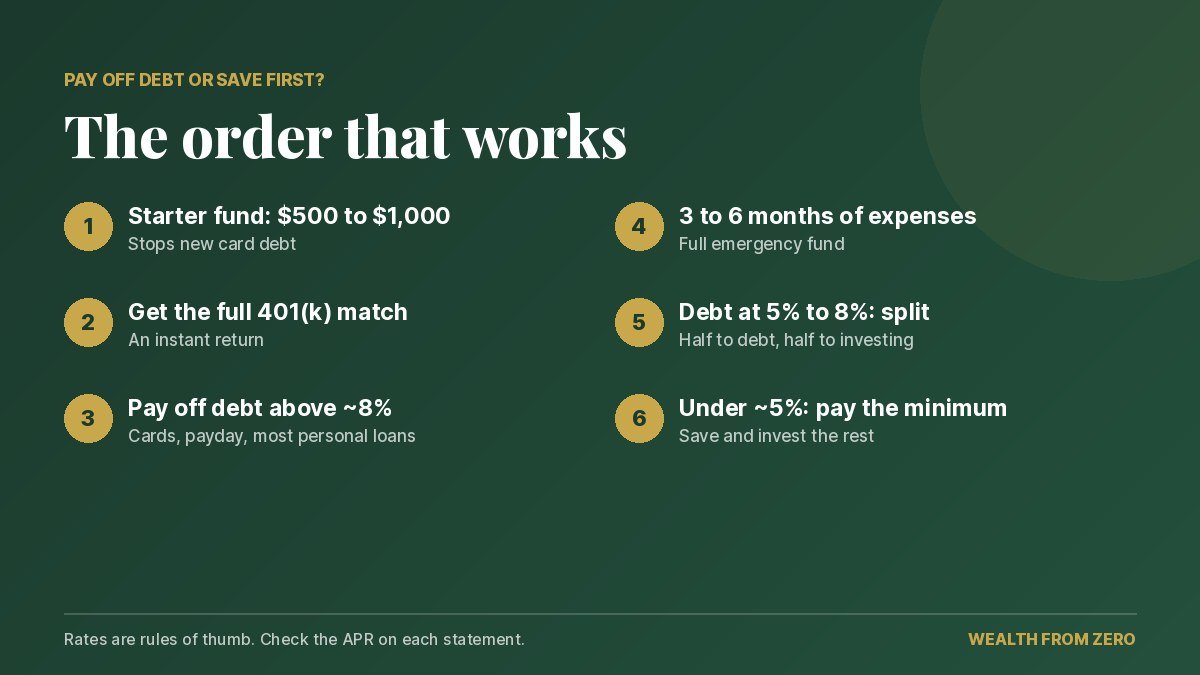
Short answer: do both, in a specific order. First save a small starter emergency fund ($500–$1,000). Then grab any 401(k) employer match. After that, the interest rate decides: pay off debt above roughly 8% (credit cards, payday and most personal loans) as fast as you can, then build a full emergency fund, and for low-rate debt under about 5% make the regular payments while you save and invest.
Here’s why that order works, a simple table by interest rate, and how it changes if you’re saving for retirement or a house.
The Order That Works for Most People
- Starter emergency fund: $500–$1,000. Without it, the next car repair goes on a credit card and undoes your progress.
- Get the full 401(k) match. If your employer matches 50% of what you contribute up to 6% of pay, that’s an instant 50% return. No debt payoff beats it.
- Attack high-interest debt (about 8% and up). Every dollar you pay on a 22% card is a guaranteed 22% “return.”
- Build a full emergency fund: 3–6 months of essential expenses. Our emergency fund guide helps you pick the right size.
- Medium-rate debt (about 5–8%): split extra money between paying it down and investing.
- Low-rate debt (under about 5%): pay the minimum and put extra money toward retirement and other goals.
Why the Interest Rate Decides
Paying off debt saves you its interest rate, with no risk. Saving earns you a savings rate. Compare them side by side for $1,000 of extra money over one year:
| Where the $1,000 goes | Rate | Value after one year |
|---|---|---|
| Pay down a credit card | 22% APR | about $220 of interest avoided |
| Pay down a personal loan | 12% APR | about $120 of interest avoided |
| High-yield savings account | about 4% APY | about $40 earned |
| Pay down a 4% loan | 4% | about $40 of interest avoided |
Against a 22% card, savings can’t compete: the debt costs you over five times what the savings account pays. Against a 4% loan, it’s a tie — so keeping cash for emergencies and investing for the long term makes more sense than racing to pay it off. The credit card rate here is the Q2 2026 average for accounts paying interest from the Federal Reserve’s G.19 report; savings rates change often.
A Quick Rule by Type of Debt
| Debt | Typical rate | What to do |
|---|---|---|
| Payday loans, cash advances | Very high | Pay off first, right after the starter fund |
| Credit cards | Around 20%+ | Pay off aggressively |
| Personal loans | Varies widely | Above ~8%: pay off aggressively |
| Car loans | Varies | Above ~8%: pay extra; below ~5%: minimum |
| Federal student loans | Fixed, set by law | Check your rate and repayment plan first |
| Mortgage | Often lower | Usually minimum payments while you save and invest |
Look up your actual rate on each statement — that’s what matters, not the type of loan. For student loans, see our student loan guide before paying extra, because repayment plans and forgiveness rules can change the math.
Pay Off Debt or Save for Retirement?
Don’t skip the employer match — it’s free money. Beyond the match, high-interest debt usually comes first, because a guaranteed 20%+ beats an expected stock-market return, which is never guaranteed. Once the expensive debt is gone, turn the payments you were making into retirement contributions. See Roth IRA vs 401(k) for where to put them.
Pay Off Debt or Save for a House?
Mortgage lenders look at your debt-to-income ratio — your monthly debt payments divided by your gross monthly income. The CFPB explains how lenders use it. Paying off a credit card or car loan can lower that ratio and your interest rate, and it can matter as much as a bigger down payment. A common approach: clear high-interest debt first, then save the down payment, and avoid taking on new debt in the months before you apply. Our guide on saving for a house on a low income has a step-by-step plan.
A Worked Example
Alex has $400 a month extra, $0 saved, a $4,000 credit card at 22% and a $12,000 car loan at 5%. Using the order above:
- Months 1–3: $400 a month into savings until there’s about $1,000 for emergencies (plus 401(k) contributions up to the match), while paying the card’s $100 minimum.
- Months 4–12: $500 a month on the card ($400 extra plus the minimum). The card is paid off by month 12, with about $570 in total interest.
- After that: keep paying the car loan’s regular payment, and send the $500 to the full emergency fund, then to investing.
| Alex’s options | Card paid off | Card interest | Emergency cushion |
|---|---|---|---|
| Starter fund first, then the card (the order above) | Month 12 | about $570 | $1,000 from month 3 |
| Everything to the card from day one | Month 9 | about $370 | $0 for 9 months |
| Only the $100 minimum, $400 to savings | Month 73 | about $3,280 | Large, but the card costs far more than it earns |
The starter fund costs Alex about $200 more in interest — a cheap price for not putting the next emergency back on the card. Paying only the minimum is the real mistake: it costs over $3,000 in interest.
Our debt payoff calculator shows your exact timeline, and how to pay off $5,000 in credit card debt has payment tables for a typical balance.
What an Emergency Fund “Costs” While You Have Debt
Keeping $1,000 in savings at about 4% while carrying a 22% card balance costs you roughly $180 a year (22% − 4% on $1,000). Think of it as insurance: $15 a month to avoid putting a $1,000 surprise on the card, where it would cost far more and set your plan back months. That’s why the starter fund stays small — big enough to cover common surprises, small enough that it doesn’t cost much while the debt is still there.
The Middle Zone: Debt at 5–8%
For a car loan or private student loan at around 6%, the math is close. Here’s $300 a month of extra money for five years:
| Where the $300 a month goes | Value after 5 years | Guaranteed? |
|---|---|---|
| Extra payments on a 6% loan | about $20,900 of debt and interest avoided | Yes |
| Invested, 7% average return | about $21,500 | No |
| Invested, 5% average return | about $20,400 | No |
The difference is small either way, which is why splitting extra money between the two is a sensible default. Lean toward the debt if the rate is variable, if you’d sleep better without it, or if your job feels uncertain. Lean toward investing if the money goes into a tax-advantaged account like a Roth IRA or 401(k), and if you have decades before you need it. Investment returns are never guaranteed.
When to Break the Rule
- Your job or income is unstable. Build a larger emergency fund before paying extra on any debt — losing your income with no savings is worse than paying interest for a few more months.
- You’re about to need cash. A move, a baby, or a car that’s on its last legs: save for it first so you don’t borrow again.
- Your debt has tax benefits. You may be able to deduct up to $2,500 a year of student loan interest (IRS Topic 456), which lowers its real cost a bit.
- You have a 0% promotional rate. Make sure the balance is paid off before the promo ends, but there’s no benefit to paying it faster than that.
Frequently Asked Questions
Should I use my savings to pay off debt?
Keep at least a starter emergency fund. Using savings above that to pay off a high-interest card usually makes sense, because the card costs far more than the savings earn. Just don’t drain everything — or the next emergency goes right back on the card.
Is it better to pay off debt or invest?
For debt above about 8%, paying it off usually wins because the “return” is guaranteed. For debt under about 5%, investing for the long term has historically done better, though returns aren’t guaranteed. In between, splitting your extra money is a reasonable middle ground.
Should I pay off my car loan early or save?
If the rate is under about 5%, saving and investing usually comes first, once you have an emergency fund. If it’s above about 8%, paying it off early usually wins. Check whether your loan has a prepayment penalty first.
How big should my emergency fund be while I pay off debt?
A starter fund of $500–$1,000 while you clear high-interest debt, then 3–6 months of essential expenses once it’s gone.
What if I have no emergency fund and a lot of debt?
Start with a small cushion — even $500 — before throwing everything at the debt. It’s what keeps a surprise expense from becoming new debt.
Sources
- Federal Reserve: G.19 Consumer Credit (credit card interest rates)
- CFPB: What is a debt-to-income ratio?
- IRS Topic 456: Student loan interest deduction
- FDIC: National rates and rate caps
The 5% and 8% cut-offs are rules of thumb, not fixed limits. Your situation, taxes and job security matter. This article is for education, not personal financial advice.