
$1,000 feels small when you hear about people investing millions. It isn’t. $1,000 invested at 7% average annual return becomes $7,600 in 30 years without adding another dollar. Add $100/month alongside it and it becomes $123,000. The amount matters far less than starting. Here is exactly how to invest $1,000 as a beginner in 2026 — the account to open, what to buy, and what it grows to.
This guide explains exactly how to invest $1,000 as a beginner in 2026 — which account to open, what to buy, the best platforms, how much it grows, and the most common mistakes that kill returns.
Before You Invest $1,000: The Priority Checklist
| Priority | Action | Why First |
|---|---|---|
| 1 | Pay off credit card debt | CC interest (20–25% APR) > any investment return. Paying $1,000 of CC debt = guaranteed 22% return |
| 2 | $1,000 starter emergency fund in HYSA | Without this, one unexpected expense forces you to sell investments at the wrong time |
| 3 | Capture employer 401(k) match | 50% match = immediate 50% return. Better than any investment. |
| 4 | Invest the $1,000 | Once above are handled, invest confidently knowing the money won’t be needed short-term |
Choose the Right Account First
| Account | Tax Benefit | Best For | 2026 Limit |
|---|---|---|---|
| Roth IRA | Tax-free growth and withdrawals | Under 40, expecting higher taxes in retirement | $7,000/yr |
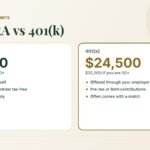
| Traditional 401(k) | Pre-tax contributions, reduces income now | Those with an employer match | $24,500/yr |
| Taxable brokerage | None, but no limits | After tax-advantaged accounts are maxed | Unlimited |
For most beginners with $1,000: open a Roth IRA at Fidelity. Takes 10 minutes, no minimum, no account fees. The tax-free growth over decades is the most powerful feature available to a beginning investor. Read our complete Roth IRA guide to open one step by step.
What to Actually Buy With Your $1,000
| Fund | Type | Expense Ratio | Where Available | Verdict |
|---|---|---|---|---|
| FZROX | Total US market index fund | 0.00% | Fidelity only | Best for Fidelity accounts |
| FXAIX | S&P 500 index fund | 0.015% | Fidelity only | Excellent alternative |
| VTI | Total US market ETF | 0.03% | Any broker | Best for Vanguard or taxable |
| VOO | S&P 500 ETF | 0.03% | Any broker | Near-identical to VTI |
| Single stocks | Individual companies | Varies | Any broker | ❌ Too concentrated for $1,000 |
| Crypto | Digital assets | Varies | Crypto exchanges | ❌ Highly speculative — not a first investment |
The principle: own the whole market at the lowest possible cost. See our detailed ETF vs Index Fund comparison to understand the differences. Related: start with $500 if you’re brand new.

What $1,000 + Monthly Contributions Actually Grows To
| Starting Amount | Monthly Addition | After 10 Years | After 20 Years | After 30 Years |
|---|---|---|---|---|
| $1,000 | $0 | $1,967 | $3,870 | $7,612 |
| $1,000 | $100/mo | $18,400 | $54,400 | $123,000 |
| $1,000 | $200/mo | $34,800 | $104,900 | $238,400 |
| $1,000 | $500/mo | $88,000 | $261,000 | $597,000 |
At 7% average annual return. The $1,000 lump sum matters far less than the monthly contribution. Model your exact numbers with our free Investment Return Calculator.
Four Mistakes Beginners Make With Their First $1,000
- Waiting for the right time. Time in the market beats timing the market. The best day to invest was yesterday; the second best is today. Markets are higher 70%+ of the time one year after any given date.
- Spreading across too many funds. Buying 8 different index funds with $1,000 adds complexity without diversification benefit. One total market fund gives you 3,600+ stocks in one purchase.
- Choosing high-fee funds. A 1% expense ratio vs 0.03% on $1,000 growing to $7,600 over 30 years costs approximately $680 in lost returns. Small fees compound into large amounts.
- Using a taxable account before tax-advantaged accounts. A Roth IRA grows tax-free. A taxable brokerage account does not. For a beginning investor, this is a significant long-term difference.
The Best Platforms to Invest $1,000 in 2026
| Platform | Account Minimum | Best For | Key Feature |
|---|---|---|---|
| Fidelity | $0 | Best overall for beginners | FZROX at 0% expense ratio |
| Vanguard | $0 | Index fund investors | VTI at 0.03%, owned by investors |
| Schwab | $0 | Active traders + investors | SWTSX at 0.03%, strong research tools |
| M1 Finance | $100 | Automated portfolio investing | Automatic rebalancing, pie investing |
| Robinhood | $0 | Not recommended | Gamified UX encourages overtrading |
For a first $1,000, Fidelity is the clear choice: $0 minimum, FZROX at 0% fee, and the most beginner-friendly interface. Open a Roth IRA there and buy FZROX — that’s the entire strategy for most people starting out. Read our full Roth IRA beginner guide to open one step by step.
How to Invest $1,000 Based on Your Age
The right investment for $1,000 depends partly on your timeline — which is closely related to your age.
| Age | Time Horizon | Recommended Approach | Why |
|---|---|---|---|
| 18–30 | 35–45 years | 100% total market index fund (FZROX/VTI) | Maximum time for compounding; short-term volatility irrelevant |
| 30–45 | 20–35 years | 90% stocks / 10% bonds (VTI + BND) | Still long horizon; slight bond allocation smooths volatility |
| 45–55 | 10–20 years | 80% stocks / 20% bonds | Approaching retirement; reduce sequence-of-returns risk |
| 55+ | Under 10 years | 60–70% stocks / 30–40% bonds | Preservation matters more; can’t afford large drops near retirement |
Should You Invest $1,000 in Crypto?
Short answer: not as your first investment. Longer answer: crypto is a legitimate asset class, but it’s one of the most volatile investments available — Bitcoin has dropped 70-80% multiple times in its history. For a $1,000 first investment, the right priority order is:
- First: Emergency fund, employer match, high-interest debt payoff
- Second: Roth IRA with index funds ($1,000 here)
- Third: If you want crypto exposure, limit it to 5–10% of your investable portfolio — meaning you’d need $10,000–$20,000 in index funds before putting $1,000 in crypto
The SEC’s investor guidance on cryptocurrency is worth reading before putting any money into digital assets.
How to Invest $1,000 When You Also Have Debt
If you have both debt and $1,000 to invest, the right move depends entirely on the interest rate. Credit card debt at 22% APR: pay it off first — no investment reliably returns 22%. Student loans at 5%: invest alongside paying down debt, since index funds historically return more than 5%. Car loans at 6–8%: judgment call — both investing and paying down are defensible. The general rule: eliminate any debt above 8% before investing, invest alongside debt below 6%, and use judgment for 6–8%.
For a personalized view of how much your debt is actually costing you versus what investing the same money would return, use our Debt Payoff Calculator alongside the Investment Return Calculator.
The Most Important Thing About Investing $1,000
Every successful long-term investor has one thing in common: they started. Not when they felt ready. Not when the market seemed safe. Not when they understood everything. They opened an account, bought an index fund, and let time do the work. The $1,000 you invest today is worth more than $5,000 invested in five years — not because of the amount, but because of the time. Open the account today. Buy FZROX or VTI. Set up a recurring transfer of whatever you can afford. Then stop watching it and live your life. That’s the entire strategy. Everything else is noise.
Your $1,000 Investment Action Plan
- ✅ Today: Open a Roth IRA at Fidelity (fidelity.com → “Open an Account” → Roth IRA → takes 10 minutes)
- ✅ Today: Transfer $1,000 from your bank account (takes 1-3 business days to settle)
- ✅ Once funds settle: Buy FZROX — type the ticker in the search bar, enter $1,000, click Buy
- ✅ Set up automatic investing: Even $50/month added automatically will dramatically change your long-term result
- ✅ Calendar reminder in 1 year: Check if you’ve contributed the full $7,500 annual Roth IRA limit
- ✅ Don’t check it daily: Set a quarterly reminder instead. Markets fluctuate — what matters is staying invested
Frequently Asked Questions
Is $1,000 enough to start investing?
Yes. Fidelity, Vanguard, and Schwab all have $0 account minimums for index funds and ETFs. $1,000 buys approximately 3.7 shares of VTI or can be invested as a lump sum in FZROX with no minimum. The amount is not the barrier — inaction is.
What is the safest investment for $1,000?
Money you might need within 1–3 years: a high-yield savings account (around 4% APY, FDIC insured, zero risk of loss). Money you won’t touch for 10+ years: a total market index fund. “Safe” depends entirely on your time horizon. See our best HYSA guide for current rates.
Should I invest $1,000 all at once or spread it out?
Research shows lump-sum investing outperforms dollar-cost averaging approximately two-thirds of the time, because markets generally go up. However, if you might panic-sell after a short-term drop, spreading it over 3–4 months provides a psychological buffer that keeps you invested.
For the latest official limits and rules, see the SEC guide to investing.
Disclaimer: This article is for informational purposes only and does not constitute financial advice. All investment involves risk, including the potential loss of principal. Past performance does not guarantee future results.