If your employer offers a 401(k) match and you’re not contributing at least enough to get the full match, you are leaving free money on the table every single pay period. A 3% employer match on a $55,000 salary is $1,650 per year — given to you for doing nothing except showing up to work and ticking a box in HR. That’s the starting point of this guide. This complete 401k for beginners guide covers everything from first contribution to retirement.
Beyond the match, a 401(k) is one of the most powerful wealth-building tools available — but most people who have one don’t fully understand how it works, what to invest in, or how to maximize it. This guide covers everything from your first contribution to how a 401(k) grows into a retirement nest egg.
What Is a 401(k) and How Does It Work?
A 401(k) is an employer-sponsored retirement savings account that lets you invest a portion of your pre-tax paycheck into the market, where it grows tax-deferred until retirement. “Tax-deferred” means you don’t pay income tax on the contributions now — you pay when you withdraw the money in retirement (typically at a lower tax rate). Your contributions reduce your taxable income today: if you earn $60,000 and contribute $6,000 to a 401(k), you’re only taxed on $54,000 of income.
The 401(k) was introduced in 1978 and has become the primary retirement vehicle for American workers. According to the Investment Company Institute, over 70 million Americans participate in 401(k) plans, with total assets exceeding $7 trillion in 2026.
Traditional 401(k) vs Roth 401(k): Key Differences
Many employers now offer both a traditional and Roth version of the 401(k). Here’s how they compare:
| Traditional 401(k) | Roth 401(k) | |
|---|---|---|
| Contributions | Pre-tax (reduces taxable income now) | After-tax (no immediate tax benefit) |
| Tax on growth | Tax-deferred | Tax-free |
| Tax on withdrawals | Taxed as ordinary income | Tax-free |
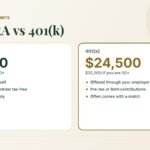
| 2026 limit | $24,500 (combined with Roth 401k) | $24,500 (combined with Traditional) |
| Income limits | None | None |
| Best for | Higher earners, expect lower tax rate in retirement | Younger earners, expect higher tax rate in retirement |
If your employer offers a Roth 401(k) option and you’re under 40, it’s worth considering — the tax-free withdrawal in retirement can be enormously valuable given decades of compound growth. You can also split contributions between traditional and Roth as long as the combined total stays under $24,500.
2026 401(k) Contribution Limits
| Who | 2026 Limit | Notes |
|---|---|---|
| Under age 50 | $24,500 | Employee contributions only |
| Age 50–59 | $32,500 | +$7,500 catch-up contribution |
| Age 60–63 | $34,750 | +$11,250 enhanced catch-up (SECURE 2.0) |
| Age 64+ | $32,500 | Standard catch-up resumes |
| Total with employer contributions | $70,000 | Employee + employer combined cap |
The Employer Match: Free Money You Cannot Afford to Miss
The employer match is the most important concept in 401(k) investing. Most employers match a percentage of your contributions — commonly 50 cents or $1 for every dollar you contribute, up to 3–6% of your salary. This is an immediate 50–100% return on your investment, guaranteed, before the market does anything.
| Salary | You Contribute (3%) | Employer Matches (3%) | Annual Free Money | Over 30 Years (7% return) |
|---|---|---|---|---|
| $40,000 | $1,200/yr | $1,200/yr | $1,200 | +$122,000 |
| $55,000 | $1,650/yr | $1,650/yr | $1,650 | +$168,000 |
| $75,000 | $2,250/yr | $2,250/yr | $2,250 | +$229,000 |
| $100,000 | $3,000/yr | $3,000/yr | $3,000 | +$305,000 |
If your employer offers a 3% match on a $55,000 salary and you’re not contributing, you’re declining $1,650/year in compensation — which compounds to $168,000 over 30 years. Log into your HR portal this week and set your contribution to at least the match percentage. This is non-negotiable.
What to Invest In Inside Your 401(k)
This is where most people freeze up — and where most 401(k) mistakes happen. Your 401(k) offers a menu of investment options chosen by your employer. Here’s how to pick intelligently:
Option 1 (Simplest): Target-date fund. Look for a fund with your target retirement year in the name — e.g., “Target Date 2055 Fund” if you plan to retire around 2055. These automatically hold a diversified mix of stocks and bonds that gets more conservative as you approach retirement. They typically cost 0.10–0.15% in fees. One fund, no decisions, fully automatic. This is the right choice for 80% of 401(k) participants.
Option 2 (DIY): Low-cost index funds. If your plan has an S&P 500 index fund or total market index fund with an expense ratio below 0.10%, choose that. Combine with a small allocation to an international index fund (if available) for broader diversification. Avoid any fund with an expense ratio above 0.50% — these quietly cost you tens of thousands of dollars over a career.
Option 3 (Avoid): Actively managed funds. These charge 0.5–1.5% annually and over 90% of them underperform their index benchmark over 15+ years (according to SPIVA data). Unless your employer plan has no index fund options, avoid actively managed funds entirely.
How Much Should You Contribute to Your 401(k)?
The right contribution amount depends on where you are financially. Here’s a simple priority ladder:
- Minimum: At least enough to get the full employer match — usually 3–6% of salary. Anything less means leaving guaranteed money on the table.
- Target: 15% of gross income total (including employer match). This is the standard financial planning recommendation for on-track retirement savings.
- Maximum: $24,500 per year (2026 limit). Once you’re maxing out the Roth IRA too ($7,000), this represents $30,500/year in tax-advantaged savings — enough for most people to retire comfortably on a 25–30 year timeline.
If 15% feels too high right now, start at the employer match and increase by 1% each year, or every time you get a raise. Most people never notice a 1% salary difference. Use our Retirement Savings Calculator to find the exact monthly contribution you need to hit your retirement goal. Related: full Roth IRA vs 401(k) comparison.
401(k) Vesting: When Is the Employer Match Actually Yours?
Your own contributions are always 100% yours immediately. The employer match, however, may be subject to a vesting schedule — meaning you have to stay employed for a set period before the matched money is fully yours.
| Vesting Type | How It Works | Example |
|---|---|---|
| Immediate vesting | Match is yours from day one | Best scenario — increasingly common |
| Cliff vesting | 0% until a set date, then 100% | 0% for 3 years, then 100% on year 3 |
| Graded vesting | Increases gradually over years | 20% year 1, 40% year 2, up to 100% year 6 |
If you’re considering leaving your job, check your vesting schedule first. Waiting an extra month or two to reach a vesting cliff can mean thousands of dollars in employer contributions becoming yours permanently.
What Happens to Your 401(k) When You Leave a Job?
You have four options when you leave an employer:
- Roll over to your new employer’s 401(k). Simple, keeps everything in one place. Only possible if your new employer accepts rollovers.
- Roll over to an IRA. Opens up a much wider range of investment options and potentially lower fees. This is often the best choice — open a Rollover IRA at Fidelity, Schwab, or Vanguard.
- Leave it with your former employer. Allowed in most cases if your balance is above $5,000. Convenient but easy to forget and may have limited investment options.
- Cash it out. Almost always a mistake. You’ll pay ordinary income tax plus a 10% early withdrawal penalty if you’re under 59½, losing 30–40% of the balance immediately.
401(k) vs Roth IRA: Use Both
The 401(k) and Roth IRA are not competitors — they’re complements. Use them in this order:
- 401(k) → up to the employer match (free money first)
- Roth IRA → max it out ($7,500 in 2026, tax-free growth)
- 401(k) → contribute more toward the $24,500 limit
Together, these two accounts give you up to $30,500 in annual tax-advantaged retirement savings. Read our full Roth IRA guide to understand how they work together.

How to Increase Your 401(k) Contributions Without Feeling It
The most effective strategy for most people: increase your contribution by 1% each time you get a raise. You were living without that money before the raise, so redirecting it to your 401(k) means your take-home pay stays roughly the same while your retirement savings grow. Over a 10-year career with annual raises of 2–3%, this approach alone can push contributions from 3% to 13–15% of salary with zero felt sacrifice.
If your plan allows it, set up automatic escalation — many 401(k) plans let you schedule automatic 1% increases each January. Turn it on once and forget it. Within 5–7 years, you’ll likely be contributing close to the optimal 15% target without ever feeling a sharp reduction in take-home pay.
How a 401(k) Fits Into Your Complete Financial Plan
A 401(k) doesn’t exist in isolation — it works best as part of a layered financial strategy:
- Before investing: Make sure you have an emergency fund of 3–6 months of expenses. See our emergency fund guide. Investing while carrying high-interest debt or no safety net means selling at the worst time when emergencies hit.
- Pay off high-interest debt first: If you carry credit card debt at 18–25% APR, paying it off produces a guaranteed return higher than the market average. Use our Debt Payoff Calculator to model how quickly you can clear it.
- Pair with a Roth IRA: After getting the 401(k) match, max out a Roth IRA ($7,500 in 2026) before adding more to the 401(k). The tax-free growth of a Roth IRA complements the tax-deferred 401(k) perfectly.
- Track your retirement trajectory: Use our Retirement Savings Calculator monthly to see if your current contribution rate keeps you on track for your target retirement age and income.
401(k) Fees: The Hidden Cost That Destroys Returns
Most 401(k) participants have no idea how much they pay in fees — and the numbers are alarming. The average 401(k) plan charges between 0.5% and 1.5% in annual fees. On a $200,000 balance, that’s $1,000–$3,000 per year leaving your account silently.
How to check your fees: log in to your 401(k) plan, find the fund information, and look for the “expense ratio” on each fund. Target anything under 0.20%. If your plan only offers high-fee funds (above 0.50%), consider contributing only up to the employer match, then directing additional savings to a Roth IRA with access to FZROX (0.00%) or VTI (0.03%).
What Happens to Your 401(k) If Your Company Goes Bankrupt?
Your 401(k) is legally separate from your employer’s assets — it’s held in a trust by a third-party custodian. If your company goes bankrupt, creditors cannot touch your 401(k) balance. The funds belong to you, not the company. You would receive full access to roll the balance to an IRA or a new employer’s plan. This protection is one of the strongest features of 401(k) accounts and applies regardless of employer size.
For comprehensive guidance on your 401(k) rights and protections, the Department of Labor’s guide to retirement plans covers everything from vesting to rollovers in plain language.
Frequently Asked Questions About 401(k) Plans
When can I start withdrawing from my 401(k)?
Without penalty, at age 59½. Early withdrawals before 59½ trigger a 10% penalty plus ordinary income tax — a combination that can cost you 35–40% of the withdrawal. Required minimum distributions (RMDs) must begin at age 73 under current law.
What happens to my 401(k) if the market crashes?
The value drops temporarily — but if you stay invested, it recovers. The S&P 500 has recovered from every single market crash in history, including 2008 (-38%), 2020 (-34%), and 2022 (-19%). Selling during a crash locks in your losses. The correct action during a market crash is to keep contributing — you’re buying shares at a discount.
Can I contribute to a 401(k) and an IRA in the same year?
Yes. Your 401(k) and IRA (including Roth IRA) have completely separate contribution limits. Maxing both gives you $30,500 in tax-advantaged savings in 2026. There’s no rule preventing simultaneous contributions.
What’s the difference between a 401(k) and a pension?
A pension (defined benefit plan) pays a guaranteed monthly income in retirement based on salary and years worked — your employer bears all investment risk. A 401(k) (defined contribution plan) depends on how much you contribute and how investments perform — you bear the investment risk. Pensions are increasingly rare in private-sector employment; 401(k)s are now the primary retirement vehicle for most American workers.