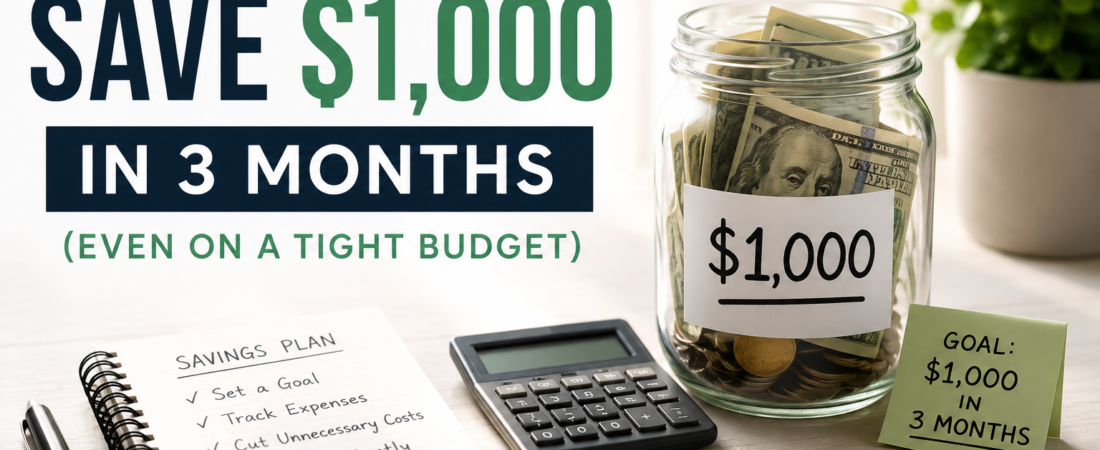
Saving money sounds simple in theory, but when you’re living paycheck to paycheck, it can feel impossible. The good news? Saving $1,000 in just three months is more achievable than you think — and it doesn’t require a six-figure salary.
Why $1,000 Matters
Before we dive into the how, let’s talk about the why. Having $1,000 saved is a game changer. It’s your first real emergency fund — enough to cover an unexpected car repair, a medical bill, or a month of groceries if things go wrong. Without it, most people turn to credit cards and debt. With it, you have breathing room.

Step 1: Track Every Dollar You Spend
You can’t fix what you can’t see. For the first two weeks, write down everything you spend — coffee, subscriptions, groceries, everything. Most people are shocked to discover they’re spending $150+ per month on things they barely notice.
Use a free app like Mint or simply a notes app on your phone. The goal isn’t to judge yourself — it’s to see clearly.
Step 2: Cut the “Invisible” Expenses
Once you’ve tracked your spending, look for the leaks. Common culprits include:
- Streaming services you forgot about
- Gym memberships you don’t use
- Food delivery fees and tips
- Impulse purchases under $20
Cutting just $85 per week gets you to $1,000 in three months. That’s less than one takeaway meal per day.

Step 3: Create a Simple Weekly Budget
Don’t overcomplicate it. If you’re unsure where to start, the 50/30/20 budget rule is one of the easiest budgeting methods for beginners.
- 50% for needs (rent, food, bills)
- 30% for wants (entertainment, dining out)
- 20% for savings
If 20% feels too much right now, start with 10% and increase it gradually.
Step 4: Automate Your Savings
Set up an automatic transfer to a separate savings account on the day you get paid. When the money moves before you see it, you won’t miss it. Out of sight, out of mind — but in your savings account.
Step 5: Find One Way to Earn Extra
Saving is powerful. Earning more is even more powerful. Consider selling things you no longer need, picking up extra hours at work, or starting a small side hustle. Even an extra $100 per month cuts your timeline significantly.
How Much Do You Need to Save Each Month?
The math is simple: $1,000 divided by 3 months equals $334 per month, or roughly $84 per week. That’s the target. But here’s the thing — you don’t have to get there all at once.
Week 1: Focus only on tracking your spending.
Week 2: Identify and cut your first $50 in unnecessary expenses.
Week 3: Set up your automatic savings transfer.
Week 4: Look for one way to bring in extra money.
By the end of month one, you should have at least $300 set aside. Month two gets easier because the habits are already in place.
The Best Place to Keep Your $1,000
Don’t keep your savings in your regular checking account — it’s too easy to spend. Instead, open a high-yield savings account (HYSA). These accounts currently offer around 4-5% annual interest, meaning your money grows while you save.
Good options include Marcus by Goldman Sachs, Ally Bank, or SoFi. All are free to open and have no minimum balance requirements. Even if you only earn $15-20 in interest over three months, it’s money you didn’t have before.
The key is to keep it separate and out of sight. Treat it like it doesn’t exist until you reach your goal.

What to Do When You Feel Like Giving Up
Every savings journey hits a rough patch. An unexpected expense hits, a social event tempts you, or you just have a bad week. Here’s what to do:
Don’t restart from zero. If you miss a week, pick up where you left off. Progress is not linear and one bad week doesn’t erase three weeks of good habits.
Visualize the goal. Write “$1,000” on a sticky note and put it somewhere you see every day — your bathroom mirror, your phone wallpaper, your wallet. Small visual reminders keep you anchored to the goal.
Celebrate small wins. Every $100 saved is a milestone. Acknowledge it without spending money to celebrate — tell a friend, check it off a list, or simply give yourself a moment to feel proud.
Common Mistakes That Slow You Down
Saving too aggressively at first. Setting an unrealistic savings rate leads to burnout. It’s better to save $50 consistently than $200 for one week and nothing for the next three.
Not having a separate account. Keeping savings in your main account means you’ll dip into it. The separation is psychological but it’s powerful.
Ignoring small expenses. Most people focus on big cuts — canceling a subscription, cooking at home — but forget about the $3 here and $7 there that add up to hundreds per month. Track everything.
Waiting for the “right time.” There is no perfect moment to start saving. The best time is now, even if you can only put aside $20 this week.
A Simple 3-Month Savings Plan
Month 1 — Build the foundation
- Track all spending for 2 weeks
- Cut at least $85/week in unnecessary expenses
- Open a high-yield savings account
- Set up automatic transfer of $334 on payday
- Target: $334 saved
Month 2 — Build momentum
- Review your budget and find one more area to cut
- Look for one extra income source
- Stay consistent with automatic transfers
- Target: $668 saved
Month 3 — Cross the finish line
- Stay the course
- Avoid lifestyle inflation
- Celebrate small milestones
- Target: $1,000 saved ✅
What Comes After $1,000?
Once you hit your goal, don’t stop. Use the same habits to keep building. Your next targets could be:
- $2,500 — covers most emergency situations
- 3 months of expenses — full emergency fund
- 6 months of expenses — financial security
If you want to know exactly how long it will take to reach your next savings goal, try our free Savings Calculator — just plug in your numbers and it does the math for you.
The Bottom Line
Saving $1,000 in three months requires discipline, not deprivation. Track your spending, cut the leaks, automate your savings, and stay consistent. Your future self will thank you.

Frequently Asked Questions:
Is it realistic to save $1,000 in 3 months on a low income?
Yes. Saving $1,000 in 3 months means setting aside around $334 per month, or roughly $84 per week. It requires cutting some expenses and being intentional with your money, but it’s achievable even on a modest income with the right plan.
What if I can’t save $334 a month?
Start with whatever you can. Even $50 or $100 a month builds the habit and gets you closer to the goal. The timeline might stretch to 6 months instead of 3, but the important thing is that you start.
Where should I keep the $1,000 once I’ve saved it?
A high-yield savings account is the best option. It keeps your money accessible while earning more interest than a standard savings account. Avoid spending it — treat it as the foundation of your emergency fund.
Should I save $1,000 before paying off debt?
Generally yes. Having a small cash buffer prevents you from going deeper into debt when unexpected expenses come up. Once you have your $1,000 saved, shift focus to paying down high-interest debt.
What’s the fastest way to save $1,000?
The fastest way is to combine cutting expenses and increasing income at the same time. Sell items you no longer need, pick up extra hours or a side hustle, and eliminate one or two recurring expenses you don’t use. Small wins add up quickly.
Disclaimer: This article is for informational purposes only and does not constitute financial advice.