Amazon is the largest online marketplace in the world, processing millions of transactions every single day. Behind many of those transactions are not Amazon employees or large corporations — they’re ordinary people running their own businesses through a programme called Fulfilment by Amazon, or FBA.
Amazon FBA allows anyone to sell products on Amazon while outsourcing the storage, packaging, and shipping entirely to Amazon’s fulfilment network. You find the products, send them to Amazon’s warehouses, and Amazon handles everything else — storage, customer service, returns, and delivery. Your job is to source great products and market them effectively.
It’s not a get-rich-quick scheme. It requires research, upfront investment, and a willingness to learn from mistakes. But for those who approach it correctly, Amazon FBA can be a genuinely profitable business — and for many people, it has become their primary source of income.
This guide covers everything a complete beginner needs to know to get started with Amazon FBA in 2025.
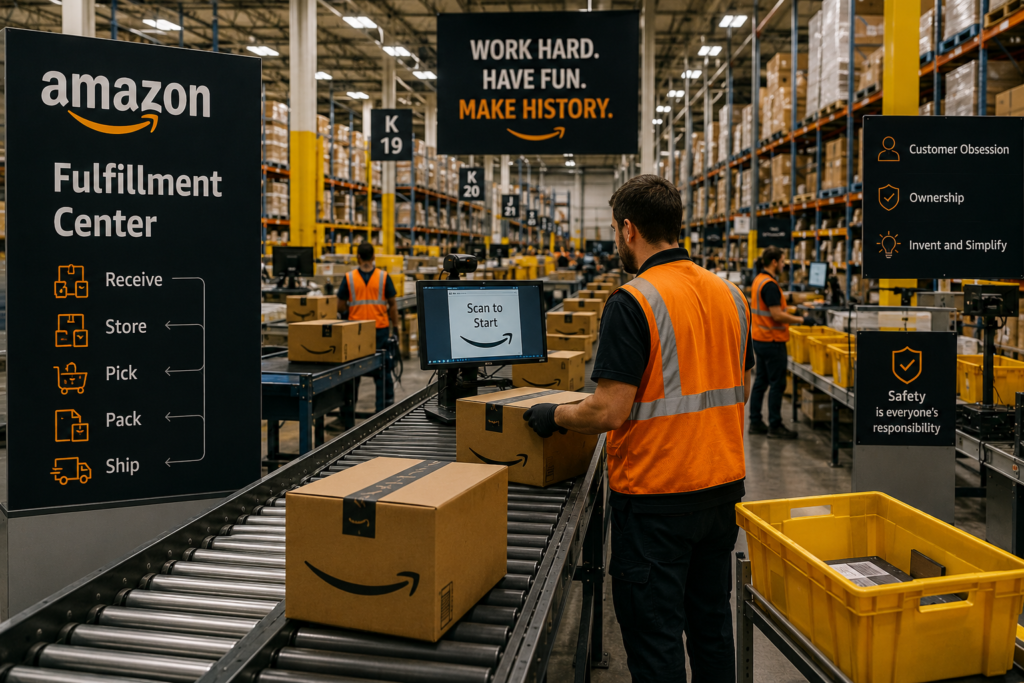
What Is Amazon FBA and How Does It Work?
FBA stands for Fulfilment by Amazon. Here’s how the basic process works:
You source a product — either by manufacturing your own, buying wholesale, or using a supplier — and ship it to one of Amazon’s fulfilment centres. Amazon stores your inventory in their warehouse. When a customer orders your product on Amazon, Amazon picks, packs, and ships the order on your behalf. Amazon also handles customer service and returns for FBA orders.
In exchange for this service, Amazon charges fulfilment fees (based on the size and weight of your product) and storage fees (based on how long your inventory sits in their warehouse).
The appeal of FBA is that it allows you to run a product business without needing your own warehouse, shipping infrastructure, or customer service team. Amazon’s logistics network is world-class, and FBA products are eligible for Amazon Prime — meaning millions of Prime members will see your product with the Prime badge, significantly increasing conversion rates.
The Different Ways to Sell on Amazon FBA
Before diving into the mechanics, it’s important to understand that there are several different business models for selling on Amazon FBA. Each has different capital requirements, risk levels, and earning potential.
Private Label
This is the most popular Amazon FBA model and the one most people mean when they talk about “Amazon FBA.” Private labelling means sourcing a generic product — typically from a manufacturer in China or another country — putting your own brand on it, and selling it as your own product on Amazon.
The advantages are significant: you own the listing, control the pricing, and build a brand asset that can be grown or eventually sold. The disadvantages are the higher upfront investment required (typically $2,000-5,000 minimum to start) and the research required to find viable products.
Wholesale
Wholesale FBA involves buying branded products in bulk from distributors or manufacturers at a discount and reselling them on Amazon at a profit. This model requires less creativity than private label but more capital, as you’re competing on existing listings rather than creating your own.
Retail Arbitrage
Retail arbitrage means buying discounted products from physical retail stores — clearance sales, liquidation, and so on — and reselling them on Amazon at a higher price. This can be started with very little capital and is a good way to learn the FBA basics, but it’s time-intensive and difficult to scale.
Online Arbitrage
Similar to retail arbitrage but sourcing products from online stores rather than physical shops. More scalable than retail arbitrage but still limited compared to private label.
For most beginners with a goal of building a serious income stream, private label is the model worth pursuing. The rest of this guide focuses primarily on the private label approach.
Step 1: Understand the Costs Involved
One of the most important things to understand before starting Amazon FBA is that it requires upfront capital. This isn’t a zero-investment side hustle. Here’s a realistic breakdown of startup costs for a private label FBA business:
- Product sourcing (initial inventory order): $1,000-3,000
- Amazon seller account: $39.99/month (professional plan) or per-item fee on the individual plan
- Product photography: $100-300 (professional photos are essential)
- Trademark registration (optional but recommended): $250-400
- Samples from suppliers: $50-200
- Shipping from supplier to Amazon: $200-600 depending on product size and shipping method
- Initial marketing and PPC advertising: $200-500
A realistic minimum budget to start an Amazon FBA private label business properly is $3,000-5,000. Starting with less is possible but significantly increases the risk of running out of inventory before generating enough revenue to reorder.
Step 2: Find a Profitable Product
Product research is the most critical step in building a successful Amazon FBA business. The right product can generate thousands of dollars per month. The wrong product can cost you your entire investment.
What makes a good Amazon FBA product? Here are the key criteria:
Strong, consistent demand. You want a product that people are actively searching for and buying year-round, not something seasonal or trend-dependent. A good starting benchmark is at least 300 sales per month across the top sellers in your target category.
Manageable competition. Highly competitive categories — electronics, supplements, phone cases — are dominated by established brands with thousands of reviews and massive advertising budgets. As a beginner, you want categories where the top sellers have fewer than 500 reviews and where a new product can realistically compete.
Good profit margins. After Amazon fees, cost of goods, shipping, and advertising, you need enough margin to make the business worthwhile. A minimum 30% profit margin is a commonly cited target, though higher is obviously better.
Simple to source and ship. Complex products with many components, fragile products, or products with strict regulatory requirements are more difficult for beginners. Start with something simple — a kitchen accessory, a fitness product, a home organisation item.
Not dominated by Amazon itself. If Amazon sells the product directly under its own brand, competing is very difficult. Check whether Amazon Basics or another Amazon private label brand appears prominently in the search results.
Tools for product research include Jungle Scout, Helium 10, and AMZScout. These paid tools provide sales data, competition analysis, and trend information that makes product research significantly faster and more accurate. Most offer free trials.

Step 3: Find a Reliable Supplier
Once you’ve identified a promising product, you need to find a manufacturer or supplier to produce it. For most private label sellers, this means working with manufacturers in China through platforms like Alibaba or Global Sources.
Here’s how to approach supplier sourcing:
Search for your product on Alibaba. You’ll typically find dozens of manufacturers. Look for suppliers with “Gold Supplier” status and good transaction histories.
Contact multiple suppliers. Send a detailed inquiry to at least five suppliers explaining what you’re looking for, your expected order quantity, and asking for their pricing, minimum order quantity (MOQ), and production timeline.
Order samples. Before committing to a full order, always order samples from your shortlisted suppliers. This allows you to assess product quality firsthand and compare suppliers.
Negotiate. Prices on Alibaba are rarely fixed. Negotiate on price, minimum order quantity, packaging, and payment terms.
Verify the supplier. For larger orders, consider paying for a third-party factory audit or quality inspection service to verify that the supplier is legitimate and the products meet your standards.
Building a good relationship with a reliable supplier is one of the most valuable assets in an Amazon FBA business.
Step 4: Create Your Amazon Seller Account
Setting up an Amazon seller account is straightforward. Go to sell.amazon.com and follow the registration process. You’ll need:
- Business or personal bank account details
- Credit card
- Government ID
- Tax information
- Phone number
Choose the Professional selling plan ($39.99/month) rather than the Individual plan if you plan to sell more than 40 units per month, as the per-item fee on the Individual plan becomes more expensive at higher volumes.
Once your account is set up, enrol in Amazon Brand Registry if you have a registered trademark for your brand. Brand Registry gives you access to A+ Content (enhanced product descriptions with images), brand protection tools, and better advertising options.
Step 5: Create a High-Converting Product Listing
Your product listing is your storefront on Amazon. A poorly optimised listing means poor visibility in search results and low conversion rates. A well-optimised listing means more customers finding and buying your product.
Key elements of a strong Amazon listing:
Title: Include your primary keyword naturally, along with key product features. Amazon’s algorithm uses the title heavily for search ranking.
Bullet points: Five bullet points highlighting the key features and benefits of your product from the customer’s perspective. Focus on what problems your product solves.
Product description or A+ Content: More detailed information about your product, brand story, and additional features.
Backend keywords: Hidden keywords in your seller account that tell Amazon’s algorithm what your product is relevant for without cluttering your visible listing.
Professional photography: This cannot be overstated. On Amazon, customers can’t touch or try your product — your images are everything. Invest in professional product photography with a white background for the main image, plus lifestyle images showing the product in use.
Step 6: Launch Your Product
Getting your first sales and reviews is the hardest part of launching on Amazon. Without reviews, customers are reluctant to buy. Without sales, you don’t rank in search results. Breaking this chicken-and-egg problem requires a deliberate launch strategy.
Effective launch tactics include:
Amazon PPC advertising: Pay-Per-Click ads on Amazon are the most direct way to drive traffic to a new listing. You pay each time someone clicks your ad, and your product appears at the top of search results. A PPC budget of $10-20 per day during launch is typical for a new product.
Friends and family purchases: Asking friends and family to purchase your product (paying them back separately) generates initial sales velocity that signals to Amazon’s algorithm that your product is selling well.
Product launch services: Several services specialise in connecting sellers with reviewers, though Amazon’s terms of service around reviews are strict and must be followed carefully.
Amazon Vine programme: Once enrolled in Brand Registry, you can submit products to Amazon Vine, which sends free units to trusted reviewers in exchange for honest reviews.
Step 7: Optimise and Scale
Once your product is live and generating initial sales, the work shifts to optimisation and scaling.
Monitor your PPC campaigns closely and adjust bids based on which keywords are generating profitable sales. Optimise your listing based on customer feedback — if reviews mention a common issue, address it in your listing or with the supplier.
As your product generates cash flow, reinvest profits into more inventory and eventually additional products. Most successful Amazon FBA sellers build a portfolio of multiple products rather than relying on a single SKU.
Common Mistakes Amazon FBA Beginners Make
Choosing the wrong product. This is the most costly mistake. Insufficient product research leads to launching into categories that are too competitive, products with too little demand, or items with margins too thin to be profitable after fees.
Underestimating cash flow needs. Amazon FBA is cash-intensive. You need to pay for inventory before you receive payment from Amazon, and you need to reorder before you run out of stock. Running out of stock kills your ranking and momentum. Always have a clear picture of your cash flow.
Ignoring Amazon’s fees. Amazon’s fees — fulfilment fees, referral fees, storage fees, advertising costs — can eat into margins significantly if not accounted for properly. Use Amazon’s FBA calculator to model your profitability before ordering inventory.
Launching without reviews. Launching a product with zero reviews and expecting organic sales is unrealistic. Have a review generation strategy in place from day one.
Giving up too early. Amazon FBA takes time. Most sellers don’t see significant profitability in their first few months. The learning curve is real, and persistence is essential.
Is Amazon FBA Right for You?
Amazon FBA is an excellent opportunity for people who are willing to invest time, money, and effort into building a real business. It’s not passive income in the true sense — at least not initially. It requires active management, continuous learning, and ongoing optimisation.
But for those who approach it seriously, the potential is significant. Many Amazon FBA sellers generate $5,000-20,000 per month in revenue within their first year, with profit margins of 20-35% or more. Some go on to build seven-figure businesses.
If you have $3,000-5,000 to invest, the willingness to do thorough research, and the patience to work through the learning curve, Amazon FBA is one of the most legitimate and scalable online business opportunities available today.

The Bottom Line
Amazon FBA gives ordinary people access to the world’s largest marketplace and Amazon’s world-class logistics infrastructure. Starting from scratch requires capital, research, and persistence — but the potential rewards are significant.
Start with thorough product research. Find a reliable supplier. Create a professional listing. Launch with a PPC strategy. Optimise based on data. Scale what works.
It won’t happen overnight. But for those willing to do the work, Amazon FBA can become a genuinely life-changing income stream.
Frequently Asked Questions:
What is Amazon FBA and how does it work?
FBA stands for Fulfillment by Amazon. You source products, send them to Amazon’s warehouses, and Amazon handles storage, packing, shipping, and customer service. You focus on finding and selling products — Amazon handles the logistics.
How much money do I need to start Amazon FBA?
Most beginners start with $500-$2,000 for initial inventory, plus Amazon seller fees. It’s possible to start with less using retail arbitrage — buying discounted products from stores and reselling them on Amazon — but private label products typically require more upfront capital.
Is Amazon FBA still profitable in 2026?
Yes, but it’s more competitive than it was five years ago. Success requires proper product research, competitive pricing, and strong listings. Sellers who treat it as a real business with proper research and planning still generate significant profits.
What are the biggest risks of Amazon FBA?
Inventory risk is the main one — if a product doesn’t sell, you’re stuck with stock and storage fees. Other risks include policy changes by Amazon, increased competition, and counterfeit issues. Thorough product research before investing minimizes these risks significantly.
How long does it take to make money with Amazon FBA?
Most beginners see their first sales within a few weeks of listing, but becoming consistently profitable typically takes 3-6 months. Building a sustainable FBA business that generates meaningful income usually takes 12-18 months of consistent effort.
Do I need my own products to sell on Amazon FBA?
No. You can start with retail arbitrage (buying and reselling existing products), online arbitrage, or wholesale. Private label — creating your own branded products — offers higher margins but requires more upfront investment and product development.
Disclaimer: This article is for informational purposes only and does not constitute financial advice.