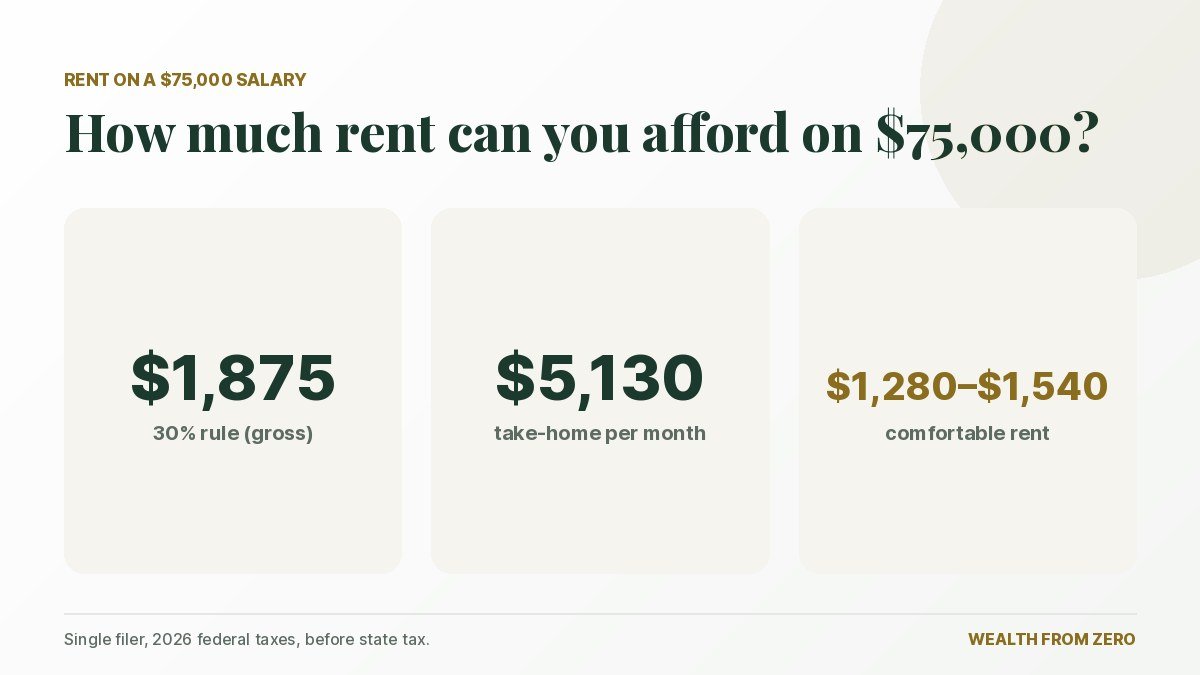
How much rent can I afford on $75,000 a year? The quick answer: about $1,875 a month under the classic 30% rule, the same figure most landlords’ 40× income test gives. But that number is based on pay before taxes. On your actual take-home pay of about $5,130 a month, a rent of $1,280–$1,540 is the range that still leaves real room to save. That covers the typical rent in most of the 50 largest U.S. metros, but not in the most expensive coastal ones.
This guide works through the numbers the way a lender or a careful budgeter would: your take-home pay line by line, four ways to set a rent limit, how debt, a roommate or a 401(k) changes the answer, where the typical rent fits a $75,000 salary in the 50 largest U.S. metros, and what landlords will check when you apply.
Key numbers for a $75,000 salary
- 30% of gross income: $1,875/month
- Landlord 40× rule: $1,875/month (3× rule: about $2,080)
- Take-home pay (single, 2026 federal taxes): about $5,130/month
- Comfortable rent (25–30% of take-home): $1,280–$1,540
- Hourly equivalent: about $36 an hour at 40 hours a week
How Much Rent Can I Afford on $75,000? Four Ways to Calculate It
No single rule is “right.” Each one answers a slightly different question, so it helps to see all four side by side before you choose a target.
1. The 30% rule (gross income): $1,875
$75,000 × 30% ÷ 12 = $1,875 a month. The 30% line comes from U.S. housing policy, where households paying more than 30% of income for housing are counted as “cost-burdened.” It is a useful ceiling, but it ignores taxes, debt and where you live.
2. The landlord’s 40× rule: $1,875
Many landlords and property managers want your yearly gross income to be at least 40 times the monthly rent: $75,000 ÷ 40 = $1,875. Others ask for monthly income of three times the rent, which works out to about $2,080. This is the number that decides whether your application is approved, not whether the rent is comfortable.
3. The take-home method: $1,280–$1,540
This method starts from the money that actually lands in your account. Keeping rent at 25–30% of take-home pay gives $1,280–$1,540. It is the most conservative of the four, and the one we recommend if you want to save at least 15–20% of your pay.
4. The 50/30/20 method: up to $1,300
The 50/30/20 rule puts all your needs, not just rent, into 50% of take-home pay. With about $1,270 a month of other essentials (utilities, groceries, transportation, phone, insurance and minimum debt payments), the most you could spend on rent and still stay inside 50% is about $1,300. If your other essentials cost more, this cap drops dollar for dollar.
| Method | What it measures | Rent on $75,000 |
|---|---|---|
| 30% of gross | The traditional affordability ceiling | $1,875 |
| 40× rule | What many landlords require to approve you | $1,875 |
| 25–30% of take-home | A comfortable rent that leaves room to save | $1,280–$1,540 |
| 50/30/20 | Rent that keeps all needs at 50% of take-home | up to $1,300 |
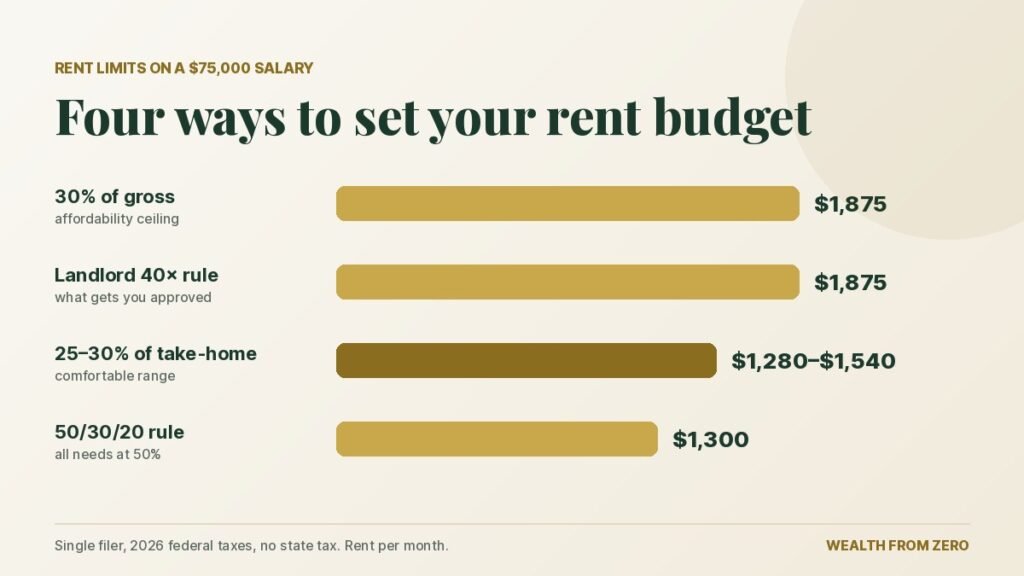
Here the methods start to agree: the 50/30/20 cap of about $1,300 is close to the take-home range. On $75,000, essentials take only about 25% of take-home, so following 50/30/20 while renting a typical apartment is realistic in many metros.
Your Take-Home Pay on a $75,000 Salary
| Per year | Per month | Every 2 weeks | |
|---|---|---|---|
| Gross salary | $75,000 | $6,250 | $2,885 |
| Federal income tax* | −$7,670 | −$639 | −$295 |
| Social Security + Medicare (7.65%) | −$5,738 | −$478 | −$221 |
| Take-home before state tax | $61,592 | $5,130 | $2,369 |
*Single filer, $16,100 standard deduction and 2026 federal tax brackets (IRS Rev. Proc. 2025-32), plus 7.65% for Social Security and Medicare. Your federal tax is about 10% of gross pay; your top bracket is 22%.
How your state changes the answer
State income tax is the biggest reason two people on the same salary have different budgets. Nine states don’t tax wages at all: Alaska, Florida, Nevada, New Hampshire, South Dakota, Tennessee, Texas, Washington and Wyoming. Elsewhere, rates and deductions vary a lot, so the table below uses simple round percentages to show the effect rather than any single state’s exact tax.
| If you live somewhere with… | Take-home per month | Comfortable rent |
|---|---|---|
| No state income tax | about $5,130 | $1,280–$1,540 |
| State tax of about 3% of pay | about $4,940 | $1,240–$1,480 |
| State tax of about 5% of pay | about $4,820 | $1,200–$1,450 |
The difference between a no-tax state and a 5% state is about $310 a month on $75,000, roughly $90 less you can comfortably put toward rent. Check your own state’s rate, or use a recent pay stub, before you sign a lease.
Step by Step: How Much Rent Can I Afford on $75,000 in My Budget?
- Start with your real take-home pay. Use a recent pay stub, not your salary. On $75,000 with no state tax, that is about $5,130 a month.
- Subtract your fixed non-rent costs. List utilities, groceries, transportation, phone, insurance and every minimum debt payment. Our example uses $1,270.
- Pay your savings first. Set aside 20% of take-home ($1,030) for your emergency fund and retirement before you look at listings.
- Leave room for everything else. Clothes, gifts, eating out and irregular costs need a line too. The example uses 25% of take-home ($1,280).
- What’s left is your rent ceiling. $5,130 − $1,270 − $1,030 − $1,280 = $1,550.
That $1,550 ceiling, with a full 20% saved, sits right at the top of the comfortable range. In other words, on $75,000 you can rent a typical apartment in most metros and still save seriously, as long as you don’t also carry large loan payments. Run the same steps with your own numbers in our 50/30/20 budget calculator.
How Much Rent Can I Afford on $75,000 With Debt or a Roommate?
Using the same step-by-step ceiling of $1,550 as the starting point, here is how common situations change the most you can pay while still saving 20%:
| Situation | Maximum rent | Why |
|---|---|---|
| Base case (no extra debt) | $1,550 | Essentials of about $1,270/month, 20% saved |
| Student loan payment of $300/month | $1,250 | A debt payment comes straight out of what’s left for rent |
| Car payment of $450/month | $1,100 | Insurance is already in the base case |
| Splitting a two-bedroom with a roommate | a $3,080 unit | Your $1,540 share stays in the comfortable range |
What about a 401(k)? Putting 5% of your salary ($312 a month) into a pre-tax 401(k) lowers take-home pay by only about $240, because it also lowers your federal income tax. Since that money is savings, it counts toward your savings goal, so your rent ceiling barely moves. If your employer matches contributions, it is usually worth getting the full match before stretching for a bigger apartment.
On $75,000 the scenarios still leave a reasonable rent. The bigger risk at this income is lifestyle creep: a larger apartment, then furniture, then a newer car. Each step looks affordable on its own.
How Much Rent Can I Afford on $75,000 in the 50 Largest Metros?
We compared the 30% budget of $1,875 with the typical rent in each of the 50 largest U.S. metros, using the Zillow Observed Rent Index for August 2026, the same data behind our income needed to afford rent by city study. Zillow’s typical rent covers all home sizes, so a studio or one-bedroom usually costs less than the figure shown.
On $75,000, the typical rent fits the 30% rule in 30 of the 50 largest metros. Another 7 are above 30% of gross but under 40% of take-home. The 13 that stay out of reach are mostly the expensive coastal metros, where the typical rent runs from about $2,167 to $3,815. The table shows the metros around that line.
| Metro | Typical rent (Aug 2026) | Share of $75,000 take-home |
|---|---|---|
| Las Vegas, NV | $1,742 | 34% |
| Charlotte, NC | $1,749 | 34% |
| Nashville, TN | $1,813 | 35% |
| Portland, OR | $1,818 | 35% |
| Atlanta, GA | $1,853 | 36% |
| Virginia Beach, VA | $1,891 | 37% |
| Philadelphia, PA | $1,911 | 37% |
| Denver, CO | $1,922 | 37% |
| Orlando, FL | $1,942 | 38% |
| Baltimore, MD | $1,948 | 38% |
| Tampa, FL | $2,001 | 39% |
| Hartford, CT | $2,034 | 40% |
| Providence, RI | $2,167 | 42% |
| Chicago, IL | $2,210 | 43% |
| Seattle, WA | $2,278 | 44% |
Typical rent at or under $1,875: 30 of 50 metros. Over 30% of gross but under 40% of take-home: 7. Over 40% of take-home: 13.
What a $75,000 Budget Looks Like at Three Rent Levels
Here is how $5,130 a month of take-home pay splits at three rents, with typical costs for a single renter:
| Monthly | $1,400 rent | $1,875 rent | $2,200 rent |
|---|---|---|---|
| Rent | $1,400 | $1,875 | $2,200 |
| Utilities + internet | $190 | $190 | $190 |
| Groceries | $420 | $420 | $420 |
| Transportation | $380 | $380 | $380 |
| Phone + insurance + minimum debt | $280 | $280 | $280 |
| Needs total | $2,670 (52%) | $3,145 (61%) | $3,470 (68%) |
| Left for savings and wants | $2,460 | $1,985 | $1,660 |
At $1,400 you can save 20% ($1,026) and still invest more on top. Paying the full 30% budget of $1,875 while saving 20% still leaves about $959 a month for other spending; this is the salary where the 30% rule starts to work as intended. At $2,200, needs pass 68% of take-home.
Costs Beyond the Rent Check on a $75,000 Salary
When you ask how much rent you can afford on $75,000, count more than the advertised rent. Before you compare a listing with your $1,280–$1,540 target, add up:
- Utilities. Ask which ones are included. Heating and cooling can swing a lot by season and building age.
- Renters insurance. Many leases require it. It is usually inexpensive and covers your belongings and liability.
- Parking, pet rent and amenity fees. These recurring charges are often listed separately from rent.
- Commute. A cheaper place farther away can cost more overall once you add gas, transit or a second car.
- Move-in money. First month’s rent, a security deposit (often one month’s rent), application fees and movers. On a $1,875 apartment, plan for roughly $3,750–$4,650 upfront, kept separate from your emergency fund.
What Landlords Check When You Apply
Qualifying for an apartment and affording it are different questions. How much rent can I afford on $75,000 in a landlord’s eyes? The income test will approve rents up to about $1,875 (40× rule) or $2,080 (3× rule). Expect to show:
- Proof of income, such as recent pay stubs, an offer letter or tax returns if you are self-employed.
- A credit check. Landlords look at payment history and existing debt. If your credit is thin, our guide on building credit from scratch can help before your next move.
- Rental history and references from previous landlords.
- A guarantor or a larger deposit if your income or credit falls short. A guarantor helps you get approved, but it doesn’t make the rent any easier to pay each month.
Why Renting Below Your Maximum Pays Off
Choosing a $1,410 apartment instead of one at the full 30% limit of $1,875 frees about $465 a month. Invested every month for 10 years at a hypothetical 7% average annual return, that would grow to roughly $80,500. Returns are never guaranteed, but the habit of renting below what you can technically afford is one of the simplest ways to build savings without feeling deprived. See the math for your own numbers with our compound interest calculator.
How to Use the Extra Room Well
- Don’t rent to your maximum by default. The difference between $1,500 and $1,875 is $4,500 a year, more than half of the $7,500 IRA limit for 2026.
- Lower your taxable income. Pre-tax 401(k) contributions save 22 cents of federal tax on every dollar at this income, so saving costs less than it looks.
- Negotiate from strength. Strong income and good credit make you an attractive tenant; ask for a concession or a longer lease at today’s rent.
- In expensive metros, consider the trade-off. A typical rent above $2,200 pushes needs past 65% of take-home. A slightly smaller unit keeps your savings rate intact.
- Watch the add-ons. Parking, pet rent and amenity fees can add hundreds a month in newer buildings.
- Plan the next step. If you want to buy a home eventually, the gap between your rent and the 30% limit is your down-payment fund.
More ideas in how to save money on rent and how to negotiate rent.
How Much Rent Can You Afford at Other Salaries?
| Salary | 30% of gross | Take-home per month | Comfortable rent |
|---|---|---|---|
| $30,000 | $750 | about $2,190 | $550–$660 |
| $40,000 | $1,000 | about $2,860 | $720–$860 |
| $50,000 | $1,250 | about $3,530 | $880–$1,060 |
| $60,000 | $1,500 | about $4,200 | $1,050–$1,260 |
| $75,000 | $1,875 | about $5,130 | $1,280–$1,540 |
| $100,000 | $2,500 | about $6,600 | $1,650–$1,980 |
Frequently Asked Questions
Can I afford $2,500 rent on $75,000 a year?
$2,500 is 40% of gross pay and 49% of take-home. It’s doable only with very low other costs; many landlords using the 40× rule would want $100,000 of income.
How much rent can I afford making $35 an hour?
Full time, $35 an hour is $72,800 a year: about $1,820 a month at 30% of gross, or roughly $1,250–$1,500 at 25–30% of take-home.
Does a 401(k) contribution change how much rent I can afford?
Landlords use gross income, so it doesn’t change what you qualify for. It does lower your take-home pay, so if you save 10% in a 401(k), set a comfortable rent from your actual paycheck.
Is it better to rent cheaper and invest the difference?
For many people, yes. Renting a few hundred dollars below your maximum and investing that money is one of the simplest ways to build wealth without changing anything else in your budget.
Is $75,000 a good salary to live alone?
In most of the 50 largest metros, yes: the typical rent fits the 30% rule in 30 of them. In the most expensive coastal metros, living alone in a typical apartment would take more than 40% of take-home pay.
How much rent can a couple earning $75,000 afford?
The 30% rule gives $1,875 a month. Filing jointly usually lowers federal tax compared with a single filer at the same income, so a couple’s take-home pay is a little higher than our table shows.
The Bottom Line
So, how much rent can I afford on $75,000? Landlords will usually approve you up to about $1,875 a month, but a rent of $1,280–$1,540 is what keeps your budget healthy, with room to save and handle surprises. This is the income where you can have both a typical apartment and a strong savings rate in most metros. Keep it that way by treating 30% as a ceiling, not a target.
How We Calculated These Numbers
Take-home pay assumes a single filer with no other income, the 2026 standard deduction of $16,100, 2026 federal income tax brackets and the 7.65% employee share of Social Security and Medicare. It excludes state and local taxes, health insurance and other payroll deductions unless noted. Typical rents are Zillow Observed Rent Index (ZORI) values for August 2026, smoothed, all homes plus multifamily, at the metro level. The 7% return used in the investing example is hypothetical and not a forecast.
Sources
- IRS Rev. Proc. 2025-32: 2026 tax brackets and standard deduction
- IRS Topic 751: Social Security and Medicare withholding rates
- Zillow Research: Zillow Observed Rent Index (ZORI), August 2026
- IRS: 401(k) contribution limits
This article is for education, not personal financial advice. Landlord requirements and state taxes vary; check the details for your situation.