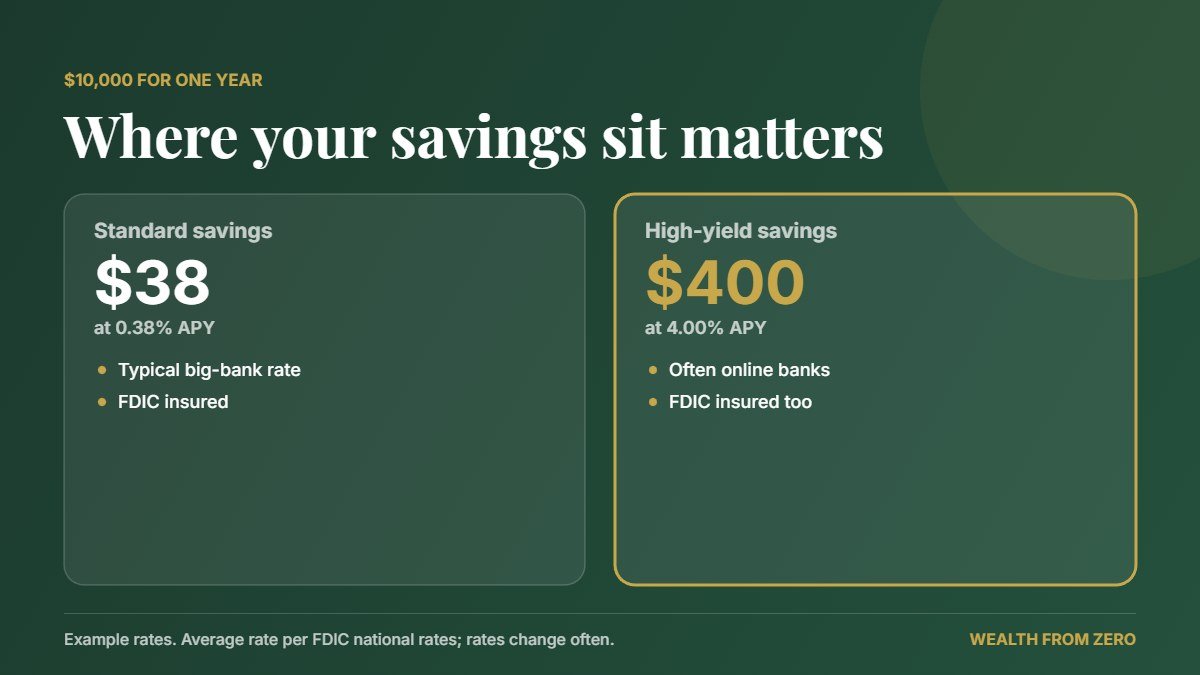
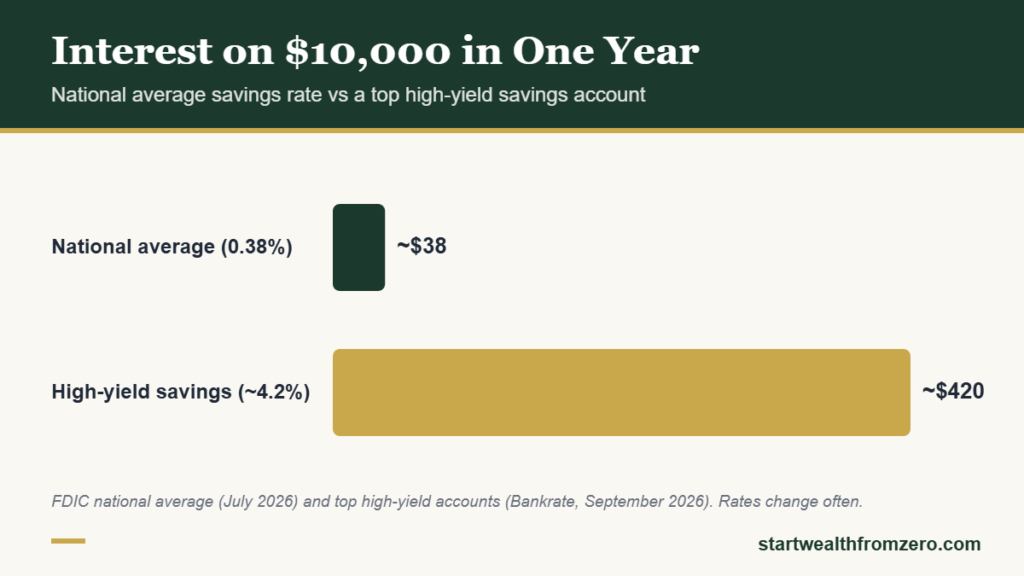
A high yield savings account is the single easiest upgrade any saver can make in 2026. The national average savings rate sits at 0.38% APY — but the best high yield savings accounts are paying around 4.0–4.2% APY right now. On a $10,000 emergency fund, that’s the difference between earning $38 per year and earning $410. Same money, same effort, 10x the return. Related: how to build an emergency fund.
This guide covers the best high yield savings accounts available in September 2026, explains exactly how they work, and tells you which one is right for your situation.

Competitive high-yield savings accounts were paying around 4.0–4.2% APY in September 2026 — roughly ten times the 0.38% national average savings rate reported by the FDIC.
What Is a High Yield Savings Account?
A high yield savings account (HYSA) is a savings account that pays significantly more interest than a standard savings account. They’re offered primarily by online banks, which have lower overhead costs than traditional banks with physical branches — and pass those savings on to customers as higher interest rates. Related: how interest rates affect savings accounts.
HYSAs work exactly like a regular savings account: your money is FDIC-insured up to $250,000, accessible within 1-3 business days, and earns interest daily. The only difference is the rate — which in 2026 is 10-40x higher than what most people are earning at traditional banks.
Why Are High Yield Savings Rates Still High in 2026?
After cutting rates three times in 2025 and holding steady for most of 2026, the Federal Reserve raised its benchmark rate to 3.75%–4.00% on September 16, 2026. Online banks are competing for deposits with rates of around 4.0–4.2% APY. That is lower than the 5%+ peaks of 2023 and only modestly above inflation — consumer prices rose 3.4% over the year to July 2026 (BLS) — so a HYSA protects your cash but won’t grow it much in real terms.
The window for earning 4%+ on savings may not last indefinitely — if the Fed cuts rates further in late 2026, these rates will follow. Locking in a high yield savings account now ensures you earn the best available rate for as long as possible.
How to Choose the Best High Yield Savings Account
Not all high yield savings accounts are equal. Here’s what actually matters when comparing options:
| Factor | What to Look For | Red Flag |
|---|---|---|
| APY | 4.00%+ in current environment | Promotional rates that drop after 3-6 months |
| Minimum balance | $0 minimum for full rate | $25,000+ required for top rate |
| Monthly fees | $0 | Any monthly fee negates the interest benefit |
| FDIC insurance | Up to $250,000 guaranteed | No FDIC or NCUA insurance |
| Transfer speed | 1-3 business days | 5+ business days (too slow for emergencies) |
| Savings buckets | Multiple named accounts (like Ally) | Single account with no sub-account option |
| Mobile app | Highly rated, easy transfers | No mobile app or poor reviews |
Best High Yield Savings Account by Use Case
| Your Situation | Best Option | Why |
|---|---|---|
| Want absolute highest rate | SoFi (with direct deposit) or CIT Bank | a competitive APY (check current rate) |
| No minimum balance requirement | Marcus by Goldman Sachs | no minimum balance |
| Want multiple savings buckets | Ally Bank | Up to 30 named “buckets” within one account |
| Existing Capital One customer | Capital One 360 | Easy integration with existing accounts |
| AmEx cardholder | American Express HYSA | Seamless integration, competitive APY |
| Building an emergency fund | Marcus or Ally | No minimum, good rate, accessible |
| Sinking funds | Ally Bank | Name each bucket (Car Fund, Christmas, etc.) |
Is a High Yield Savings Account Safe?
Yes — with one important caveat. All reputable high yield savings accounts at established online banks are FDIC-insured (or NCUA-insured for credit unions) up to $250,000 per depositor, per institution. This means even if the bank fails, your money is protected by the federal government up to that limit.
The key is choosing an established bank. Marcus (Goldman Sachs), Ally, Capital One, American Express, and CIT are all large, regulated institutions with full FDIC coverage. Avoid obscure fintech apps offering unusually high rates without clear FDIC insurance disclosure.
High Yield Savings Account vs CD vs Money Market: Which Wins?
| High Yield Savings | CD (1-year) | Money Market Account | Treasury Bills | |
|---|---|---|---|---|
| Typical top rate (Sept 2026) | ~4.0–4.2% | ~4.2–4.5% | ~3.5–4.0% | ~3.7–4.4% (by term) |
| Access to money | ✅ Anytime (1-3 days) | ❌ Locked for term | ✅ Anytime | ⚠️ Locked until maturity |
| Rate changes | Variable (can drop) | Fixed for term | Variable | Fixed |
| Minimum balance | $0–$5,000 | $500–$1,000 | $0–$2,500 | $100 |
| Best for | Emergency fund, sinking funds | Money you won’t touch for 1+ years | Large balances needing check-writing | Money you won’t need for 3-12 months |
Verdict: For emergency funds and sinking funds — money you may need quickly — a high yield savings account wins. For money you definitely won’t need for 12 months, a CD or T-Bill will earn slightly more. Don’t sacrifice liquidity chasing an extra 0.3% on money earmarked for emergencies.
Best High-Yield Savings Accounts in 2026: Rates Compared
Top high-yield savings accounts were paying around 4.0–4.2% APY in September 2026 (Bankrate), versus a national average of 0.38% (FDIC, July 2026). Individual bank rates change often, so the table below compares the features that stay stable — check each bank’s site for its current APY before opening.
| Bank | Minimum balance | Monthly fees | Best for |
|---|---|---|---|
| Ally Bank | $0 | None | All-round online banking with savings “buckets” |
| Marcus by Goldman Sachs | $0 | None | Established brand, simple savings-only account |
| SoFi Checking & Savings | $0 | None | Higher rate tier when you set up direct deposit |
| Capital One 360 Performance Savings | $0 | None | Branch and café access alongside online banking (Capital One acquired Discover in 2025) |
| Fidelity Cash Management Account | $0 | None | Keeping cash next to your Fidelity investments |
| Big-bank standard savings | Varies | Often $5–$15 unless waived | Convenience only — rates are often close to 0.01% |
Rates are approximate top-of-market figures for September 2026 based on Bankrate’s savings and CD rate surveys and published Treasury yields. They change frequently — confirm current rates with the bank or at TreasuryDirect before committing money.
Rates change frequently — always verify the current APY directly on the bank’s website before opening an account. The gap between the best HYSA and a traditional savings account remains significant: on a $10,000 balance, the difference between the 0.38% national average and a 4.20% APY is about $382 per year in extra interest with zero additional effort or risk.
When NOT to Use a High-Yield Savings Account
A HYSA is the right tool for specific jobs. It’s the wrong tool for others:
- Long-term investing. At 4.10% APY, a HYSA doesn’t keep pace with inflation over 20-30 years. For money you won’t touch for 10+ years, a total market index fund averaging 7% real return is a better choice. See our investing for beginners guide.
- Money you need to grow aggressively. If you’re trying to build serious wealth, HYSAs are a holding vehicle, not a wealth-building tool. The 4% you earn will barely beat inflation.
- Daily spending money. A HYSA is for savings, not transactions. Keep your checking account for daily spending and only transfer to the HYSA what you won’t need for at least 30-90 days.
The right use of a HYSA: emergency fund (3-6 months expenses), short-term savings goals (vacation, car, home deposit within 1-3 years), and parking money while deciding where to invest it. For anything beyond 3 years, investments beat savings accounts. Use our Savings Calculator to see exactly how fast your HYSA grows.
How to Open a High-Yield Savings Account: Step by Step
- Choose a bank. Compare two or three online banks with no monthly fees and no minimum balance. Top accounts were paying around 4.0–4.2% APY in September 2026, but rates change frequently — always confirm the current rate on the bank’s own website before opening.
- Complete the online application. Takes 5-10 minutes. You’ll need your Social Security Number, address, and a government ID. Most banks do a soft credit check (doesn’t affect your score).
- Fund the account. Link your existing checking account and transfer your initial deposit. Many accounts have no minimum, but starting with at least one month of expenses is recommended.
- Set up automatic transfers. Schedule a recurring transfer on payday. Even $100/month automatically moved to a HYSA earning 4% will grow to $14,800 in 10 years.
- Verify FDIC insurance. Confirm your bank is FDIC-insured at FDIC BankFind. This takes 30 seconds and confirms your deposits up to $250,000 are protected.
Frequently Asked Questions About High-Yield Savings Accounts
Are high-yield savings accounts safe?
Yes — all accounts on this page are FDIC-insured up to $250,000 per depositor. This means even if the bank fails, the federal government guarantees your deposits. In the history of FDIC insurance (since 1933), no depositor has lost a single cent in a federally insured account.
Do HYSAs have withdrawal limits?
Federal Regulation D previously limited savings account withdrawals to 6 per month, but the Federal Reserve suspended this rule in 2020. Most online banks no longer enforce withdrawal limits, though some still do — check your account terms.
Is interest from a HYSA taxable?
Yes. Interest earned in a HYSA is taxed as ordinary income in the year it’s earned. Your bank will send you a 1099-INT form if you earn more than $10 in interest during the tax year. On $10,000 earning 4.10% APY, you’d owe taxes on approximately $410 of interest income.
Can I have multiple high-yield savings accounts?
Yes, and many people do. You might use one for your emergency fund, another for a house deposit, and another for a vacation fund. Having separate accounts makes it easier to track progress toward each goal without mixing funds.
How often does a high yield savings account pay interest?
Most HYSAs compound interest daily and credit it to your account monthly. So your balance grows every day, and you see it added to your account balance at the end of each month.
Will my high yield savings rate change?
Yes — HYSA rates are variable and tied to the federal funds rate. When the Fed cuts rates, banks typically lower their HYSA rates within weeks. This is why locking in a CD makes sense for money you won’t need for 12+ months.
Is there a limit on how much I can put in a high yield savings account?
No limit on deposits, but FDIC insurance only covers up to $250,000 per depositor per institution. If you have more than $250,000 to save, spread it across multiple FDIC-insured banks.
High Yield Savings Account: The Bottom Line
A high yield savings account is the highest-return, zero-risk financial move available in 2026. You’re already saving money — the question is whether you’re earning 0.10% or 4.10% on it. Moving your emergency fund or sinking funds to a high yield savings account takes 10 minutes and costs nothing. The difference in interest earned over 12 months on $10,000 is about $400 — free money for doing nothing except choosing the right bank.
Once your savings are earning 4%+, the next step is making sure your monthly budget is set up to keep building them. Read our guide on the 50 30 20 budget rule to see how to consistently allocate 20% of your income to savings every month.
Disclaimer: This article is for informational purposes only and does not constitute financial advice. Rates are accurate as of September 2026 but are subject to change. Always verify current rates directly with the bank before opening an account.