
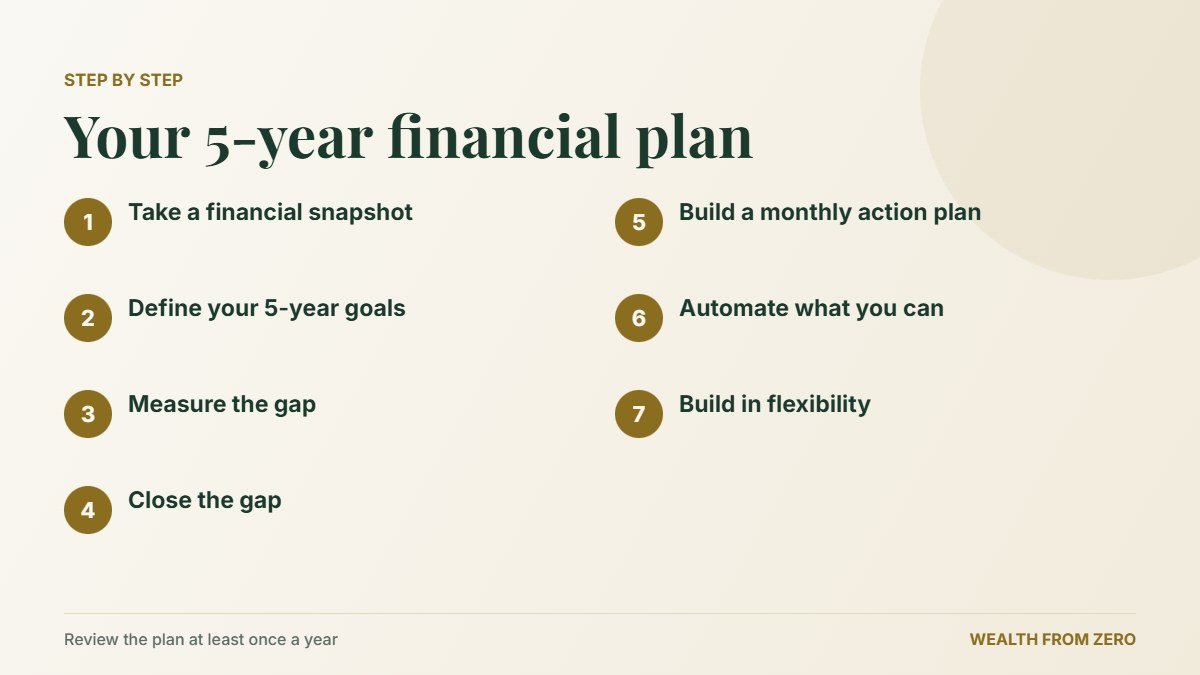
Most people have a vague sense of what they’d like their financial life to look like in five years. They want to be debt-free, or have a house deposit saved, or be earning more money, or simply feel less anxious about money than they do today. But having a vague wish and having a concrete plan are very different things — and the gap between them is where most financial intentions go to die.
According to the Bureau of Labor Statistics, the average US household spent about $78,535 in 2024 — roughly $6,545 a month.
A five-year financial plan bridges that gap. It takes your financial goals from abstract aspirations to specific, time-bound targets with clear action steps attached. It gives you a roadmap for where you want to go and a way of measuring whether you’re on track to get there.
This guide will walk you through exactly how to build a realistic, actionable five-year financial plan — one you’ll actually be able to follow.

Why Five Years Is the Right Planning Horizon
| Financial Plan Stage | Goal | Timeline | Key Action |
|---|---|---|---|
| Month 1–3 | Know your numbers | Now | Budget, track spending, check credit score |
| Month 3–12 | Build stability | Year 1 | $1,000 emergency fund, pay minimum debts |
| Year 1–2 | Eliminate debt | Year 1–2 | Pay off high-interest debt aggressively |
| Year 2–3 | Build security | Year 2–3 | 3–6 month emergency fund, start investing |
| Year 3–5 | Build wealth | Year 3–5 | 15–20% income invested, increase income |
Five years is long enough to achieve genuinely significant financial goals — paying off debt, saving a house deposit, building a meaningful investment portfolio, significantly increasing your income — but short enough to feel tangible and motivating rather than abstract and distant.
One-year plans often don’t allow enough time for meaningful change, particularly when starting from a difficult financial position. Ten-year plans are so far away that it’s hard to maintain motivation or account for the significant life changes that occur over a decade.
Five years hits a sweet spot: ambitious enough to be genuinely transformative, close enough to feel real.
Step 1: Take an Honest Financial Snapshot
Before you can plan where you’re going, you need to know exactly where you are. This step is uncomfortable for most people — but it’s non-negotiable. You cannot build an effective financial plan on vague or inaccurate foundations.
Your financial snapshot should cover four areas:
Income: What is your current monthly and annual take-home income from all sources? Include your salary, any side income, rental income, and any other regular income streams. Related: how to negotiate a salary increase.
Expenses: What do you actually spend each month? Not what you think you spend — what the bank statements show. Review the last three months and calculate your real average monthly spending across all categories.
Assets: What do you own that has financial value? This includes savings accounts, investment accounts, pension or retirement funds, property, and any other valuable assets.
Liabilities: What do you owe? List every debt — student loans, credit cards, car loans, personal loans, mortgage — with the current balance, interest rate, and minimum monthly payment for each.
Your net worth is your total assets minus your total liabilities. This number might be negative if you have significant debt. That’s okay — the point isn’t to feel good or bad about where you are, it’s to have an accurate starting point.
Step 2: Define Your Financial Goals for the Next Five Years
Now that you know where you’re starting from, you can define where you want to be. This is the most personal step in the process — the right goals for you depend entirely on your values, priorities, and life circumstances.
Common five-year financial goals include:
- Paying off all credit card debt
- Paying off student loans
- Saving a house deposit
- Building a six-month emergency fund
- Reaching a specific investment portfolio value
- Achieving a certain net worth
- Increasing income by a specific amount
- Saving enough to take a career break or change careers
When setting your goals, use the SMART framework:
Specific: “Save $20,000 for a house deposit” rather than “save more money.”
Measurable: The goal should have a clear number attached so you can track progress.
Achievable: The goal should be stretching but realistic given your starting point and realistic income growth.
Relevant: The goal should align with what genuinely matters to you, not what you think you should want.
Time-bound: Give each goal a specific deadline within your five-year window.
Prioritize your goals if you have several. You may not be able to aggressively pursue all of them simultaneously, and knowing which matter most helps you allocate resources effectively.

Step 3: Calculate the Gap Between Where You Are and Where You Want to Be
For each goal, calculate the gap between your current situation and your target. This turns abstract goals into concrete numbers.
For example:
- Goal: Save $20,000 house deposit in five years
- Current savings: $2,000
- Gap: $18,000
- Monthly saving required: $18,000 ÷ 60 months = $300 per month
- Goal: Pay off $15,000 in student loan debt in five years
- Current balance: $15,000
- Monthly payment required: $15,000 ÷ 60 months = $250 per month (plus interest)
Add up the monthly requirements for all your goals. This is the monthly surplus you need to achieve your five-year plan. Compare it to your current monthly surplus (income minus expenses). The difference between what you need and what you currently have is the gap you need to close — through reducing expenses, increasing income, or both.
Step 4: Close the Gap
If your required monthly surplus to achieve your goals exceeds your current surplus, you have three options: spend less, earn more, or adjust your goals.
Reduce your expenses
Go through your monthly spending and identify where cuts are possible. Focus on the areas with the most significant impact first — housing, transport, and food offer the biggest opportunities. Related: what to do with your first paycheck.
Look for recurring costs that can be eliminated or reduced: subscriptions you don’t use, insurance policies that haven’t been shopped around recently, utility providers that aren’t competitive.
Be realistic about what cuts you can sustain for five years. A budget so restrictive that it makes you miserable is one you’ll abandon within months. Build in reasonable amounts for the things that genuinely matter to you.
Increase your income
Alongside expense reduction, look for realistic opportunities to increase your income over the five-year period. This might include:
- Asking for a raise at your current job
- Developing skills that qualify you for higher-paying positions
- Changing employers strategically
- Starting a side hustle
- Monetizing a hobby or skill
Income growth is often the most powerful lever in a five-year financial plan. Even a $5,000-10,000 annual salary increase, sustained over five years, dramatically changes what’s achievable.
Adjust your goals or timeline
If after realistic expense reduction and income growth projections you still can’t hit all your goals within five years, adjust. This isn’t failure — it’s honest planning. Perhaps the house deposit takes six years instead of five, or you pay off debt more slowly while also saving a smaller amount. A plan you can actually execute is infinitely more valuable than an aspirational plan you abandon after three months.
Step 5: Build Your Month-by-Month Action Plan
A five-year financial plan isn’t just a destination — it’s a series of monthly actions that get you there. Break your plan down into monthly targets for each goal.
Create a simple tracking document — a spreadsheet works well — with columns for each goal and rows for each month. Set monthly targets for savings contributions, debt payments, and income milestones. Update it monthly with your actual figures.
Seeing your actual progress against your targets each month provides accountability and allows you to spot problems early. If you’re consistently falling behind on a specific goal, you can adjust your approach before small deviations compound into major shortfalls.
Step 6: Automate Everything You Can
Manual financial management relies on willpower and memory — both of which are unreliable. Automation removes the need for either.
Set up automatic transfers for:
- Monthly savings contributions (on payday, before you can spend the money)
- Investment contributions to your 401(k) or IRA
- Debt overpayments above the minimum
When money moves automatically toward your goals before you have a chance to spend it, your plan executes itself. The only active role you need to play is checking in monthly to verify everything is working as intended and making adjustments when life changes require it.
Step 7: Build Flexibility Into Your Plan
A five-year financial plan needs to account for the reality that life doesn’t stay constant. Jobs change. Relationships change. Health changes. Children arrive. Opportunities emerge that weren’t anticipated.
Build flexibility by:
Reviewing your plan quarterly. A quarterly review allows you to catch significant deviations early and make adjustments before they become serious problems. Annual reviews alone leave too much time between course corrections.
Building a buffer into your monthly budget. A small monthly “miscellaneous” category — perhaps $100-200 — absorbs minor unexpected costs without requiring you to raid savings or abandon your plan.
Keeping your emergency fund intact. Your emergency fund is the financial shock absorber that prevents unexpected events from derailing your five-year plan entirely. Never raid it for planned expenses.
Being willing to reprioritize. If a significant life event occurs — a job loss, a health issue, a major opportunity — be willing to temporarily reprioritize your goals rather than abandoning the plan entirely. Pausing contributions to one goal to address an urgent situation is different from giving up.
What a Realistic Five-Year Financial Transformation Looks Like
Let’s look at a concrete example to illustrate what’s achievable with a well-executed five-year financial plan.
Starting position at Year 0:
- Income: $42,000/year take-home ($3,500/month)
- Expenses: $3,200/month
- Savings: $500
- Debt: $12,000 credit card and personal loan at 18% interest
- Net worth: -$11,500
Five-year plan:
- Year 1-2: Focus on paying off high-interest debt ($500/month extra toward debt)
- Year 2: Debt-free. Redirect $500/month toward emergency fund
- Year 3: Six-month emergency fund complete ($9,000). Begin investing $400/month and saving $100/month for house deposit
- Years 3-5: Build investment portfolio and house deposit simultaneously. Also negotiate two pay rises and start side hustle generating $500/month
Position at Year 5:
- Income: $52,000/year + $6,000 side hustle = $58,000 total
- Savings: $6,000 emergency fund
- Investment portfolio: $20,000+
- House deposit savings: $10,000
- Debt: Zero
- Net worth: approximately $36,000
That’s a net worth improvement of nearly $48,000 over five years — from -$11,500 to +$36,000 — on a relatively modest income, through disciplined execution of a clear plan.
The Bottom Line
A five-year financial plan isn’t a guarantee of success. Life will throw unexpected events your way, and the plan will need to adapt. But having a clear, written plan with specific monthly targets is one of the most powerful things you can do for your financial future.
People with written financial plans consistently accumulate more wealth, carry less debt, and report less financial stress than those without them. The plan itself isn’t magic — the accountability, clarity, and intentionality it creates are.
Take the time to build your plan. Know your numbers. Set specific goals. Create monthly targets. Automate what you can. Review quarterly. Adjust when needed.
Five years from today, you’ll either be grateful you started — or wish you had. The choice is yours, and it starts today.
Frequently Asked Questions
Below are the most common questions people ask about how to make a financial plan.
Below are the most common questions people ask about how to make a financial plan.
What should a 5 year financial plan include?
A solid 5 year financial plan covers six areas: a clear picture of your current finances, specific savings and debt payoff goals, an investment strategy, an emergency fund target, an income growth plan, and regular review checkpoints. It doesn’t need to be complicated — a simple one-page document you actually follow beats a detailed plan you ignore.
How do I start a financial plan from scratch?
Start by calculating your net worth — everything you own minus everything you owe. Then track your monthly income and expenses for one month. With that data, set specific goals for where you want to be in 5 years and work backwards to monthly actions you need to take today.
How realistic is it to transform my finances in 5 years?
Very realistic. Five years is enough time to pay off significant debt, build a full emergency fund, start investing, and make meaningful progress toward financial independence — if you follow a consistent plan. Most people dramatically underestimate what’s achievable in 5 years with focused effort.
Should my 5 year financial plan include investing?
Yes, as early as possible. Even small monthly investments compound significantly over 5 years. Prioritize paying off high-interest debt first, then redirect those payments into investments. Time in the market matters — starting sooner always beats waiting until you feel “ready.”
How often should I review my financial plan?
At minimum, review it every 6 months and make a full reassessment annually. Life changes — income, expenses, goals, and circumstances — and your plan should adapt accordingly. A plan that’s never reviewed quickly becomes irrelevant.
What is the biggest mistake people make when creating a financial plan?
Setting vague goals. “Save more money” is not a plan. “Save $500 per month into a high-yield savings account until I reach $6,000, then open a Roth IRA and invest $300 per month” is a plan. Specificity is what turns intentions into results. For a deeper dive, read our Roth IRA for Beginners.
Track your financial progress with our free calculator.
A 5-year financial plan works best when you’re also budgeting monthly. Start with our beginner’s budgeting guide to build the foundation.