
Saving money on a low income isn’t just difficult — it can feel genuinely impossible. When every penny of your paycheck is already spoken for before it arrives, the idea of setting anything aside seems almost laughable. Rent, bills, food, transport — by the time the essentials are covered, there’s often nothing left.

But here’s what most financial advice misses: saving money fast on a low income isn’t about following the same strategies as someone earning $80,000 a year. It requires a different approach — one that’s specifically designed for tight budgets, limited flexibility, and the real constraints that come with earning less.
This guide covers 12 proven strategies that actually work when money is genuinely tight. Not vague tips about cutting your coffee habit, but concrete, actionable strategies that can help you find money you didn’t know you had and put it to work for your future.

Why Saving on a Low Income Is Harder Than Most Advice Acknowledges
How to Save Money Fast on Low Income: 12 Strategies Ranked
| Strategy | Monthly Savings Potential | Effort | Works on Very Low Income? |
|---|---|---|---|
| Cut subscription services | $50–$150 | Low | ✅ Yes |
| Meal prep + reduce eating out | $100–$300 | Medium | ✅ Yes |
| Negotiate bills (phone, internet) | $30–$100 | Low | ✅ Yes |
| Switch to a HYSA | $10–$50 extra interest | Very Low | ✅ Yes |
| Sell unused items | $50–$500 (one-time) | Medium | ✅ Yes |
| Side hustle (freelance, gig) | $200–$1,000+ | High | ✅ Yes |
| Apply for assistance programs | Varies | Medium | ✅ Yes — if eligible |
See how fast your savings can grow with our free Savings Calculator.
Most mainstream financial advice is written by and for people with middle to upper-middle incomes. The standard recommendations — max out your 401(k), invest 20% of your income, build six months of expenses in savings — are genuinely good advice for people who can afford to follow them. For people on low incomes, they’re often completely out of reach.
On a low income, fixed essential expenses (rent, utilities, transport, food) take up a much larger percentage of total income than they do for higher earners. There’s simply less discretionary income to work with. This means that the standard advice to “cut discretionary spending” has limited impact — because there often isn’t much discretionary spending to cut.
Effective saving on a low income requires a combination of maximizing what you keep from your current income, finding ways to increase that income even slightly, and being strategic about where your limited savings go.
Strategy 1: Start With a Bare-Bones Budget
Before you can save money faster, you need to know exactly where every penny is currently going. A bare-bones budget strips your spending down to absolute essentials — the things you genuinely cannot live without.
List every expense and categorize each one as either essential (rent, basic food, utilities, transport to work) or non-essential (everything else). Calculate your total essential spending and subtract it from your income. Whatever remains is your starting point for savings.
For many people on low incomes, this exercise reveals that the gap between income and essential expenses is smaller than expected — but it also clarifies exactly what there is to work with.
Strategy 2: Attack Your Biggest Expenses First
When money is tight, small savings add up slowly. The fastest way to save more is to reduce your biggest expenses — which for most people means housing, food, and transport.
Housing: If you’re spending more than 35-40% of your income on rent, your housing cost is likely your biggest financial problem. Consider getting a roommate, moving to a cheaper area, or exploring whether you qualify for any housing assistance programs in your area.
Food: Food is the most controllable major expense. Meal planning, buying store-brand products, cooking in bulk, and shopping at discount supermarkets can noticeably cut your food bill without reducing nutritional quality.
Transport: If you have a car loan, consider whether the car is truly necessary. Public transport, cycling, or carpooling can eliminate hundreds of dollars per month in car-related costs.
Strategy 3: Find and Eliminate Every Unnecessary Fixed Cost
Go through your bank statements line by line and identify every recurring charge. Subscriptions, memberships, and automatic renewals often accumulate without people noticing.
Common unnecessary fixed costs include streaming services (how many do you actually watch?), gym memberships, app subscriptions, insurance policies that could be switched to cheaper providers, and any service you’re paying for but barely using.
Canceling $50-100 worth of unnecessary monthly subscriptions can meaningfully change your savings rate on a low income.
Strategy 5: Automate Micro-Savings
When there’s very little to save, the traditional advice of saving a set percentage each month can feel pointless. Micro-saving apps change the dynamic by saving tiny amounts automatically and continuously.
Apps like Acorns round up every purchase to the nearest dollar and invest the difference. Digit analyzes your spending patterns and automatically moves small amounts — sometimes just $1-5 — to savings when it determines you can afford it.
These micro-amounts feel insignificant in the moment but compound into meaningful sums over time. More importantly, they build the habit of saving without requiring any active decision or willpower.
Strategy 11: Use Cash for Discretionary Spending
Many people find they spend less when they use cash than when they tap a card, because handing over bills makes spending feel more real and creates a natural spending limit — when the cash is gone, it’s gone.
Withdraw your weekly discretionary spending allowance in cash at the start of each week. Use it for food, entertainment, and any other variable expenses. When it’s gone, stop spending until next week.
This simple system creates a hard limit on discretionary spending without requiring constant monitoring of your bank account.
For more on curbing unplanned spending, see how to stop impulse buying.
The Mindset Shift That Makes Everything Else Possible
Perhaps the most important strategy isn’t a financial tactic at all — it’s a mindset shift. Saving money on a low income requires accepting that progress will be slow and that small steps are still steps.
Saving $20 when your income is $1,500 per month is a 1.3% savings rate. That’s not going to make you rich quickly. But it’s infinitely better than saving nothing. And it builds a habit — a muscle memory around saving — that becomes more powerful as your income grows.
Comparing your financial progress to people with higher incomes is demoralizing and unhelpful. The only relevant comparison is to where you were last month. Any forward movement, however small, is genuine progress.
Tax Credits That Reward Saving on a Lower Income
Two federal tax credits are built specifically for workers with modest incomes, and many people who qualify never claim them:
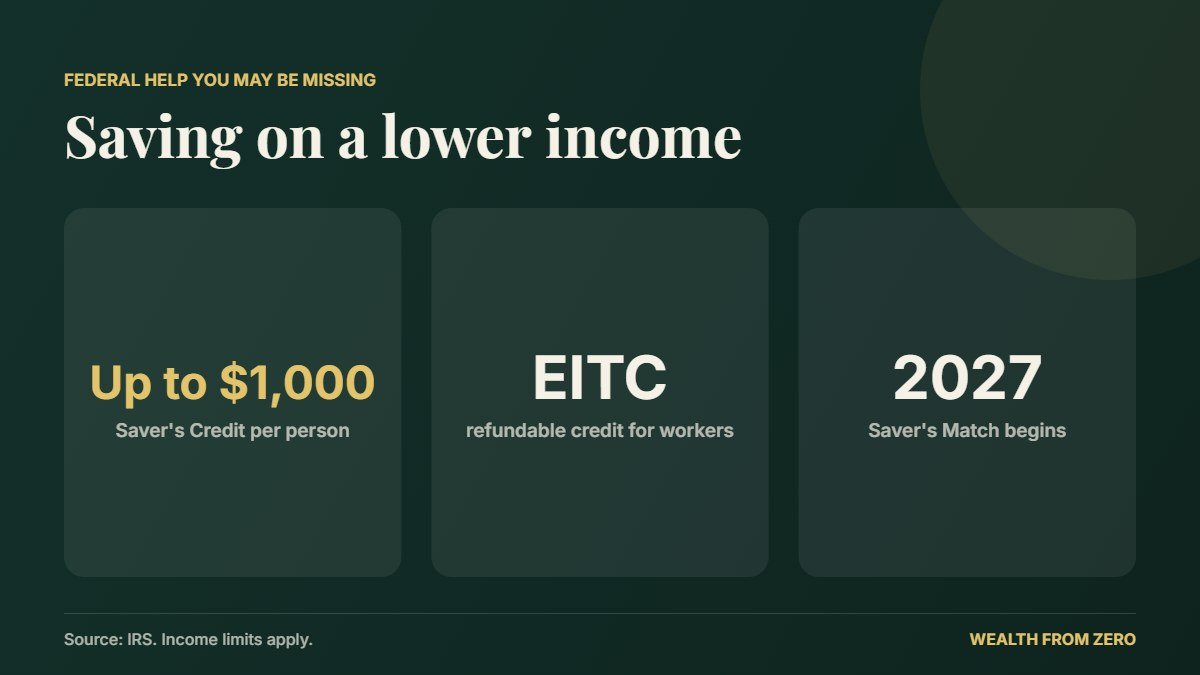
- Saver’s Credit. If you put money into a 401(k), IRA or similar plan, you may get a tax credit worth 50%, 20% or 10% of up to $2,000 of contributions ($4,000 if married filing jointly), depending on your income. For 2026, it’s available if your adjusted gross income is up to $40,250 (single), $60,375 (head of household) or $80,500 (married filing jointly) (IRS). You claim it with Form 8880. Starting with contributions made in 2027, it’s being replaced by the Saver’s Match, a government deposit of up to $1,000 per person into your retirement account.
- Earned Income Tax Credit (EITC). A refundable credit for low- to moderate-income workers, so it can increase your refund even if you owe no tax. Check whether you qualify with the IRS EITC Assistant. A refund is one of the easiest moments to move a chunk of money straight into savings.
Frequently Asked Questions
Below are the most common questions people ask about how to save money fast on a low income.
How can I save money fast when I barely have enough to cover my bills?
Start by identifying any expense you can cut immediately — unused subscriptions, daily coffee, takeaway meals. Even freeing up $30-$50 a month creates momentum. Simultaneously look for ways to bring in extra money quickly — selling unused items, picking up extra hours, or a small side hustle.
What is the fastest way to save $1,000 on a low income?
Combine cutting expenses and increasing income at the same time. Sell items you no longer need, eliminate one or two recurring expenses, and put every extra dollar into a separate savings account. Most people can reach $1,000 faster than they expect once they’re intentional about it.
How do I save money when my income barely covers my expenses?
Start by tracking every expense for one month — most people discover spending they’d forgotten about. Then prioritize ruthlessly: needs first, everything else negotiable. Even saving $10-$20 per week builds the habit and creates a small buffer that reduces financial stress significantly.
Should I save money or pay off debt first on a low income?
Save a small emergency fund of $1,000 first, then focus on high-interest debt. Without any savings buffer, every unexpected expense pushes you deeper into debt. Once high-interest debt is cleared, build your full emergency fund and start investing. For a deeper dive, read our Frugal Living: 50 Money-Saving Habits.
What are the best ways to reduce expenses quickly on a low income?
Focus on your three biggest expenses first — housing, food, and transport. Even small reductions in these categories have more impact than cutting minor expenses. Consider a roommate, meal planning, or switching to public transport if feasible.
Does saving a small amount really make a difference on a low income?
Yes, more than most people realize. Saving consistently — even $20 a week — builds financial resilience, reduces stress, and creates options. The habit of saving matters as much as the amount. As your income grows, the habit is already in place and you simply increase the amount.
The first thing to do when you find extra savings is build your emergency fund — it’s the foundation that protects everything else.
Sources
- Internal Revenue Service, 2026 retirement limits and Saver’s Credit income limits.
- Internal Revenue Service, Saver’s Match.
- Internal Revenue Service, Earned Income Tax Credit.