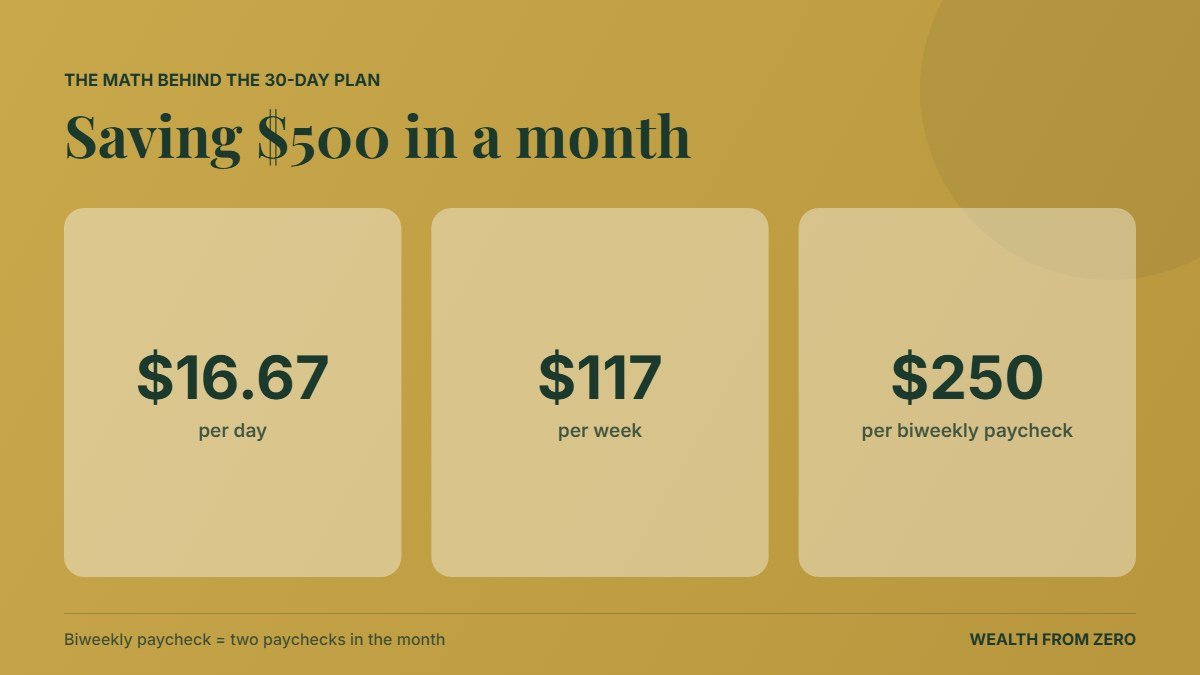
Saving $500 in a month is different from long-term saving. Thirty days isn’t enough time for small habit changes to add up, so the plan has to combine a few quick wins: stopping money leaks immediately, freeing up cash you already have, and a short burst of extra income.
Below is a week-by-week plan, where the money can realistically come from, and what to avoid. Once you’ve hit $500, our guide to saving $1,000 in 3 months shows how to keep the momentum going.
The Math: $500 in 30 Days
| Per day | Per week | Per biweekly paycheck | Share of $2,500 take-home | Share of $4,000 take-home |
|---|---|---|---|---|
| ~$16.67 | ~$117 | ~$250 | 20% | 12.5% |
On a lower income, finding $500 from everyday spending alone is hard. That’s why the plan below leans on one-off sources of cash as well as cuts.
Where the $500 Can Come From
| Source | Example amount | How quickly |
|---|---|---|
| Cancel unused subscriptions and memberships | $20–$80 | Day 1 |
| One no-spend week (no takeout, shopping or extras) | $50–$150 | Week 3 |
| Cheaper groceries: meal plan, store brands, fewer trips | $50–$150 | Across the month |
| Sell items you no longer use | $100–$300+ | 1–2 weeks |
| Extra shifts or short-term gig work | $100–$300 | Varies |
| Call providers to lower bills (phone, internet, insurance) | $20–$60 | Week 4 |
Example ranges — your results depend on your current spending and what you have to sell. You don’t need every row: two or three strong sources can get you to $500.
Week 1: Stop the Leaks and Set Up the Account
- Open a separate savings account (ideally a high-yield one) just for this goal, so the money is out of sight.
- Go through your last two bank statements and cancel every subscription you haven’t used in the past month.
- Set an automatic transfer for payday — $250 per biweekly paycheck if you can manage it, less if you’ll make up the rest by selling items.
Week 2: Sell What You Don’t Use
Walk through your home and list anything you haven’t used in six months: electronics, gaming gear, furniture, sports equipment, tools, baby items and clothing in good condition. Price items to sell quickly, take clear photos and list them on local marketplaces. Every sale goes straight to the savings account. If you want to turn this into ongoing income, our guide to flipping items for profit explains how.
While you’re at it, search your state’s unclaimed property database through Unclaimed.org (run by the National Association of Unclaimed Property Administrators). Forgotten deposits, refunds and old paychecks sometimes turn up there — it only takes a few minutes to check.
Week 3: Do a No-Spend Week
- Pay only for essentials: rent or mortgage, utilities, groceries from a list, fuel or transit, and minimum debt payments.
- No takeout, coffee runs, online shopping or entertainment spending — plan free alternatives in advance.
- Cook from what’s already in your pantry and freezer before buying more.
- Move whatever you didn’t spend compared with a normal week into savings at the end of the week.
Week 4: Cut Bills and Close the Gap
Call your phone, internet and insurance providers and ask whether there’s a cheaper plan or a current promotion — or get a quote from a competitor first so you have something to compare. Then check your total. If you’re still short, one or two extra shifts or a weekend of gig work usually closes a gap of $100–$200. Our list of ways to make extra money from home has more options.
What to Avoid
- Payday loans and cash advances: the fees and interest can turn a short-term shortfall into a much bigger problem.
- “Saving” by skipping bills: late fees and credit damage cost more than you save.
- Cutting so hard you rebound: a plan you can’t sustain for 30 days often ends in a spending splurge.
What to Do With Your First $500
Keep it in savings as the start of an emergency buffer. $500 won’t cover every emergency, but it can absorb many small surprises — a car repair, a medical copay — without a credit card. When you’re ready for the next step, use our Emergency Fund Calculator to set a full target.
How to Save $500 in 3, 4 or 6 Months
If 30 days is too tight, spreading the goal out makes it much easier. Here is what each timeline takes:
| Timeline | Per month | Per week |
|---|---|---|
| 1 month | $500 | about $117 |
| 3 months | about $167 | about $39 (13 weeks) |
| 4 months | $125 | about $29 (17 weeks) |
| 6 months | about $83 | about $19 (26 weeks) |
Keep the money in a separate savings account at an FDIC-insured bank (or an NCUA-insured credit union) so it isn’t mixed with your spending money. High-yield accounts pay well above the FDIC’s published national average savings rate, though on $500 the interest is small — the real win is keeping it out of reach.
Frequently Asked Questions
How much do I need to save per day to have $500 in a month?
About $16.67 a day, $117 a week or $250 per biweekly paycheck. Most people find it easier to split the goal: part from spending cuts and part from a one-off boost such as selling items you no longer use.
Can I save $500 in a month on a low income?
Often, yes — but usually not from cuts alone. On $2,500 a month take-home, $500 is 20% of your pay. Combining a no-spend week, canceled subscriptions and selling a few items is typically more realistic than trying to cut that much from everyday spending.
What’s the fastest way to get $500?
Selling things you already own is usually the fastest — electronics, furniture, tools and clothing in good condition can sell within days. Extra shifts or short-term gig work are the next fastest options.
Should I borrow to reach $500 quickly?
No. Payday loans and credit card cash advances carry very high costs and can leave you worse off than before. If you need money for an emergency right now, contact the provider you owe to ask about a payment plan, or look for local assistance programs.
Disclaimer: This article is for informational purposes only and is not financial advice. Example savings amounts are illustrative.