
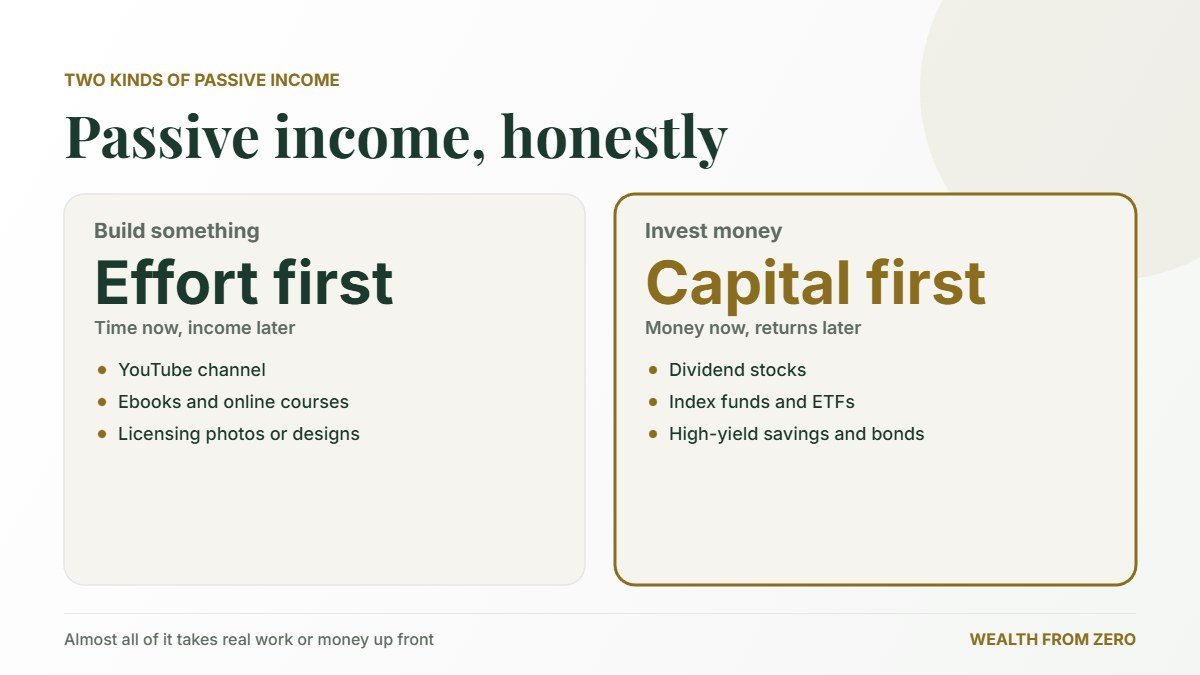
The idea of earning money while you sleep sounds too good to be true. But passive income — income that requires little or no active effort to maintain once it’s set up — is a genuine and achievable financial goal for ordinary people. You don’t need to be wealthy, technically gifted, or unusually lucky to build passive income streams. You need the right knowledge, realistic expectations, and the willingness to put in the upfront work that most passive income requires.
The word “passive” can be misleading. Almost every form of passive income requires significant effort, time, or money to set up initially. The passive part comes later — once the system is running, it generates income without requiring your constant active involvement. Think of it less as “doing nothing” and more as “working once and getting paid repeatedly.” This guide covers 15 proven passive income ideas that beginners can realistically pursue, ranging from options that require almost no money upfront to those that benefit from having some capital to invest.
Why Passive Income Matters
| Passive Income Stream | Monthly Potential | Startup Capital | Truly Passive? |
|---|---|---|---|
| Dividend stocks / ETFs | $50–$2,000+ | $1,000+ | ✅ Yes |
| High-yield savings / CDs | $20–$500 | $1,000+ | ✅ Yes |
| REITs | $30–$500+ | $500+ | ✅ Yes |
| Digital products (eBooks, courses) | $100–$10,000+ | $0–$500 | ⚠️ Some maintenance |
| Affiliate content sites | $100–$20,000+ | $0–$1,000 | ⚠️ Content updates needed |
| Rental property | $200–$3,000+ | $20,000+ | ⚠️ Ongoing management |
| Peer-to-peer lending | 5–10% returns | $500+ | ✅ Mostly |
Most people have a single income stream: their job. If they lose their job, get sick, or simply want to take time off, their income stops. Passive income changes this dynamic by creating additional income streams that continue flowing regardless of whether you’re actively working.
Even a modest passive income of $200-500 per month can make a meaningful difference to your financial situation. It can cover a significant portion of your monthly expenses, accelerate your debt repayment, or go directly into investments — compounding your wealth over time.
Building multiple income streams is also one of the most effective forms of financial security. When your income comes from several different sources, the loss of any single one is far less catastrophic than losing your only source of income.
1. Start a Blog and Monetize With Advertising
A blog is one of the most accessible passive income vehicles for beginners. You write articles on a topic you know well, build an audience through search engine optimization, and monetize through advertising networks like Google AdSense, which pays you every time a visitor sees or clicks an ad on your site.
The startup costs are minimal — a domain name and hosting typically cost less than $100 per year. The work is significant upfront: writing high-quality articles consistently for 6-12 months before meaningful traffic and income arrives. But once a blog is established and ranking well in search results, it generates income continuously from articles written months or years ago.
Finance, health, food, travel, and personal development are among the most profitable blogging niches because they attract advertisers willing to pay high rates per click.
2. Create a YouTube Channel
YouTube monetization works similarly to blogging — you create content, build an audience, and earn advertising revenue through the YouTube Partner Program. Once accepted (which requires 1,000 subscribers and 4,000 watch hours), you earn money every time someone watches your videos.
The passive element comes from the fact that a video you made two years ago can still be generating views and income today. Popular evergreen videos — tutorials, explainers, and how-to guides on topics people consistently search for — can generate income for years after they’re published.
3. Write and Self-Publish an Ebook
If you have expertise in a particular area — personal finance, fitness, cooking, language learning, career development — you can package that knowledge into an ebook and sell it on platforms like Amazon Kindle Direct Publishing.
The upfront work involves writing and formatting the book, designing a cover, and marketing it. Once published, the book can generate royalties indefinitely with minimal ongoing effort. Successful ebooks in popular niches can earn hundreds or even thousands of dollars per month.
4. Create and Sell an Online Course
Online courses are one of the highest-earning passive income vehicles available. If you have skills or knowledge that others want to learn — graphic design, coding, photography, marketing, personal finance — you can create a course once and sell it repeatedly through platforms like Udemy, Teachable, or Gumroad.
The upfront investment is time rather than money: planning the curriculum, recording the content, and creating any supporting materials. Once the course is live, each sale generates revenue without additional work.
5. License Your Photography or Digital Art
If you’re a photographer or digital artist, you can upload your work to stock platforms like Shutterstock, Adobe Stock, or Getty Images and earn royalties every time someone downloads your work. A single photo or illustration can generate small payments repeatedly over years.
This requires building a substantial portfolio to generate meaningful income, but the ongoing effort is minimal once your work is uploaded.
6. Affiliate Marketing
Affiliate marketing involves promoting other companies’ products or services and earning a commission on any sales made through your unique referral link. It works particularly well when combined with a blog, YouTube channel, or social media presence.
For example, a personal finance blogger might recommend a budgeting app and earn a commission every time a reader signs up through their link. The commission is paid automatically, with no additional work required after the recommendation is published.
Amazon Associates is the most accessible affiliate program for beginners, but virtually every major company — from software providers to financial services to e-commerce brands — offers affiliate programs.
Passive Income Ideas That Require Some Capital
7. Invest in Dividend-Paying Stocks
Dividend stocks are shares in companies that pay a portion of their profits to shareholders on a regular basis — typically quarterly. If you own shares in a company that pays a 3% annual dividend and your investment is worth $10,000, you receive $300 per year in passive income without selling any shares.
The passive income from dividends grows as you invest more and as companies increase their dividend payments over time. Dividend investing requires capital to start and patience to build — but it’s one of the most genuinely passive income streams available, requiring minimal ongoing management once your portfolio is established.

8. Invest in Index Funds and ETFs
Index funds and ETFs don’t just provide capital growth — many also pay dividends from the companies held within the fund. A broad market index fund tracking the S&P 500, for example, pays dividends that can be reinvested automatically or taken as income.
Over time, as your investment portfolio grows, the dividend income it generates can become a meaningful passive income stream. This is one of the core mechanisms behind the FIRE movement — accumulating enough invested assets that the returns cover your living expenses.
9. High-Yield Savings Accounts
While not as exciting as other passive income methods, high-yield savings accounts provide genuinely passive income with zero risk. Interest is calculated and paid automatically without any action on your part.
In a higher interest rate environment, a $10,000 balance in a high-yield savings account earning 4-5% generates $400-500 per year in completely passive income. While this won’t replace a salary, it’s a useful foundation — and it’s completely risk-free.
10. Buy Bonds or Bond Funds
Bonds are debt instruments issued by governments or companies. When you buy a bond, you’re essentially lending money to the issuer in exchange for regular interest payments over a set period. At the end of the bond term, your original investment is returned.
Bond funds work similarly but pool money from many investors to buy a diversified portfolio of bonds, paying regular income distributions. Bonds are lower risk than stocks but typically offer lower returns — they’re best used as part of a diversified portfolio rather than as a standalone investment.
11. Peer-to-Peer Lending
Peer-to-peer lending platforms connect borrowers with individual lenders, allowing you to earn interest on money you lend to others. Returns can be significantly higher than savings accounts — sometimes 5-10% or more — but the risk is also higher, as borrowers can default on loans.
This passive income method has become less prominent in recent years as some P2P platforms have struggled or closed, but it remains an option for those willing to accept higher risk in pursuit of higher returns. Research any platform thoroughly before investing.
12. Real Estate Investment Trusts (REITs)
REITs are companies that own income-producing real estate — office buildings, shopping centers, apartment complexes, warehouses — and are required by law to distribute at least 90% of their taxable income to shareholders as dividends.
Investing in REITs gives you exposure to real estate income without the hassle and capital requirements of directly owning property. REITs trade on stock exchanges like regular shares and can be bought through any standard brokerage account. They typically offer higher dividend yields than regular stocks.
Passive Income Ideas That Leverage Assets You Already Have
13. Rent Out a Room or Property
If you own or rent a property with a spare room, renting it out through platforms like Airbnb or to a long-term tenant can generate significant passive income. The setup work involves preparing the space and listing it, but once established, the income flows regularly.
In the U.S., income from renting out a room is generally taxable, but you can deduct the share of expenses that relates to the rented space. One exception: if you rent out your home for fewer than 15 days during the year, you don’t have to report that rental income (IRS Topic 415). Keep good records and check your lease, HOA and local rules before you start.
14. Rent Out Your Car
If you own a car that sits unused for significant periods, platforms like Turo allow you to rent it out to other drivers and earn income from an asset that would otherwise just be depreciating in your driveway.
This requires some setup and occasional coordination, but the ongoing effort is minimal and the income can be meaningful depending on your location and vehicle.
15. Create a Digital Product and Sell It Repeatedly
Digital products — templates, spreadsheets, printables, design assets, music, sound effects, fonts — can be created once and sold an unlimited number of times with no additional cost per sale. Platforms like Etsy, Gumroad, and Creative Market make it straightforward to list and sell digital products.
A well-designed budget spreadsheet template, for example, could sell for $5-15 and be downloaded hundreds or thousands of times. Once created and listed, the income is genuinely passive.
Passive Income Ideas Ranked by Startup Cost and Time to First Dollar
| Passive Income Idea | Startup Cost | Time to First $ | Monthly Potential | Effort Level |
|---|---|---|---|---|
| High-yield savings account | $0 | 1 month | $40–$400 on $10K | Zero |
| Index fund dividends | $1+ | 3 months | $25–$250 on $10K | Zero (set and forget) |
| REITs | $1+ | 1 quarter | $40–$120/month | Very low |
| Dividend stocks | $500+ | 1 quarter | $20–$150/month | Low (research needed) |
| Rental property | $20K–$60K | 1–3 months | $200–$800/month | Medium–High |
| Digital products | $0–$100 | 1–6 months | $50–$2,000/month | High upfront, low ongoing |
| Print-on-demand | $0 | 1–3 months | $50–$500/month | Medium upfront |
| Affiliate website | $50–$200/year | 6–18 months | $100–$5,000/month | Very high initially |
Income ranges are realistic estimates based on typical starting points — actual results vary significantly by effort, capital, and market conditions.
The Honest Truth About Passive Income
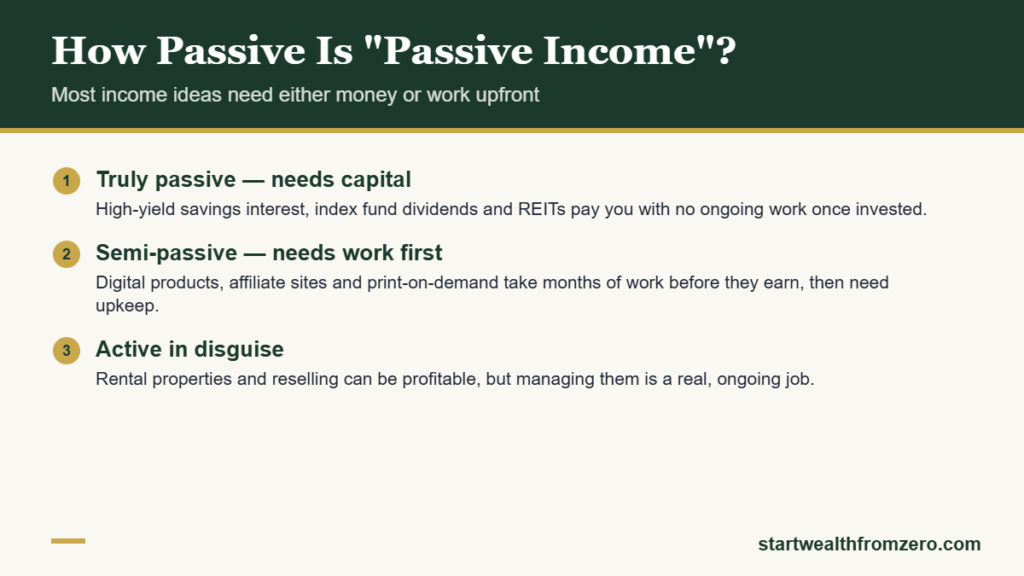
Most “passive income” content online overpromises. Here’s the reality: truly passive income (dividends, interest, REIT distributions) requires capital upfront. Semi-passive income (digital products, affiliate sites, rental property) requires significant work upfront before it generates anything, and ongoing maintenance after. There is no way to generate $1,000/month passive income from zero capital and zero effort. What you can do: invest consistently until your portfolio generates meaningful income, or put in the work to build something that pays you later.
For the most reliable passive income on any amount of money, start with our Compound Interest Calculator to see what a consistent investment generates over time — then decide whether a higher-effort passive income stream is worth pursuing alongside it.
How to Choose the Right Passive Income Stream for You
With so many options available, the key is choosing the passive income stream that best matches your existing skills, available time, and financial resources.
Ask yourself these questions:
- What skills or knowledge do I already have? Blogging, YouTube, online courses, and ebooks are best suited to people with expertise to share.
- How much time can I invest upfront? Content-based passive income requires significant time investment before income arrives.
- Do I have capital to invest? Dividend stocks, index funds, REITs, and bonds require money to start generating meaningful income.
- What level of risk am I comfortable with? Savings accounts and bonds are low risk; individual stocks and P2P lending carry higher risk.
The best passive income stream is the one you’ll actually follow through on. Starting with one method, building it properly, and then adding additional streams over time is far more effective than trying to pursue multiple methods simultaneously.
Realistic Expectations for Passive Income
It’s important to be honest about timelines and income potential. Most passive income streams take 6-24 months of consistent effort before generating meaningful income. Anyone promising overnight passive income is almost certainly selling something.
A realistic trajectory for a beginner blogger, for example, might look like this: six months of consistent publishing with minimal traffic, gradual growth in months 7-12, and meaningful income beginning in months 12-18 as content ranks in search results.
Similarly, building a dividend portfolio large enough to generate $500/month in passive income requires a substantial investment base — at a 4% yield, you’d need $150,000 invested. Building that takes time.
The key is to start, stay consistent, and think in years rather than weeks.
The Bottom Line
Passive income is real, achievable, and genuinely life-changing when built consistently over time. It doesn’t happen overnight, and it almost always requires significant upfront work or capital. But for those willing to invest the effort, the long-term rewards — financial security, freedom, and multiple income streams — are well worth it.
Choose one passive income method that matches your skills and resources. Start today. Stay consistent for 12-24 months. Then add a second stream. Over time, these streams compound into something genuinely significant.
The best time to start building passive income was five years ago. The second best time is today.

Frequently Asked Questions
Below are the most common questions people ask about best passive income ideas.
What is passive income?
Passive income is money earned with little to no active daily effort once the initial work or investment is in place. It’s not truly “do nothing” income — most passive income streams require upfront time, money, or both — but once established, they generate returns without constant active work.
How much money do I need to start earning passive income?
It depends on the stream. Some require no money at all — like starting a blog or creating digital products — just time and effort. Others like dividend investing or rental properties require capital. Start with whatever resources you have and build from there.
How long does it take to see passive income results?
Most passive income streams take 6-24 months to generate meaningful returns. Anyone promising passive income overnight is likely selling something. The upfront work is real — but so are the long-term rewards if you stick with it.
Is passive income taxable?
Yes. Most forms of passive income are taxable, though the rates vary depending on the source and your country. Dividend income, rental income, and business profits are all generally taxable. Consult a tax professional to understand your specific obligations.
What is the best passive income stream for beginners with no money?
Content creation — blogging, YouTube, or digital products — has the lowest barrier to entry. It requires time and consistency rather than capital. While it takes longer to generate income, the long-term potential is significant and the startup cost is minimal.
Can passive income replace a full-time salary?
Yes, but it takes time and multiple income streams working together. Most people who achieve this have spent years building several streams simultaneously. Start with one, master it, then add another. Diversification across multiple passive income sources is what creates true financial independence.
Track your financial progress with our free calculator.
Track how your passive income streams are building your net worth with our Net Worth Calculator.