
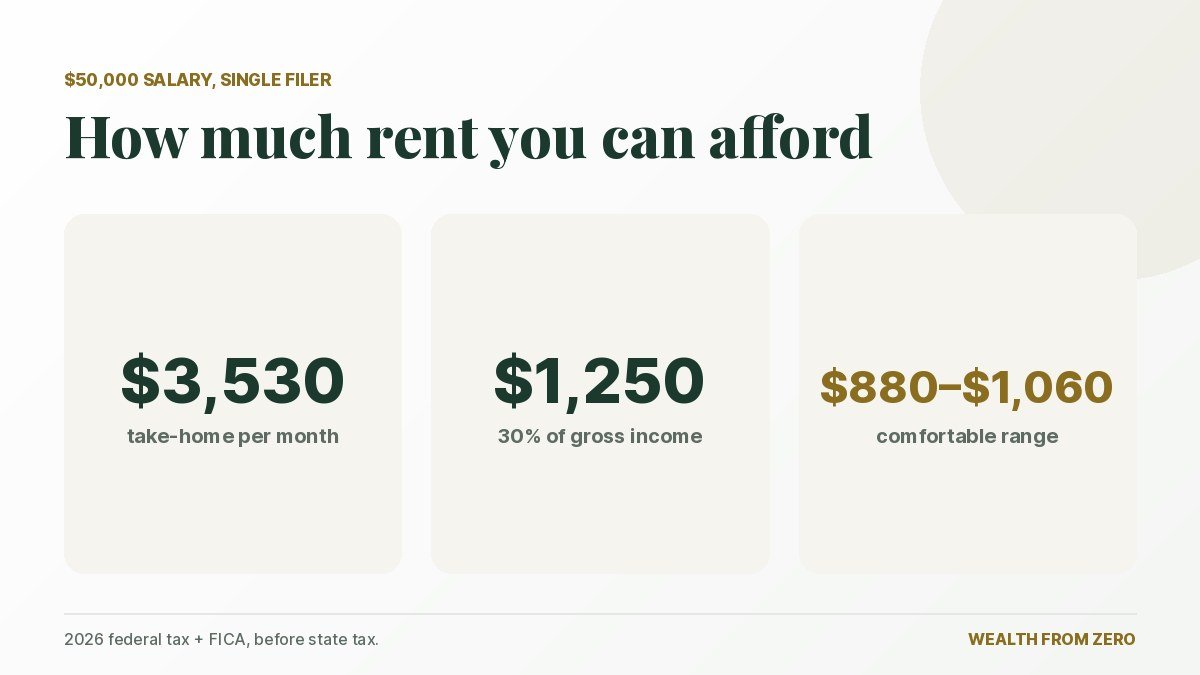
Short answer: on a $50,000 salary, the standard guideline says you can afford about $1,250 a month in rent — 30% of your gross income. That’s also what most landlords check: many want your yearly income to be at least 40 times the monthly rent, which on $50,000 is again $1,250. But because taxes take a bite first, $1,250 is about 35% of your actual take-home pay. If you want room to save, a more comfortable target is $900–$1,050.
Below: the three ways to calculate it, a table for other salaries, and what a $50,000 budget looks like with rent at each level.
Three Ways to Calculate Affordable Rent on $50,000
1. The 30% rule (gross income)
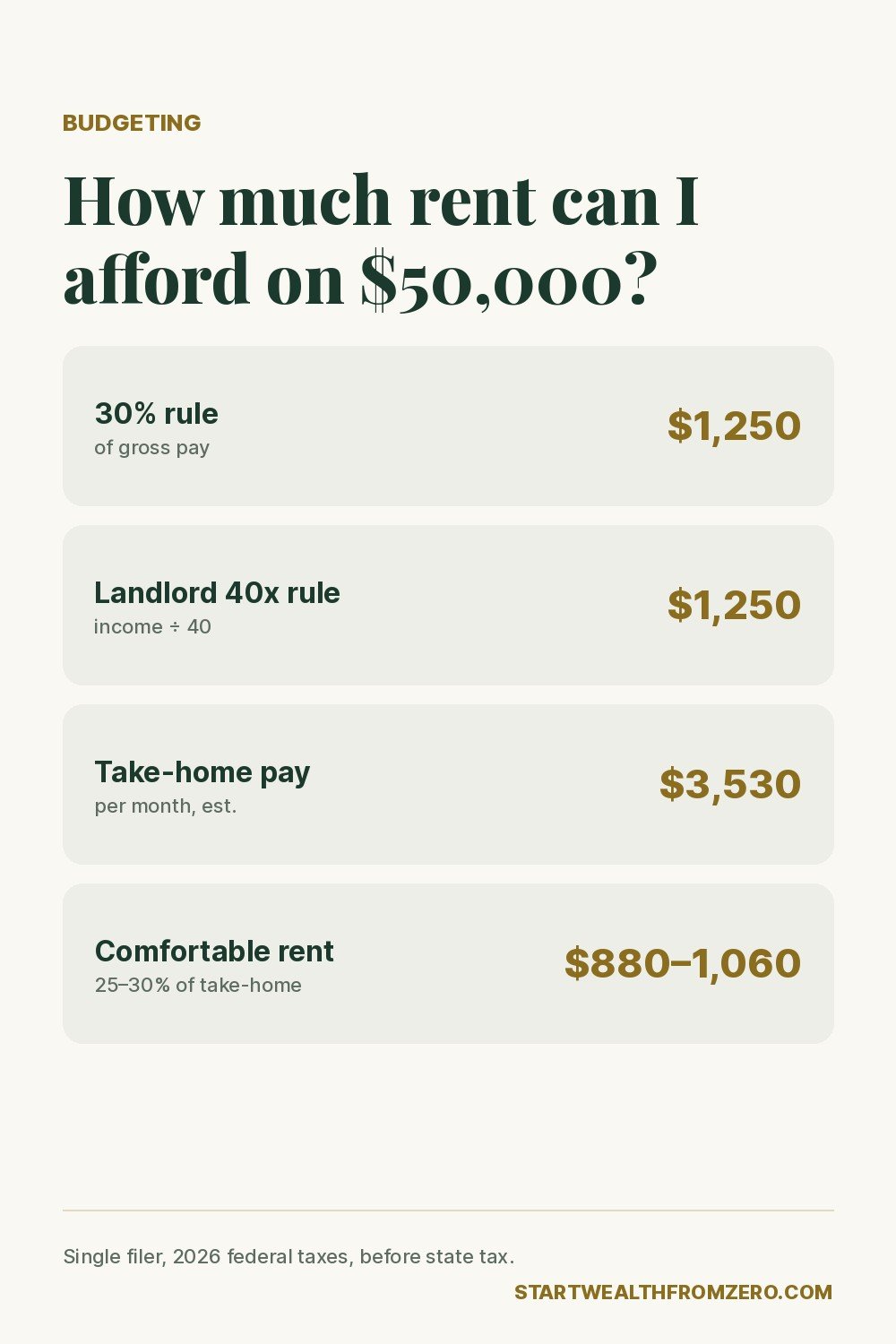
$50,000 × 30% ÷ 12 = $1,250 a month. Housing agencies and researchers use 30% of income as the line for being “cost-burdened” — paying more than that is common, but it leaves less for everything else.
2. The landlord’s 40× rule
Many landlords and property managers require gross annual income of about 40 times the monthly rent. $50,000 ÷ 40 = $1,250. Some use 3× monthly rent instead ($50,000 ÷ 12 ÷ 3 = about $1,390), so requirements vary.
3. The take-home pay method
This is the one that matches your real budget. A single filer earning $50,000 takes home about $3,530 a month after 2026 federal income tax and Social Security/Medicare (before state tax and benefits deductions). Keeping rent at 25–30% of take-home gives you about $880–$1,060.
Find Your Own Number in 4 Steps
- Start with your real take-home pay. Look at your last two pay stubs and add up what landed in your bank account in a typical month. On $50,000, it’s often $3,200–$3,500 once state tax, health insurance and a 401(k) contribution come out.
- Subtract your fixed costs other than rent: car payment and insurance, minimum debt payments, phone, and other bills you can’t skip.
- Set your savings first: even 10% of take-home ($330–$350) protects you from the next emergency.
- What’s left, minus food and basics, is your realistic rent ceiling. If it comes out lower than the 30% rule, trust your number, not the rule.
Example: $3,300 take-home − $550 fixed costs − $330 savings − $650 food, transport and basics = $1,770 left. Rent of $1,100–$1,250 leaves $520–$670 for everything else; $1,500 would leave only $270.
How Much Rent You Can Afford by Salary
| Salary | 30% of gross (and 40× rule) | Take-home per month* | Comfortable (25–30% of take-home) |
|---|---|---|---|
| $30,000 | $750 | about $2,190 | $550–$660 |
| $40,000 | $1,000 | about $2,860 | $715–$860 |
| $50,000 | $1,250 | about $3,530 | $880–$1,060 |
| $60,000 | $1,500 | about $4,200 | $1,050–$1,260 |
| $75,000 | $1,875 | about $5,130 | $1,280–$1,540 |
| $100,000 | $2,500 | about $6,600 | $1,650–$1,980 |
*Single filer, standard deduction, 2026 federal income tax brackets (IRS Rev. Proc. 2025-32) and 7.65% Social Security and Medicare. State and local taxes, health insurance and retirement contributions will lower your take-home further.
$50,000 a year is about $24 an hour at 40 hours a week.
What $50,000 Covers in Real Cities
We checked the typical rent in large U.S. metro areas against a $50,000 salary, using the Zillow Observed Rent Index for August 2026. The result is sobering: in none of the 50 largest metros is the typical rent at or below $1,250.
| Metro area | Typical rent | Share of gross pay | Share of take-home |
|---|---|---|---|
| Louisville, KY | $1,348 | 32% | 38% |
| Oklahoma City, OK | $1,388 | 33% | 39% |
| Memphis, TN | $1,400 | 34% | 40% |
| San Antonio, TX | $1,422 | 34% | 40% |
| St. Louis, MO | $1,443 | 35% | 41% |
| Cleveland, OH | $1,454 | 35% | 41% |
| Houston, TX | $1,643 | 39% | 47% |
| Dallas, TX | $1,659 | 40% | 47% |
| Phoenix, AZ | $1,722 | 41% | 49% |
| Atlanta, GA | $1,853 | 44% | 52% |
| U.S. typical | $1,948 | 47% | 55% |
| Chicago, IL | $2,210 | 53% | 63% |
| New York, NY | $3,615 | 87% | 102% |
“Typical rent” covers all kinds of rental homes, including houses, so a smaller or older apartment can cost well under these figures. Still, the table shows why so many people on $50,000 share housing. See all 50 metros in our income needed to afford rent by city study.
What a $50,000 Budget Looks Like at Each Rent Level
Here’s how $3,530 a month of take-home pay splits with three different rents, using the other costs of a typical single renter:
| Monthly | Rent $950 | Rent $1,250 | Rent $1,500 |
|---|---|---|---|
| Rent | $950 | $1,250 | $1,500 |
| Utilities + internet | $180 | $180 | $180 |
| Groceries | $400 | $400 | $400 |
| Transportation | $350 | $350 | $350 |
| Phone + insurance + minimum debt | $250 | $250 | $250 |
| Needs total | $2,130 (60%) | $2,430 (69%) | $2,680 (76%) |
| Left for savings and wants | $1,400 | $1,100 | $850 |
At $950 you can save 20% ($706) and still have about $694 for everything else. At $1,500, saving even 10% leaves only about $500 a month for food out, clothes, gifts and fun. Plug your own numbers into our budget calculator.
With a Roommate or a Partner
| Situation | Total rent you could afford (30% of gross) | Your share |
|---|---|---|
| Alone on $50,000 | $1,250 | $1,250 |
| Two roommates, $50,000 each | $2,500 | $1,250 |
| Two roommates splitting a $1,800 two-bedroom | — | $900 (22% of gross) |
| Couple, $50,000 + $35,000 | $2,125 | Split 50/50 or by income |
Landlords usually look at combined income for people on the same lease, so two incomes make the 40× test much easier to pass. If incomes are unequal, splitting rent in proportion to income is a common fair option: on $50,000 and $35,000, that’s about 59% and 41%.
What Landlords Check Besides Income
- Proof of income: recent pay stubs, an offer letter or tax returns if you’re self-employed.
- Credit: many landlords run a credit check. Paying cards on time and keeping balances low helps — see credit score ranges explained.
- Rental history: references from past landlords and no unpaid rent.
- Fees and deposits: application fees and deposit limits vary by state and city, so check your local rules before you apply.
Don’t Forget the Move-In Costs
A new lease usually needs first month’s rent plus a security deposit (often one month’s rent), application fees and moving costs. On a $1,250 apartment, plan for $2,500–$3,500 upfront. Keep that separate from your emergency fund — our guide on how big an emergency fund should be helps you size both.
How to Pay Less Than the “Rule” Says
- Get a roommate. Splitting a $1,800 two-bedroom puts your share at $900.
- Negotiate. Ask for a lower rent or a concession, especially on a renewal or a unit that’s been empty a while. Our guide on how to negotiate rent has scripts.
- Look a little farther out. A slightly longer commute can cut rent a lot, but count the extra transportation cost.
- Time your search. Winter often has less competition than summer.
More ideas in how to save money on rent.
Mistakes to Avoid
- Budgeting rent on gross pay. $1,250 sounds like 30%, but it’s about 35% of what actually lands in your account.
- Forgetting utilities and parking. Ask what’s included. $150–$250 a month of extra costs can turn an affordable apartment into a stretch.
- Ignoring the commute. A cheaper place far from work can cost more once you add gas, tolls or transit.
- Leaving no room to save. If the rent you’re considering leaves nothing for an emergency fund, keep looking or find a roommate.
Frequently Asked Questions
Can I afford $1,500 rent on $50,000 a year?
It’s possible but tight: $1,500 is 36% of gross income and about 42% of take-home pay. Many landlords using the 40× rule would want about $60,000 of income for that rent.
Is the 30% rule based on gross or net income?
The traditional rule uses gross (pre-tax) income. Because that ignores taxes, many people use 25–30% of take-home pay instead, which gives a lower, safer number.
How much rent can I afford on $25 an hour?
Full time, $25 an hour is $52,000 a year, so 30% of gross is $1,300 a month and the comfortable range is about $910–$1,100.
Can I live alone on $50,000 a year?
In many lower-cost metros, yes, with a modest apartment and a tight budget. In the most expensive metros it’s very hard: the typical rent in New York takes about 87% of a $50,000 gross salary.
How much rent can I afford on $4,000 a month?
If $4,000 is your gross monthly pay ($48,000 a year), 30% is $1,200. If $4,000 is your take-home pay, 25–30% of that is $1,000–$1,200.
What if rent in my area is more than 30% of my income?
You’re not alone — paying more than 30% is common for renters. Keep your other fixed costs low, protect a small savings habit, and use our 50/30/20 guide to adjust the split (60/20/20 or 70/20/10) instead of giving up on saving.
Sources
- IRS Rev. Proc. 2025-32 (2026 tax brackets and standard deduction)
- IRS Topic 751: Social Security and Medicare withholding rates
- Zillow Research: Zillow Observed Rent Index (ZORI)
Take-home figures are estimates for a single filer with no other income. Landlord requirements vary. This article is for education, not personal financial advice.