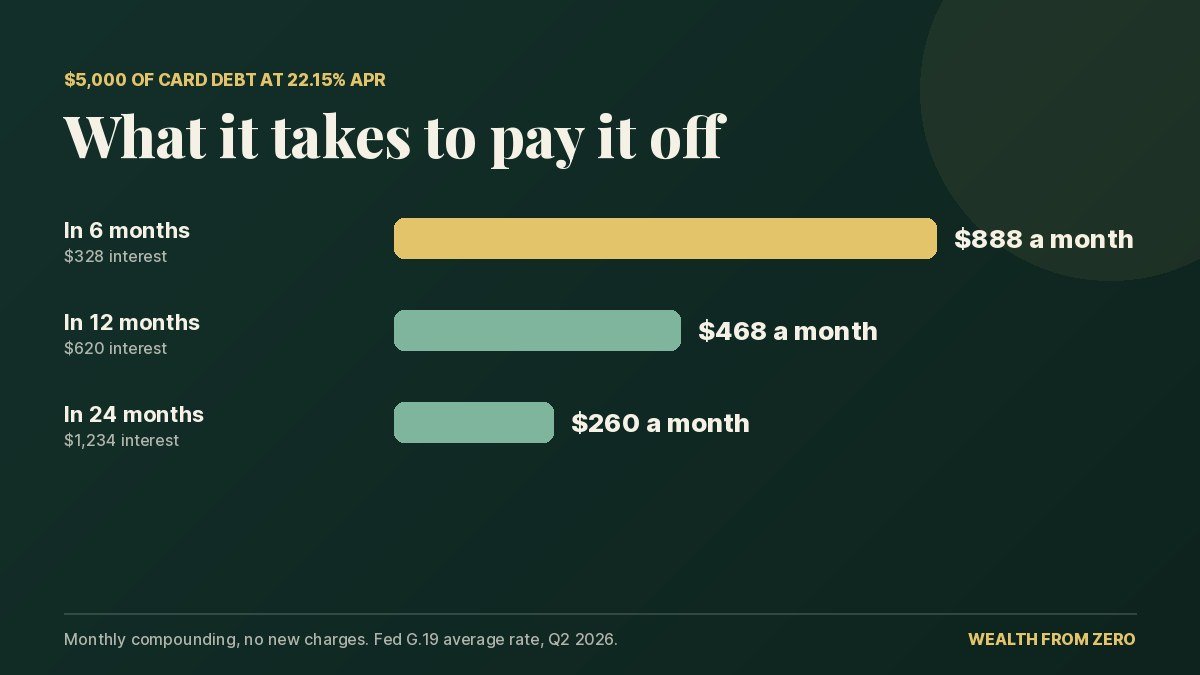
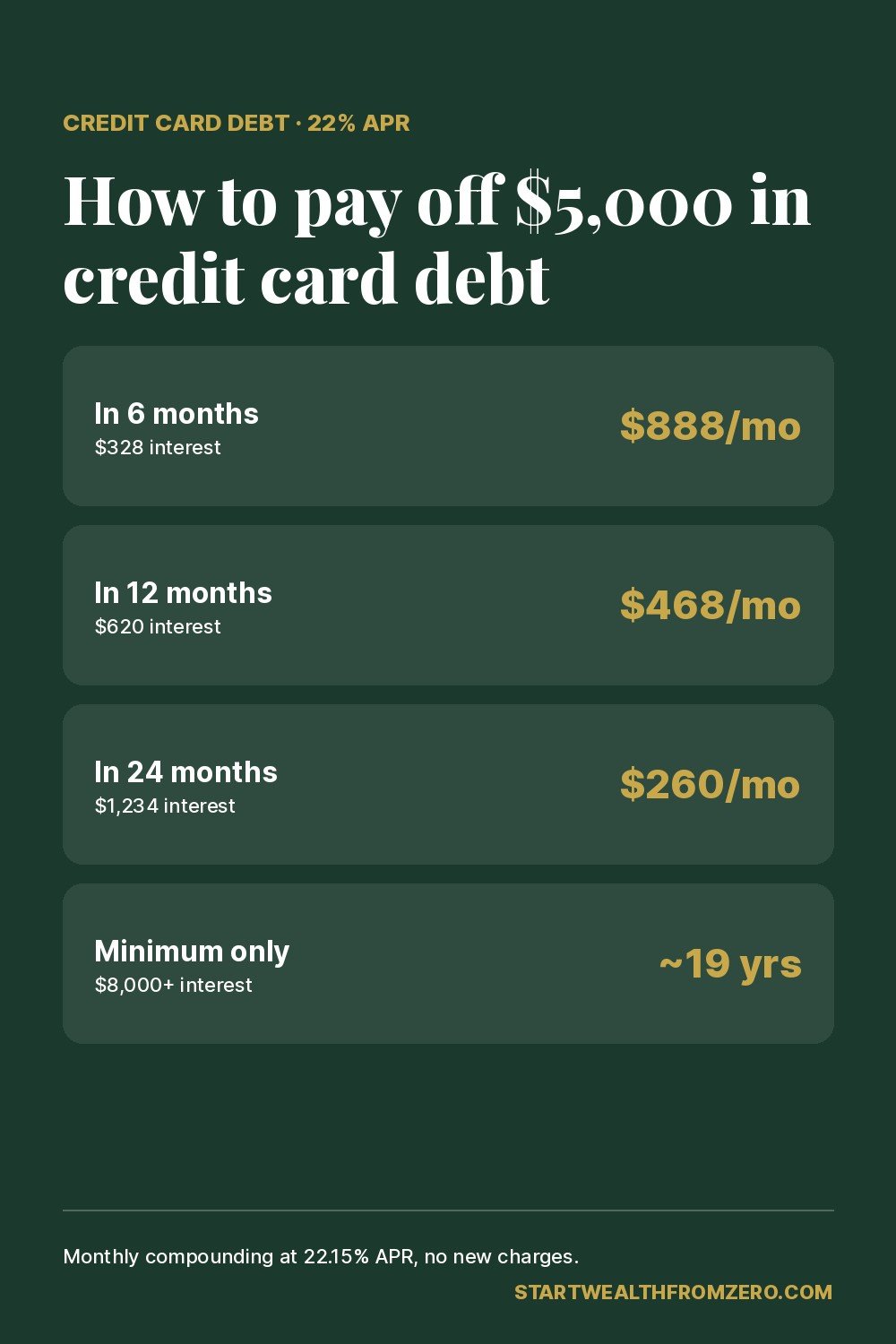
Short answer: at a typical 22% credit card APR, paying off $5,000 in 12 months takes about $468 a month and costs about $620 in interest. Stretch it to 24 months and it’s about $260 a month, but the interest roughly doubles to $1,234. Pay only the minimum and the same $5,000 can take around 19 years and more than $8,000 in interest.
Below are the exact monthly payments for every common timeline and interest rate, what a fixed payment like $200 or $300 really gets you, how a balance transfer or personal loan compares, and a step-by-step plan to find the money. All figures assume a 22.15% APR — the average rate on credit card accounts assessed interest in the Federal Reserve’s G.19 consumer credit report for Q2 2026 — and no new charges on the card.
How Much You Need to Pay Each Month
Pick the timeline that fits your budget. The shorter it is, the more you save in interest.
| Pay it off in | Monthly payment | Total interest |
|---|---|---|
| 6 months | $888 | $328 |
| 12 months | $468 | $620 |
| 18 months | $329 | $922 |
| 24 months | $260 | $1,234 |
| 36 months | $191 | $1,888 |
Going from 36 months to 12 months saves about $1,270 in interest. That’s the real price of “taking it slow.”
How Your Interest Rate Changes the Math
22% is an average. Store cards and cards for people rebuilding credit often charge closer to 30%. Find the APR on your statement and use the matching row:
| Card APR | 12 months: payment | 12 months: interest | 24 months: payment | 24 months: interest |
|---|---|---|---|---|
| 18% | $458 | $501 | $250 | $991 |
| 22.15% (average) | $468 | $620 | $260 | $1,234 |
| 25% | $475 | $703 | $267 | $1,405 |
| 29.99% | $487 | $849 | $280 | $1,709 |
The monthly payment barely changes between rates — about $30 a month from 18% to 30% on a 12-month plan — but the interest you pay over two years goes up by more than $700. That’s why lowering the rate (step 4 below) is worth a phone call.
Where Your Payment Goes, Month by Month
On the 12-month plan ($468 a month at 22.15%), the early payments are heavy on interest. As the balance drops, more of each payment goes to the debt itself:
| Month | Interest | Toward the balance | Balance left |
|---|---|---|---|
| 1 | $92 | $376 | $4,624 |
| 3 | $78 | $390 | $3,851 |
| 6 | $56 | $412 | $2,637 |
| 9 | $33 | $435 | $1,355 |
| 12 | $8 | $460 | $0 |
Halfway through the year you’ve paid off almost half the balance, and the interest charge has dropped by about 40%. Seeing those numbers fall on your statement is often what keeps people going.
What a Fixed Payment Gets You
If you’d rather start from what you can afford each month, here is how long a fixed payment takes on the same $5,000 at 22.15% APR:
| Fixed monthly payment | Time to pay off | Total interest |
|---|---|---|
| $100 | 141 months (almost 12 years) | about $9,010 |
| $150 | 53 months | about $2,830 |
| $200 | 34 months | about $1,770 |
| $250 | 26 months | about $1,300 |
| $300 | 21 months | about $1,030 |
| $500 | 12 months | about $580 |
Notice the cliff at the top: $100 a month barely covers the interest (about $92 in the first month), so the balance hardly moves. Adding just $50 more cuts the payoff time from 12 years to under 5.
Why the Minimum Payment Is a Trap
Many cards set the minimum at the month’s interest plus 1% of the balance, with a floor of around $25. On $5,000 that starts at roughly $142 and keeps shrinking as the balance falls — which is exactly why it takes so long. With that formula, the payoff takes about 19 years and costs over $8,000 in interest, more than the original debt. Your statement is required to show how long minimum payments will take; the CFPB’s credit card guide explains how to read it.
Card, Balance Transfer or Personal Loan? Compared
Moving the $5,000 somewhere cheaper can cut the cost a lot — if you qualify and don’t run the card back up. Here’s how the options compare:
| Option | Monthly payment | Interest + fees | Watch out for |
|---|---|---|---|
| Keep it on the card, 24 months at 22.15% | $260 | $1,234 | Rate can rise; new charges |
| 0% balance transfer, 3% fee, 21-month promo | $245 | $150 fee | Usually needs good credit; any balance left after the promo goes back to a high APR |
| 0% balance transfer, 5% fee, 15-month promo | $350 | $250 fee | Higher payment to finish in time |
| Personal loan at 12% for 24 months (example rate) | $235 | $649 | Origination fees; your rate depends on your credit |
Balance transfer figures assume you pay the balance plus fee in equal payments before the promo ends. Before you apply, compare the full cost including fees, and don’t close the old card on the same day — and don’t use it either.
A 5-Step Plan to Pay Off $5,000
1. Stop adding to the balance
Take the card out of your digital wallets and use a debit card for daily spending while you pay it down. A payoff plan doesn’t work if new charges keep landing on the same card.
2. Choose your target and automate it
Pick a monthly amount from the tables above and set it as an automatic payment a few days after payday. Treat it like rent: it leaves your account before you can spend it.
3. Find the extra money
Going from $200 to $300 a month saves about 13 months and $740 in interest. Common places to find $100: one streaming and one app subscription you don’t use, a cheaper phone plan, two fewer takeout meals a week, or selling one thing you no longer need each month. Our budget calculator shows what’s left after your needs.
Here’s one example of how someone with about $3,500 a month of take-home pay might free up the $468 needed for the 12-month plan:
| Change | Per month |
|---|---|
| Cancel two unused subscriptions | $30 |
| Switch to a low-cost phone plan | $40 |
| Plan groceries and cook more | $80 |
| Cut takeout from three times a week to one | $100 |
| Sell things you don’t use | $70 |
| A few hours of side work | $150 |
| Total | $470 |
Your mix will be different, but the pattern holds: small cuts rarely get you all the way there, and a bit of extra income usually does the rest. Our list of ways to make extra money from home has ideas.
4. Try to lower the rate
Call your card issuer and ask for a lower APR, especially if you’ve paid on time for a year. A 0% balance transfer card can also help: for example, with a 3% transfer fee ($150) and a 15-month 0% period, $5,000 becomes $5,150 that you’d clear with about $343 a month and no interest — if you pay it off before the promo ends and don’t use the old card again. A personal loan at a clearly lower rate is another option — see the comparison above.
5. Send every windfall to the card
Tax refunds, bonuses and cash gifts go straight to the balance. A $1,000 tax refund applied at the start of a $300-a-month plan cuts it from 21 months to 16.
Should You Save or Pay Off the Card First?
Keep a small starter emergency fund — even $500 to $1,000 — so a flat tire doesn’t go back on the card. After that, money in a savings account earning around 4% can’t beat a 22% card, so extra cash usually does more good on the debt. The one exception most experts agree on: if your employer matches 401(k) contributions, contribute enough to get the full match while you pay down the card.
If Your $5,000 Is Spread Across Several Cards
Say your $5,000 is on three cards and you can pay $300 a month in total. You pay every card’s minimum and send the rest to one card at a time:
| Card | Balance | APR | Minimum |
|---|---|---|---|
| Card A | $2,500 | 27.99% | $75 |
| Card B | $1,500 | 24.99% | $45 |
| Card C | $1,000 | 19.99% | $30 |
| Method | First card paid off | Debt-free in | Total interest |
|---|---|---|---|
| Avalanche (highest APR first: A, B, C) | Month 14 | 21 months | about $1,179 |
| Snowball (smallest balance first: C, B, A) | Month 6 | 22 months | about $1,317 |
The avalanche saves about $140 and a month. The snowball gives you a paid-off card in month 6 instead of month 14, which can be what keeps you motivated. Both beat paying minimums by years. With $400 a month, both methods finish in 15 months.
If $5,000 Is Part of Bigger Debt
Our debt snowball vs avalanche comparison runs the numbers, and the debt payoff calculator shows your exact debt-free date. If you can’t keep up with minimum payments at all, a nonprofit credit counselor can help — the CFPB explains what credit counseling is and how to choose one.
Mistakes That Keep People Stuck
- Paying off the card, then using it again. A plan only works if the balance stays at zero afterwards. Use the card for one small bill and pay it in full each month, or put it away.
- Letting a 0% promo run out. Divide the transferred balance plus fee by the promo months and pay at least that much.
- Skipping the emergency fund completely. Without a small cushion, the next car repair goes back on the card.
- Paying late. A late payment can add a fee and may trigger a higher penalty APR. Set up autopay for at least the minimum.
- Paying for “debt relief” you don’t need. Debt settlement companies charge fees, can hurt your credit and are not a fit for most people with $5,000 of debt who can make payments. The FTC’s guide How to Get Out of Debt explains the warning signs.
Frequently Asked Questions
Is $5,000 in credit card debt a lot?
It’s manageable with a plan, but expensive if left alone: at 22% APR, $5,000 builds about $92 of interest in the first month. A focused payment of $300–$500 a month clears it in one to two years.
Can I pay off $5,000 in 6 months?
Yes, with about $888 a month at 22.15% APR, or about $858 a month if you move it to a 0% balance transfer card with a 3% fee. That usually takes extra income or a temporary cut in spending, not just trimming small expenses.
How long does it take to pay off $5,000 at $200 a month?
About 34 months at 22.15% APR, with about $1,770 in interest. Paying $300 instead cuts it to 21 months and about $1,030.
What if my card’s APR is 29.99%?
Paying it off in 12 months takes about $487 a month and costs about $849 in interest. That’s a good reason to look at a balance transfer or a lower-rate loan.
Will paying off my card raise my credit score?
Usually, yes. Lower balances reduce your credit utilization, one of the biggest factors in your score, and the change typically shows up after your issuer next reports to the credit bureaus.
Should I close the card after paying it off?
Often it’s better to keep it open with a zero balance, since closing it reduces your available credit. Close it if it has an annual fee you don’t want to pay or if keeping it open tempts you to spend.
Sources
- Federal Reserve: G.19 Consumer Credit (credit card interest rates)
- CFPB: Credit cards
- CFPB: What is credit counseling?
- FTC: How to Get Out of Debt
Calculations: monthly compounding at 22.15% APR, no new charges, no fees unless stated. Your card’s terms may differ. This article is for education, not personal financial advice.